Family archive

Loading the tree…

All branches are from daughters: to the left are the younger generations, to the right are the older generations. Click on the person to open the card.

Family history

Loading…

All people

Questions and discussion

Here relatives ask and answer questions, share memories and corrections. The answer to the question about the person will appear in his card.

Latest comments

Questions for the family

We don't know this yet. If you remember at least something, even approximately, answer right here.

Leads and search directions

Matches and archived addresses that have not yet been confirmed. They are not included in the tree.

Places

Places where our relatives lived, studied, served and were buried. Each branch has its own map, numbered as in the list. Click a place to read its history.

All places on one map

Index of places

Locations to verify

These places are mentioned in records, but their precise modern locations have not yet been verified.

Family archive

All documents, photographs, manuscripts and references on which the tree is based. Click on a card to open the document, read the description, and see who it applies to. Download the tree in GEDCOM format - for MyHeritage, Gramps and other programs.

Filters
View
Rod
Order

Search log

What and where were they looking for, with what result - so as not to repeat.

Family stories

For Masha and Alisa

Names open cards of relatives, names of places open a map. Photos and documents can be enlarged.

The people whose stories make up ours

Маша and Alisa, there is a photograph in which Маша stands on the embankment of Novorossiysk next to Ekaterina Konstantinovna. Eighty-four years lie between them. When Екатерина Константиновна was little Katya, she knew neither that she would become an engineer, nor that she would spend her life by the Black Sea, nor that one day she would be photographed next to her great-granddaughter.
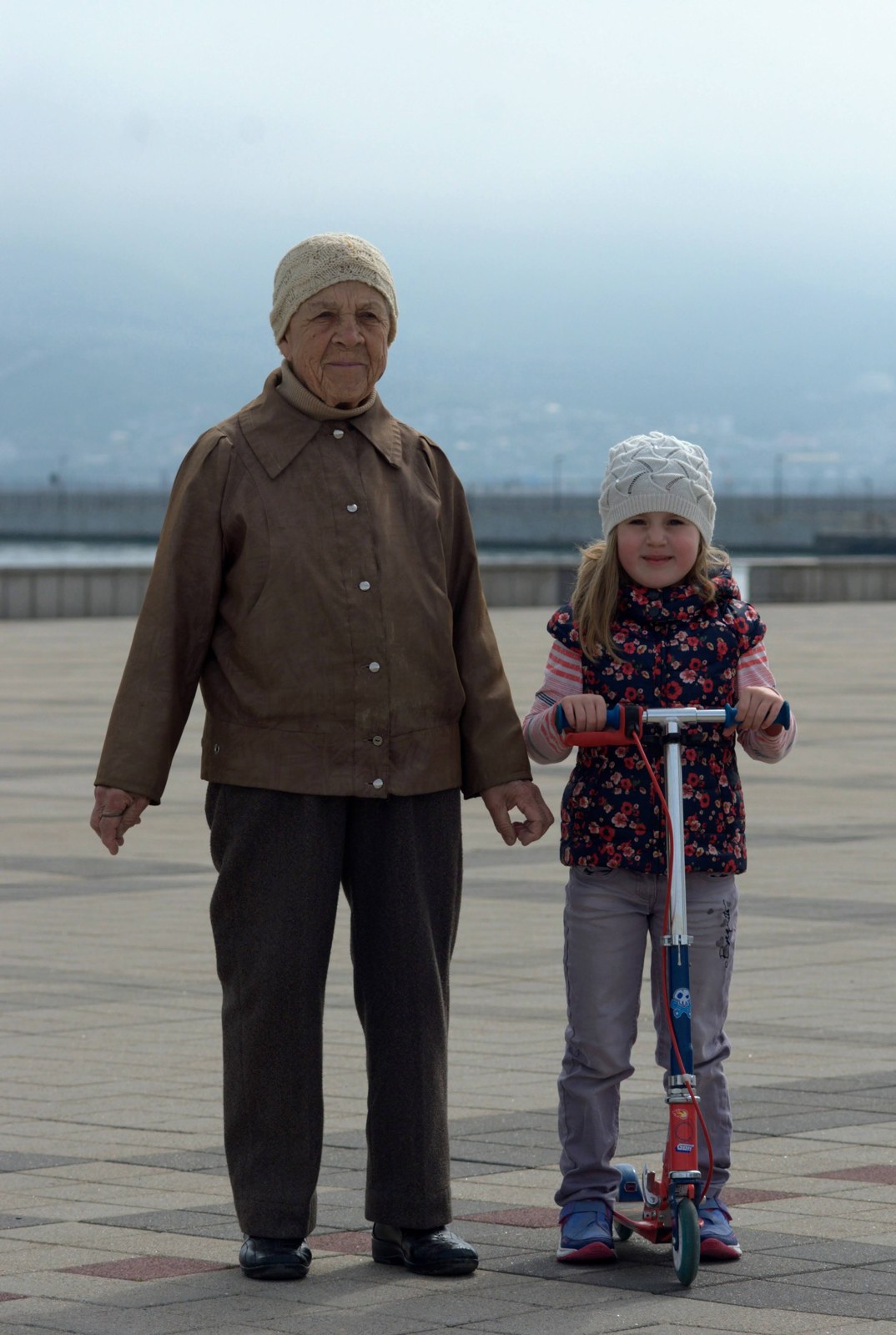
Ekaterina Konstantinovna with her great-granddaughter Masha on the Novorossiysk embankment. Around 2016.
Екатерина Константиновна with great-granddaughter Masha on the embankment Novorossiysk. Around 2016. Source and full document

On 25 September 2026 your great-grandmother turned one hundred.

Within this century her life held six schools, a war, moves, an institute, work, children, grandchildren and great-grandchildren. And also a few sheets of paper on which she wrote down everything she remembered about her family. It is from these sheets that we learned about people born more than a century and a half ago.

Here are a few of their stories.

Chapter 1Workshop on the Volga

In Puchezh, a small town on the Volga, lived Семён and Anna Kolodin — your mum’s ancestors. They ran a sewing workshop, where not only the owners but also hired craftsmen worked.
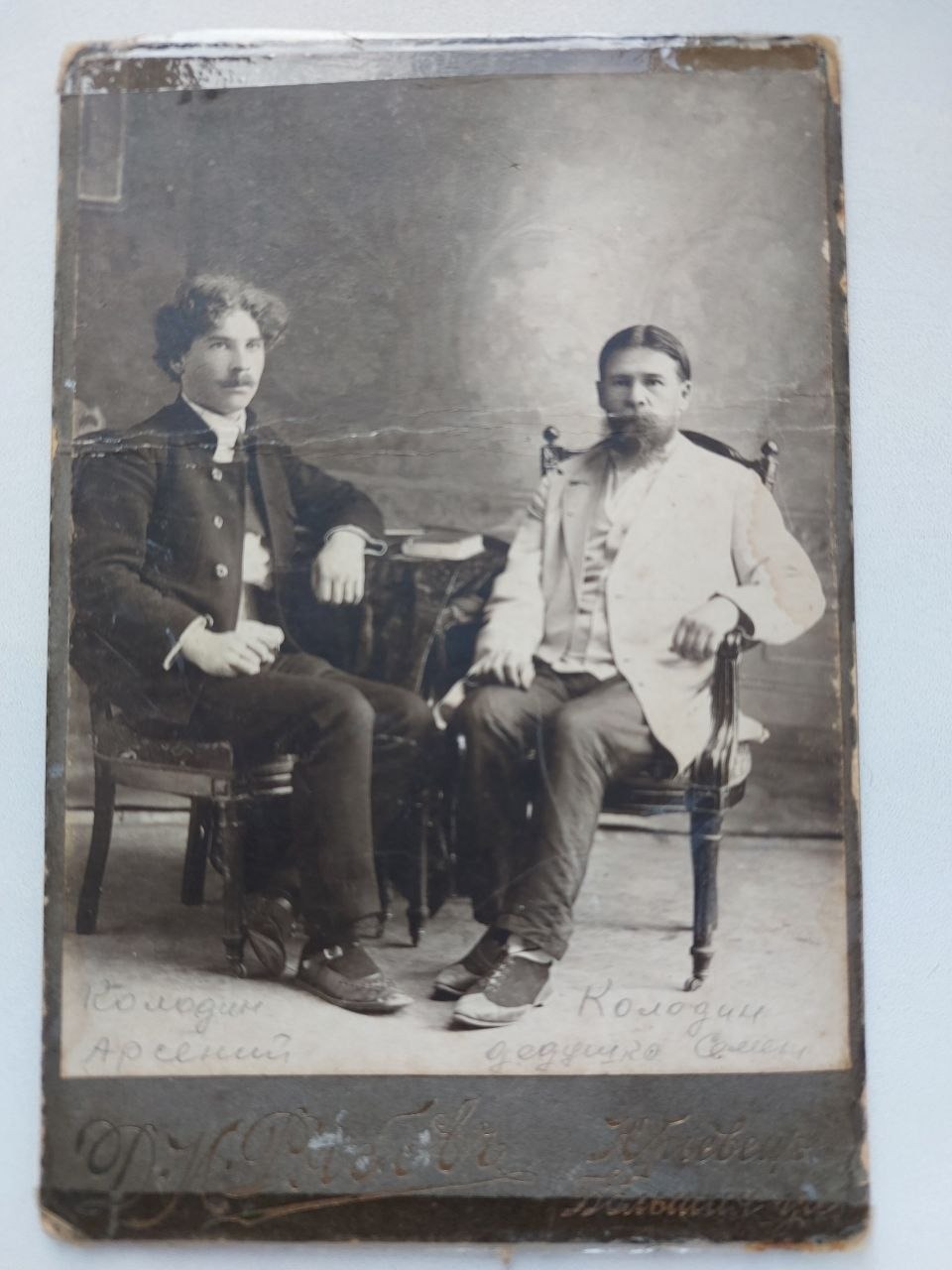
Arseny and Semyon Kolodin. Original family photo with handwritten signatures.
Arseny and Семён Kolodina. Original family photo with handwritten signatures. Source and full document

What was sewn there — dresses, coats or something else — we do not yet know. But we do know that the Kolodins had many children and that all of them were sent to study in nearby Yuryevets. They grew up to be teachers, a medic and the head of a library.

The family manuscript about the Kolodins says: «They lived in great harmony. All their lives they helped one another». You will see this more than once: in our story there is always a relative you can go to for your studies or stay with through hard times.
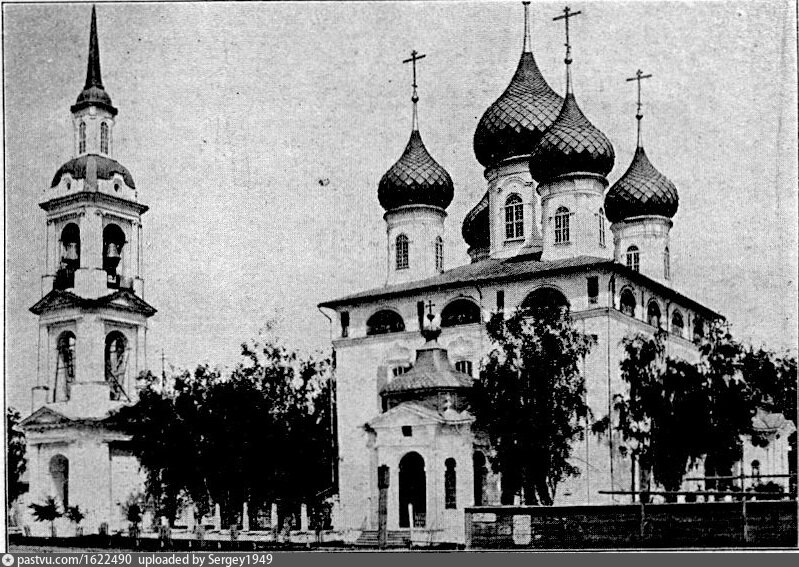
The Transfiguration church «under the hill» in Puchezh
The Transfiguration church «under the hill» in Puchezh. This is where Семён and Анна were married and their children christened. Today there is water here: old Puchezh was flooded when the reservoir was built. «Churches of the Kostroma Diocese», 1909 · PastVu

There is a surviving photograph of Semyon with his son Arseny, taken in Yuryevets. One of the descendants wrote on it: «Grandad Semyon Kolodin». To us he is a distant ancestor, but to the person writing those words he was simply Grandad.

Look at the photograph. Which two captions would you write on your own family photo so that in a hundred years it would be easier to make sense of?

Chapter 2The teacher with a four in mathematics

Semyon and Anna’s daughter, Alexandra, studied at the Pushkin Girls’ Gymnasium in Yuryevets. She was the mother of Ekaterina Konstantinovna and your great-great-grandmother.
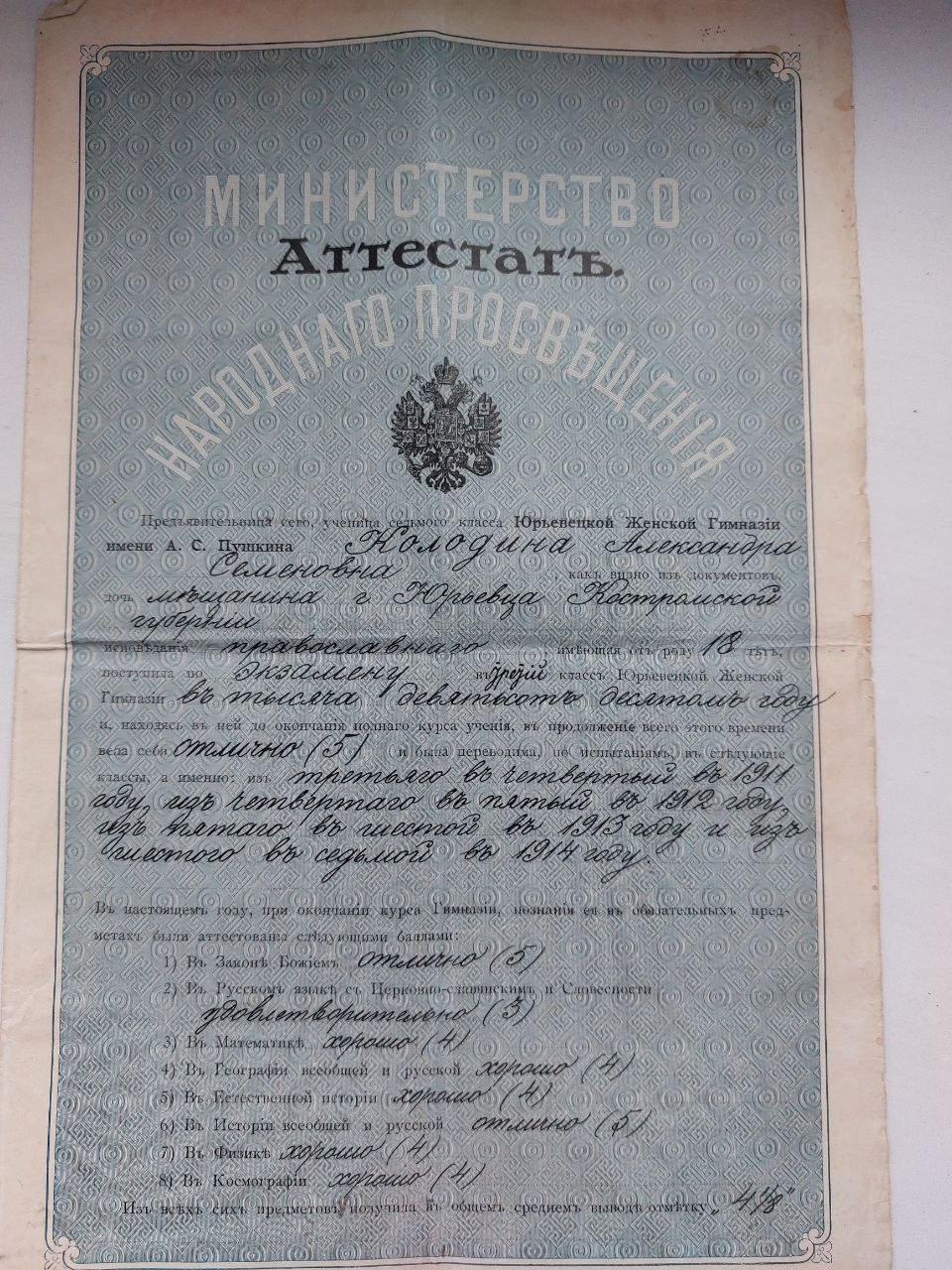
Certificate of Alexandra Kolodina, 1915. Find the average score of 4⅛.
Certificate Alexandra Kolodina, 1915. Find the average score of 4⅛. Source and full document

From Alexandra we have a real gymnasium certificate of 1915. In history she got a five, in mathematics and geography fours, in Russian a three. The average mark is written as a fraction: 4⅛.

Among the subjects is a puzzling word, «cosmography». That was the name for the science of the Earth and the heavenly bodies, and in it Alexandra got a four as well.

After the gymnasium she studied for another year in a teacher-training class, where pupils learned to explain to others what they knew themselves. The trial mathematics lesson given by Alexandra was marked «good», and in 1916 she received a certificate entitling her to teach mathematics.

She was not a top pupil, yet she became a teacher. Her daughter remembered this all her life, and now we also have a document showing how Alexandra gained her profession.
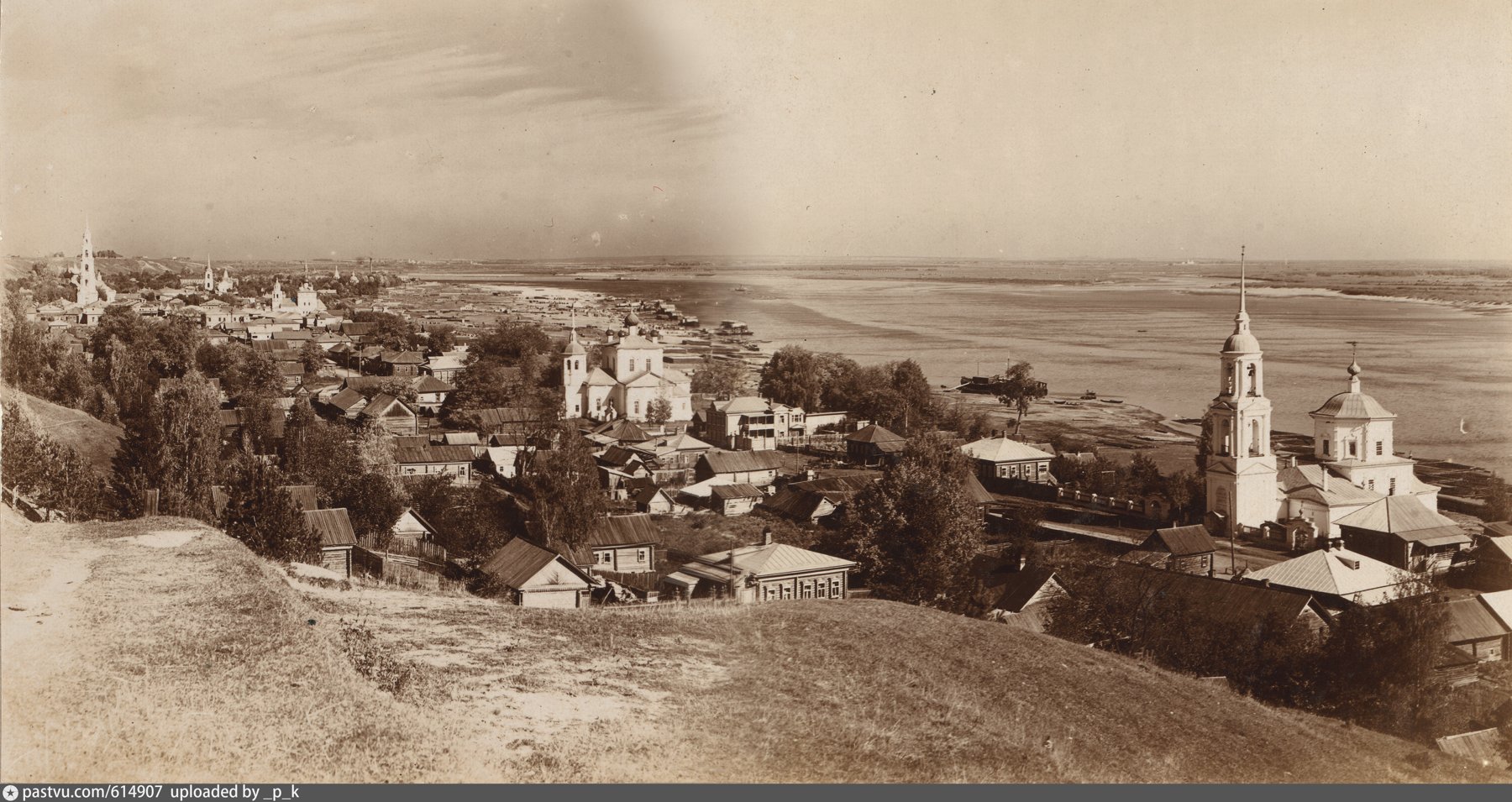
Yuryevets from the hill, 1910
Yuryevets in 1910 — the town of the gymnasium attended by Alexandra. A colour photograph by Sergei Prokudin-Gorsky. Library of Congress · PastVu

Later Alexandra fell gravely ill with typhus and went deaf in one ear. The family said that after this she could no longer work at school. There was bookkeeping, there were children and moves. She spent her last years with her daughter in Novorossiysk.

Open her certificate. Which of these subjects does your school have, and which are now called something else?

Chapter 3Katya, who went to six schools

Katya Figurovskaya was born in 1926 in Ostrogozhsk. Her father Konstantin was an army veterinarian: he treated horses and was responsible for the health of the cavalry and the artillery teams. The family moved wherever his service sent him. In ten years Katya went to six different schools.
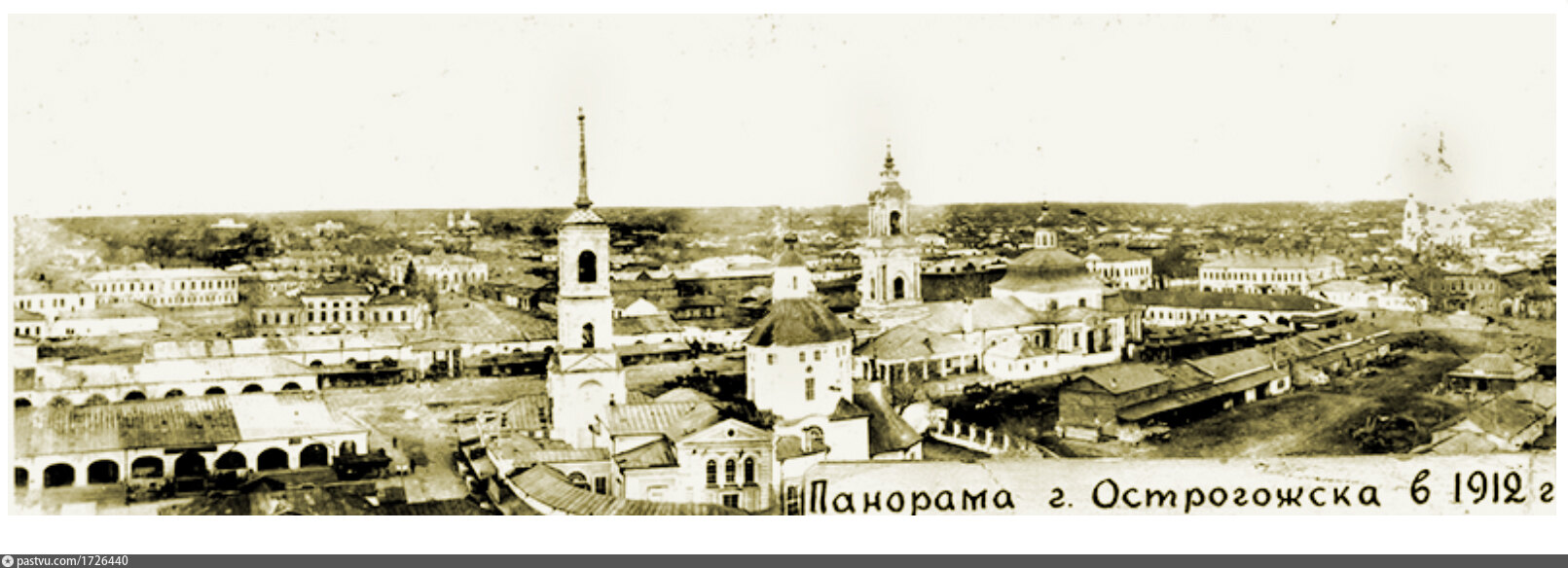
Panorama of Ostrogozhsk, 1912
Ostrogozhsk in 1912. Fourteen years later it became the birthplace of Katya. PastVu
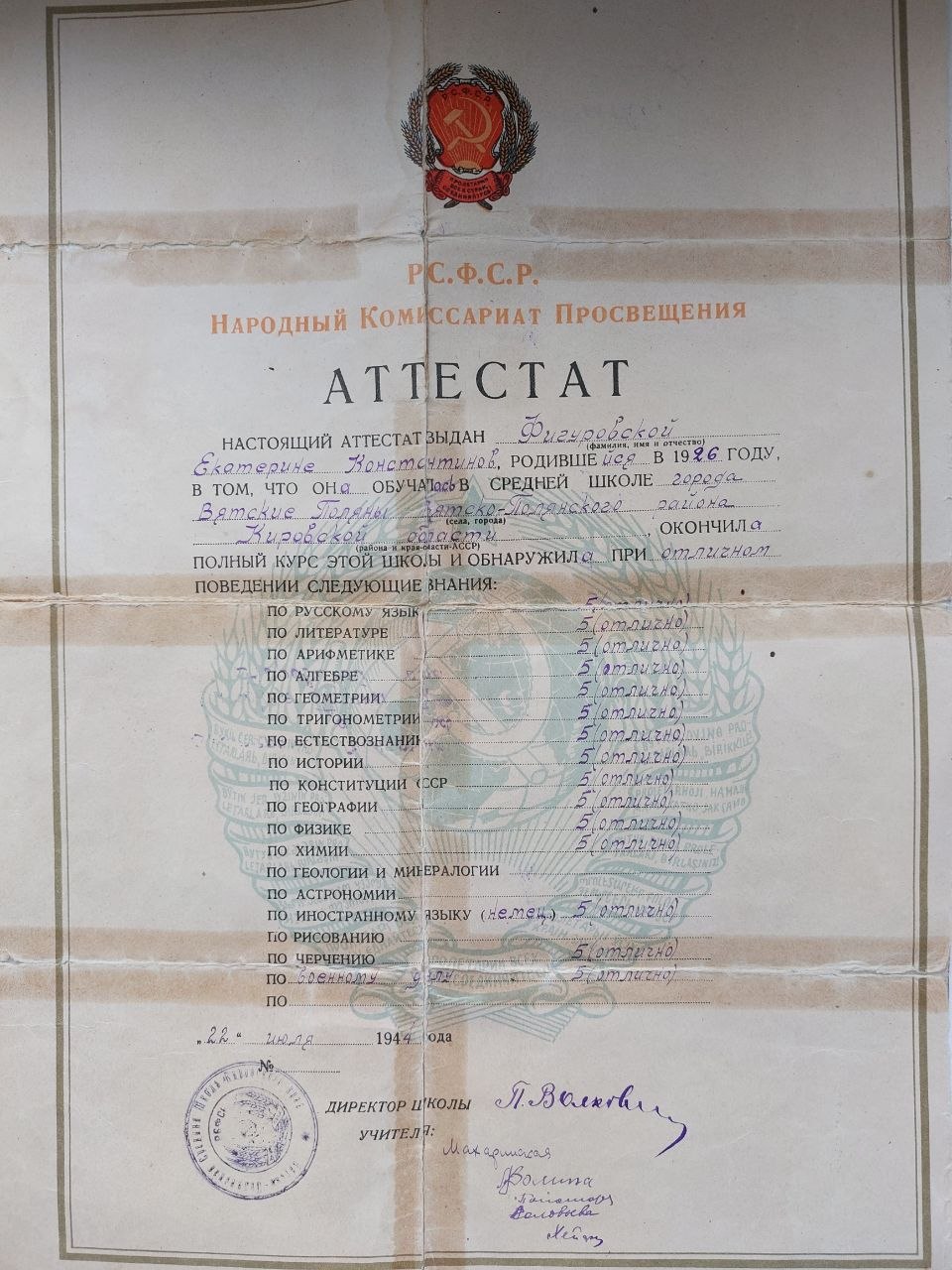
Certificate of Ekaterina Figurovskaya. Vyatskie Polyany, July 22, 1944.
Certificate of Ekaterina Figurovskaya. Vyatskie Polyany, July 22, 1944. Source and full document

Every move means a new class, new teachers and children who have long been friends with each other.

The war found Katya and her mother in Arkhangelsk. In the winter of 1941–1942 there was famine there. In the summer of 1942 her brother Юрий wrote to them from the front: «Mum, move as soon as you can. Take only what you need». They left the flat with everything in it and went to relatives in Vyatskie Polyany. The family manuscript says exactly that: they had to leave behind everything they had at home.

In Vyatskie Polyany Katya finished school. Her certificate was issued on 22 July 1944, while the war was still going on. «Excellent» in every subject, even in two you would not find side by side in a school report today: German and military training.

Then her aunt Мария invited her to study in Ivanovo. Katya entered the power engineering institute and became a power engineer — one of those thanks to whom electricity reaches homes and factories. After the institute she was sent to Novorossiysk, and there she married Pavel Kamyshanov. Their daughter Галина is your grandmother.

So from the Volga town of Puchezh, through several towns, this branch of the family made its way to the Black Sea.

Chapter 4Yuri’s letters

The older brother of Katya was called Юрий. He was born in 1920 in Puchezh, into that same Volga family — the son of Alexandra by her first marriage. His stepfather, Константин Фёдорович, adopted him, and Юрий grew up a Figurovsky.

After school he entered a military flying school. Look at this portrait: a forage cap with a little star and, on his chest, a GTO badge — «Ready for Labour and Defence». Now turn the photo over.
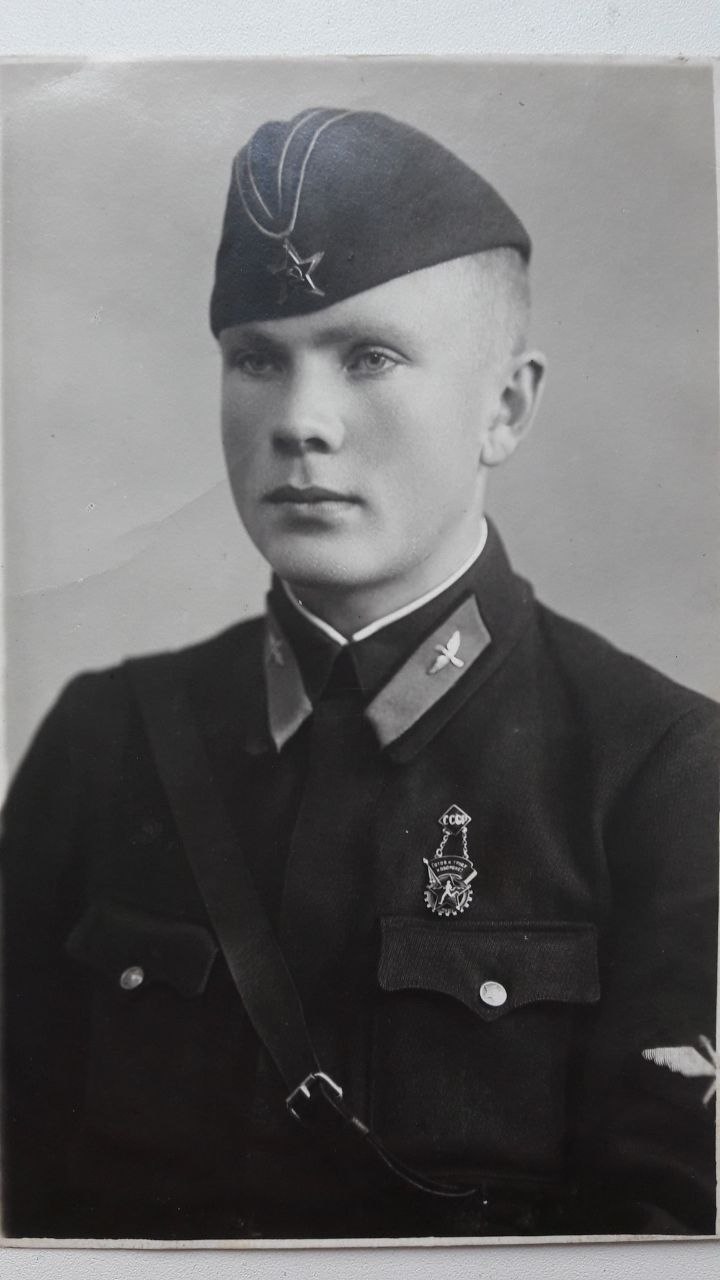
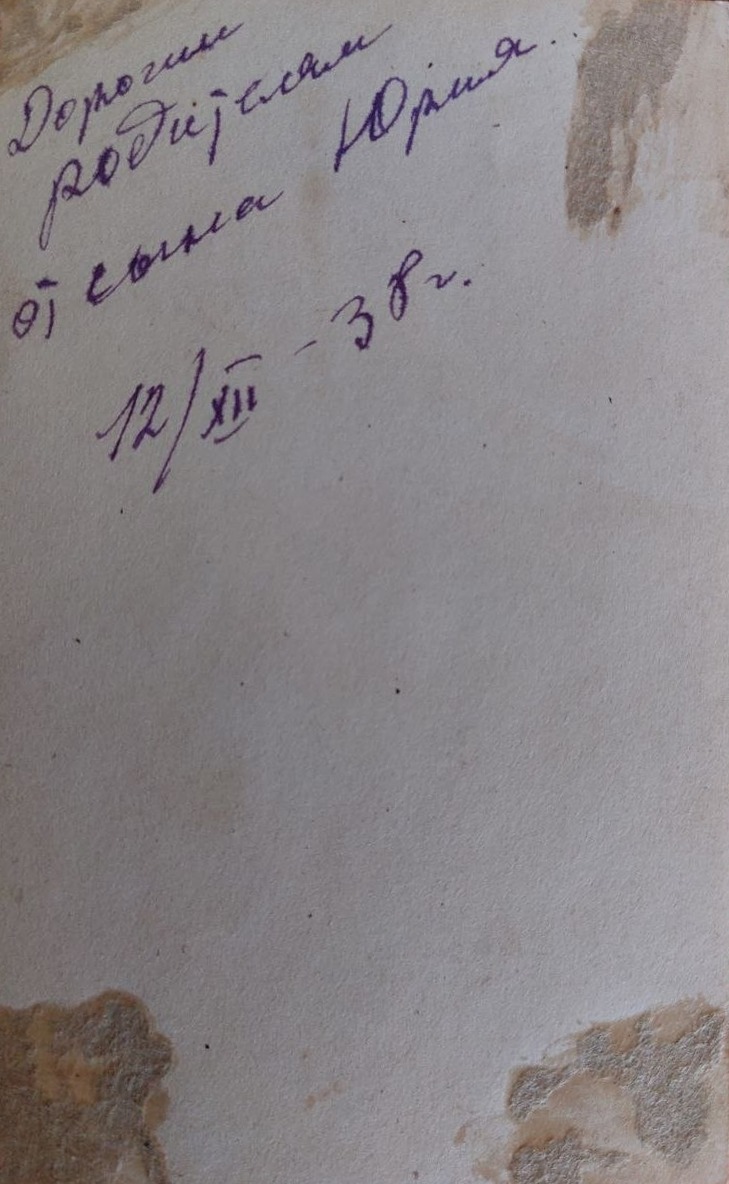
Yuri Figurovsky in a forage cap, 1938.
Yuri Figurovsky, a cadet at the flying school. December 1938. Source and full document

On the back, in his hand: «Dear parents, from your son Yuri. 12/XII-38». He is eighteen — the age Masha will reach in the summer of 2028.

Then came service in Staraya Russa and marriage to Tamara. In 1941 they had a daughter, Irina. The war began that same year.

Юрий became a technician in a dive-bomber regiment, making sure the instruments on the planes worked properly. In the summer of 1942 he wrote to his mother and Katya in Arkhangelsk. Both letters have been kept by his daughter’s family.
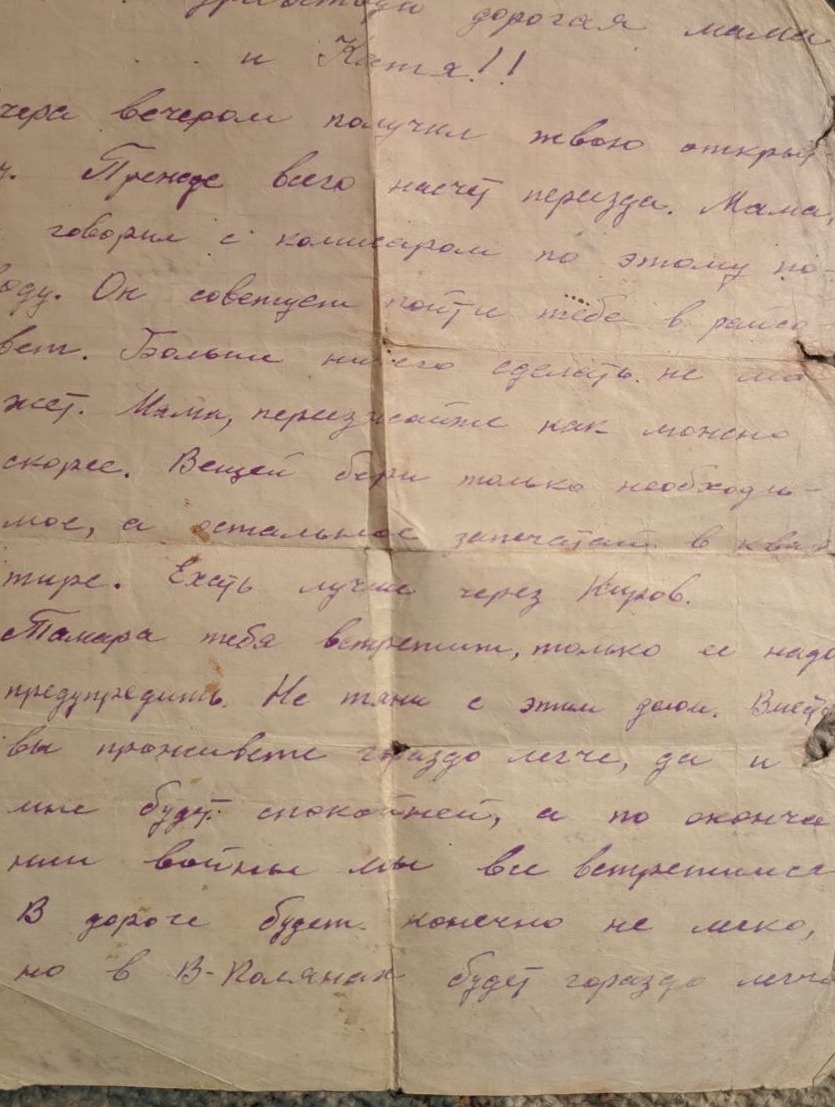
Yuri Figurovsky’s letter to his mother and sister, 8 July 1942.
Letter of 8 July 1942, first page. Source and full document

«My daughter is growing, and I haven’t even seen her,» he writes. «I was home for 4 hours in passing, and Irishka was asleep.» And about himself: «I do get thoroughly tired, it’s true… But for now we must fight, we must win this life.» He urges his mother and Katya to move as soon as they can to Vyatskie Polyany, to Tamara, and at the end he promises: «when the war is over, we will all meet again».

They never met again. On 5 September 1942 Юрий was killed at an airfield near Moscow during an enemy air raid. He was buried in a mass grave at the Herzen sanatorium, near Kubinka.
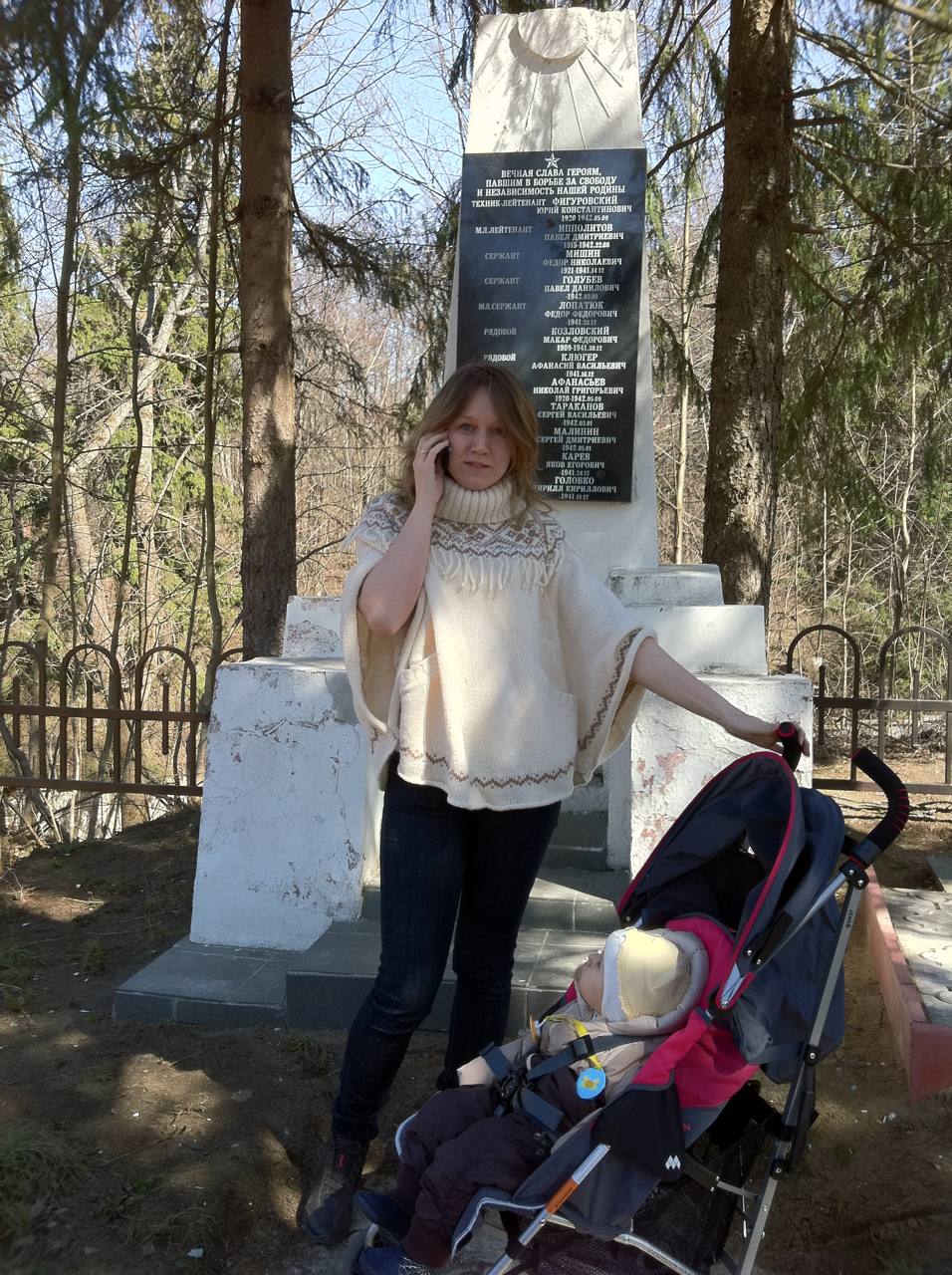
Elena Melnikova with little Masha at the obelisk at the Herzen sanatorium, 24 April 2011.
Елена and little Маша at the obelisk, 24 April 2011. Source and full document

Almost seventy years later, on 24 April 2011, your mum came to this obelisk, and beside her in a pram was little Маша. The first line on the plaque reads: «Technician-Lieutenant Figurovsky Yuri Konstantinovich».

And his daughter Irina grew up. In July 1958, on the day she finished school in Leningrad, she gave her grandmother her photograph. Turn it over too.
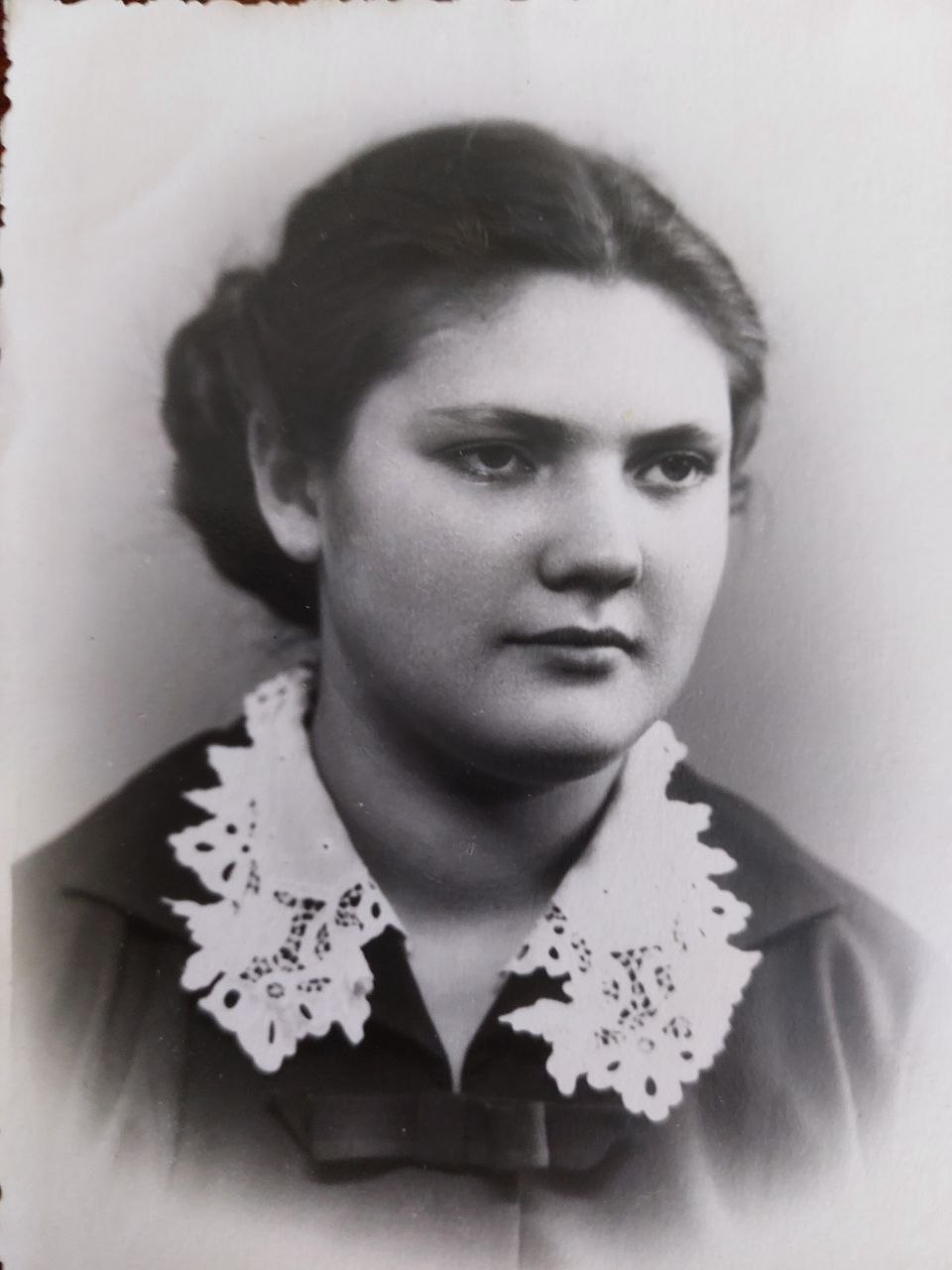
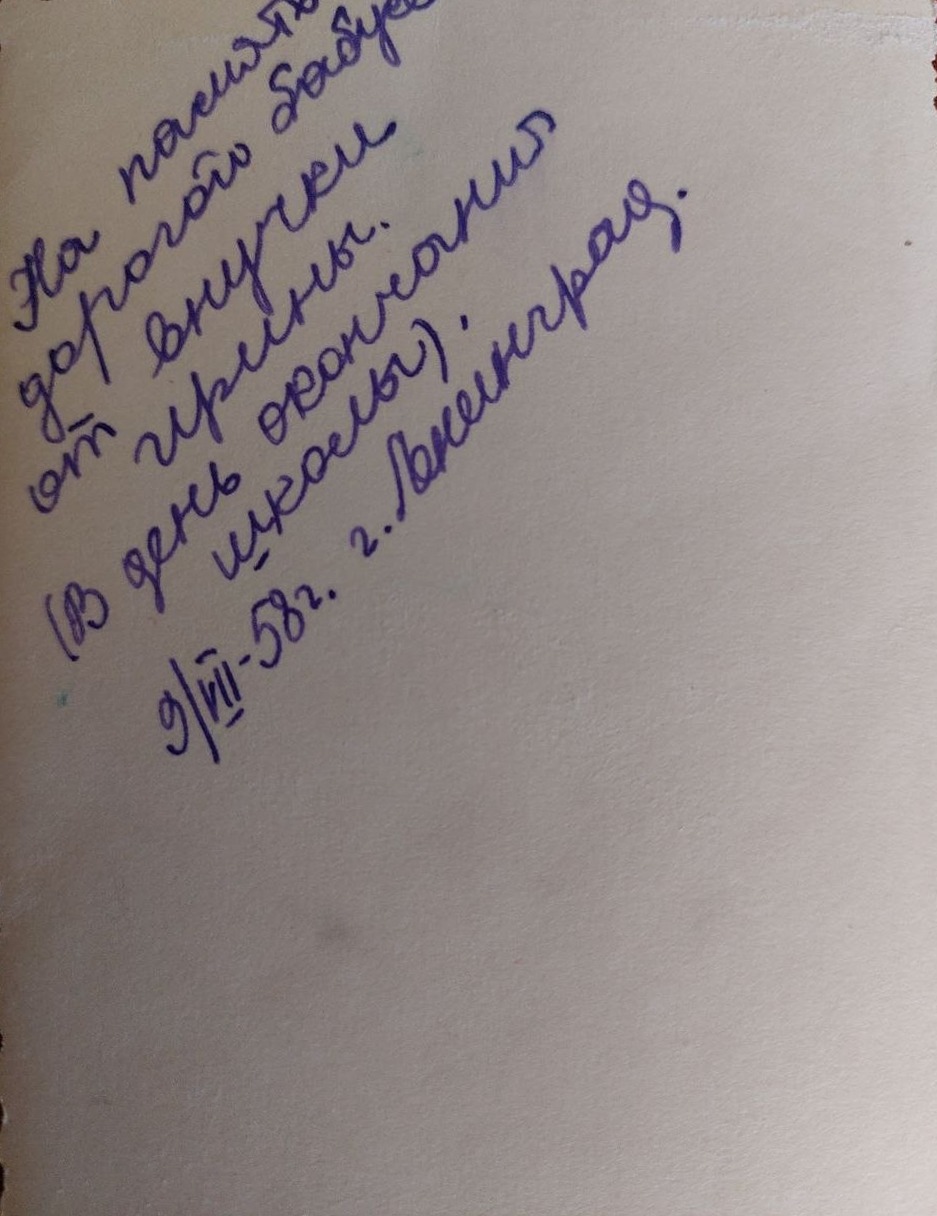
Irina Figurovskaya on the day she finished school, 1958.
Irina Figurovskaya on the day she finished school. Leningrad, 9 July 1958. Source and full document

«In memory, to dear granny, from her granddaughter Irina». Granny is most likely Александра Семёновна, the very gymnasium pupil with a four in mathematics from the second chapter. Twenty years earlier her son had inscribed his portrait to his parents; now her granddaughter inscribed hers to her grandmother.

Turn your family photographs over. Are there inscriptions on the back? Who wrote them, and to whom?

Chapter 5The thirteen-year-old tailor

Dad’s family has a road of its own — from villages in the Tula region to the area around Moscow. The Melnikovs are linked with Chernyaevka, the Bushins and Fetisovs with Lidinka.
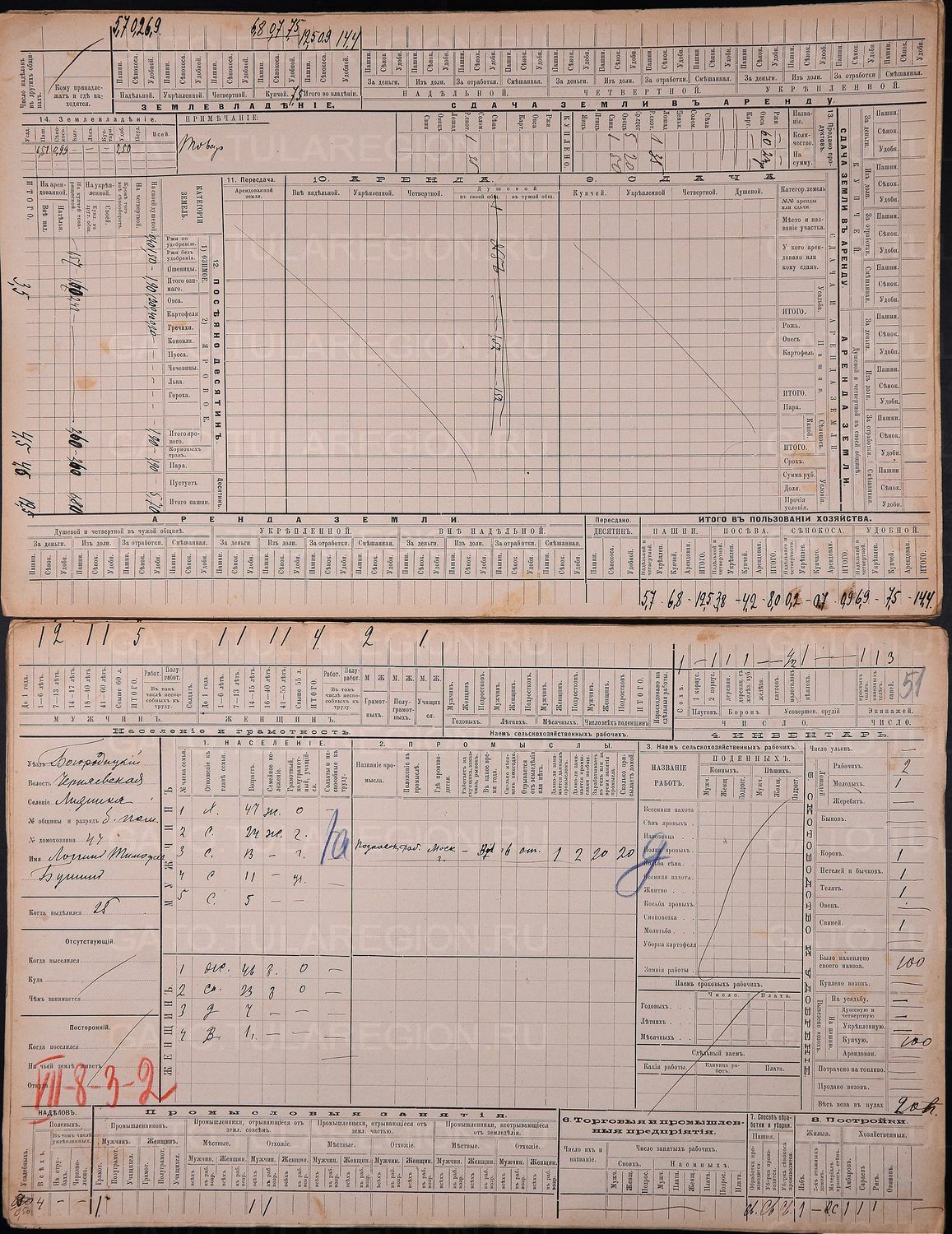
Card of Loggin Bushin's yard in Lidinka. Beginning of the 20th century. GATO, F. 4, Op. 3, D. 1176.
Card of Loggin Bushin's yard in Lidinka. Beginning of the 20th century. GATO, F. 4, Op. 3, D. 1176. Source and full document

One of the most remarkable documents of this branch is the census card of a peasant household from the early 20th century. The head of the household is recorded as Loggin Timofeevich Bushin. Next to him the family members are listed with their ages and occupations, but, sadly, not the others’ names.

One of the sons was thirteen and already worked as a tailor in Moscow and sent money home.

He was only three years older than Alisa and three years younger than Masha. What he thought of his work, whether he missed home, what he wanted to learn — we do not know: the card keeps only a few short answers. But even they show how unlike yours his boyhood was.

We cannot yet name this boy. Perhaps it is Alexey, the future father of Valentina Bushina, Dad’s grandmother, but to say for certain we need one more document.

This often happens in family research: the age, the town and the trade are known, but the name is still to be found.

Chapter 6Two employment record books

Some documents a person carries all their life. In the old days the employment record book was one of them: every job, every promotion and every commendation went into it. Two have survived for us — those of your great-grandfather Sergei Ivanovich Melnikov and great-grandmother Valentina Alekseevna. Put them side by side, and you get the story of how they met.

On 6 June 1946 twenty-year-old Valentina Bushina was taken on as an accounting clerk at a big plant in Podolsk — the Kalinin mechanical plant. A year and a half later, on 23 December 1947, nineteen-year-old Sergey Melnikov. Both came from neighbouring villages in the Tula region: she from Lidinka, he from Chernyaevka. Here, at the plant, is where they apparently met.

Then in Sergei’s book comes an entry: on 14 December 1948, «dismissed on joining the Soviet Army». He served for four years. In January 1949 Valentina left for near Lopasnya, to the timber-industry settlement, and began working there as an accounting clerk. That summer, on 1 July 1949, their son was born there — Валерий, your grandfather.
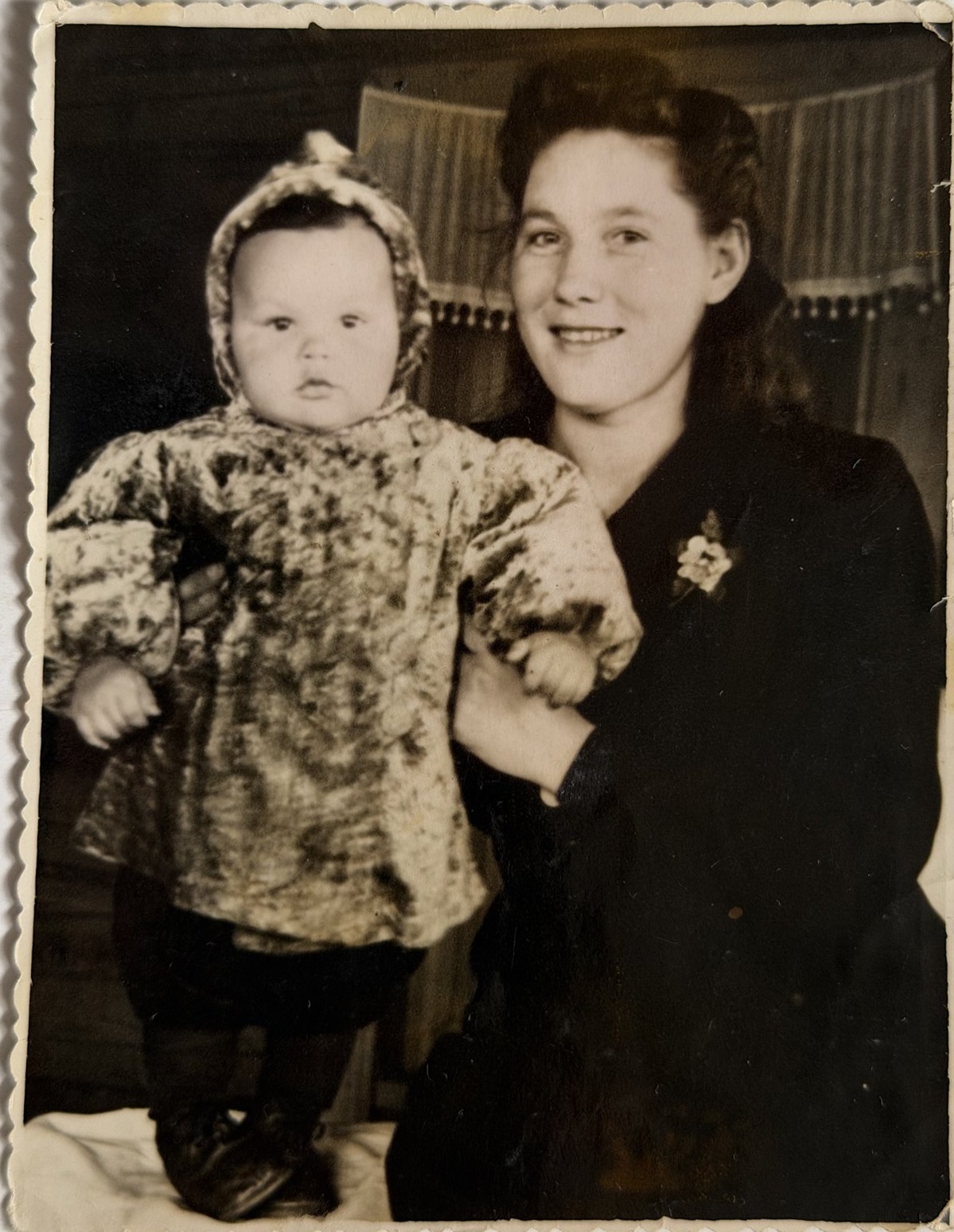
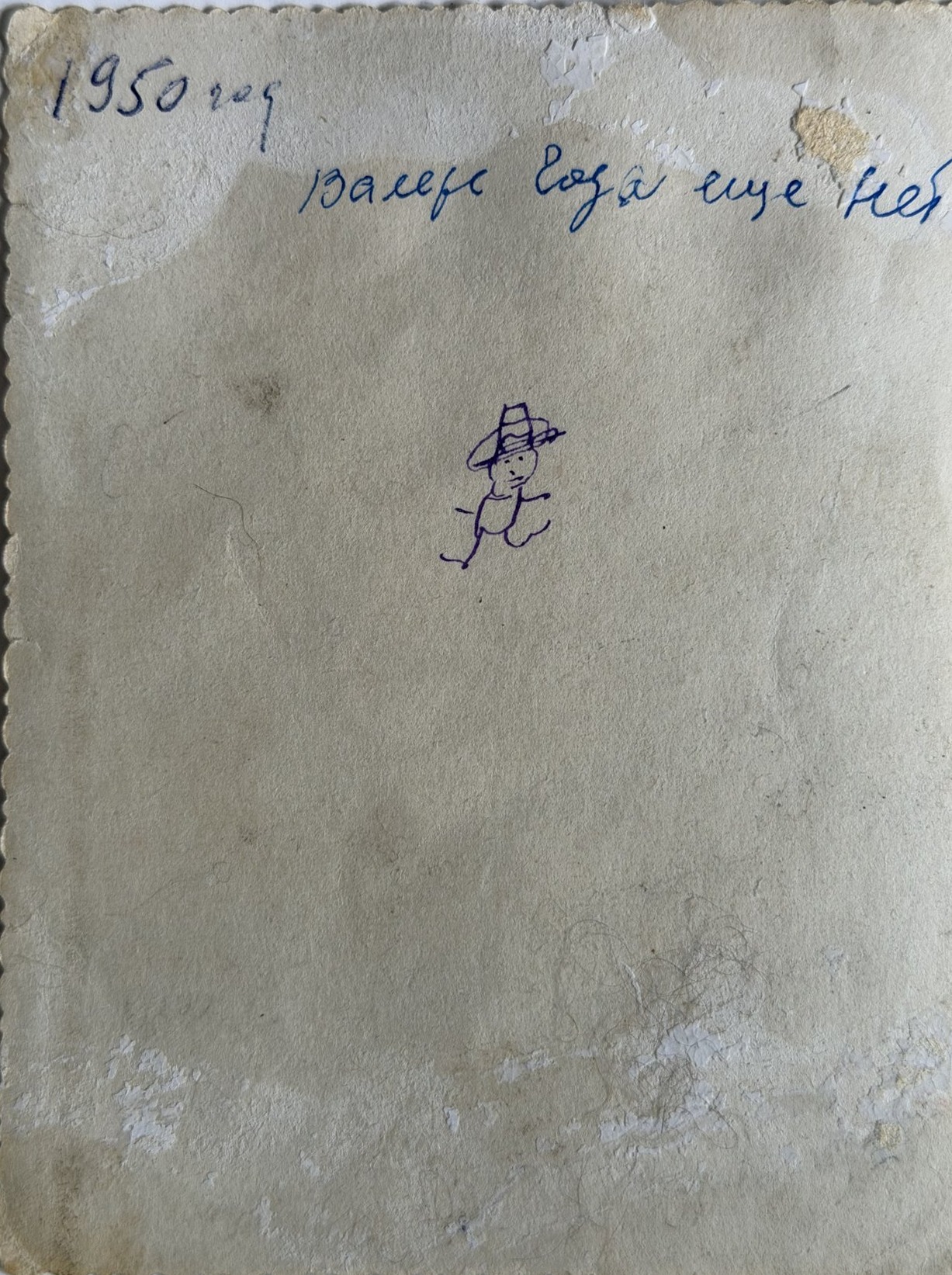
Valentina Alekseevna with her son Valery, 1950.
Валентина Алексеевна with little Valery — your grandfather. Source and full document

Turn this photo over. On the back someone wrote: «1950. Valera is not yet a year old». Valera’s father was serving in the army at the time and may have been waiting for just such a picture.

In November 1952 the family came together again in Podolsk. After that, each of them kept to one road for life. Сергей Иванович worked as a fitter for more than forty years; his book has some fifty entries of commendations and certificates, and the city newspaper wrote about him.
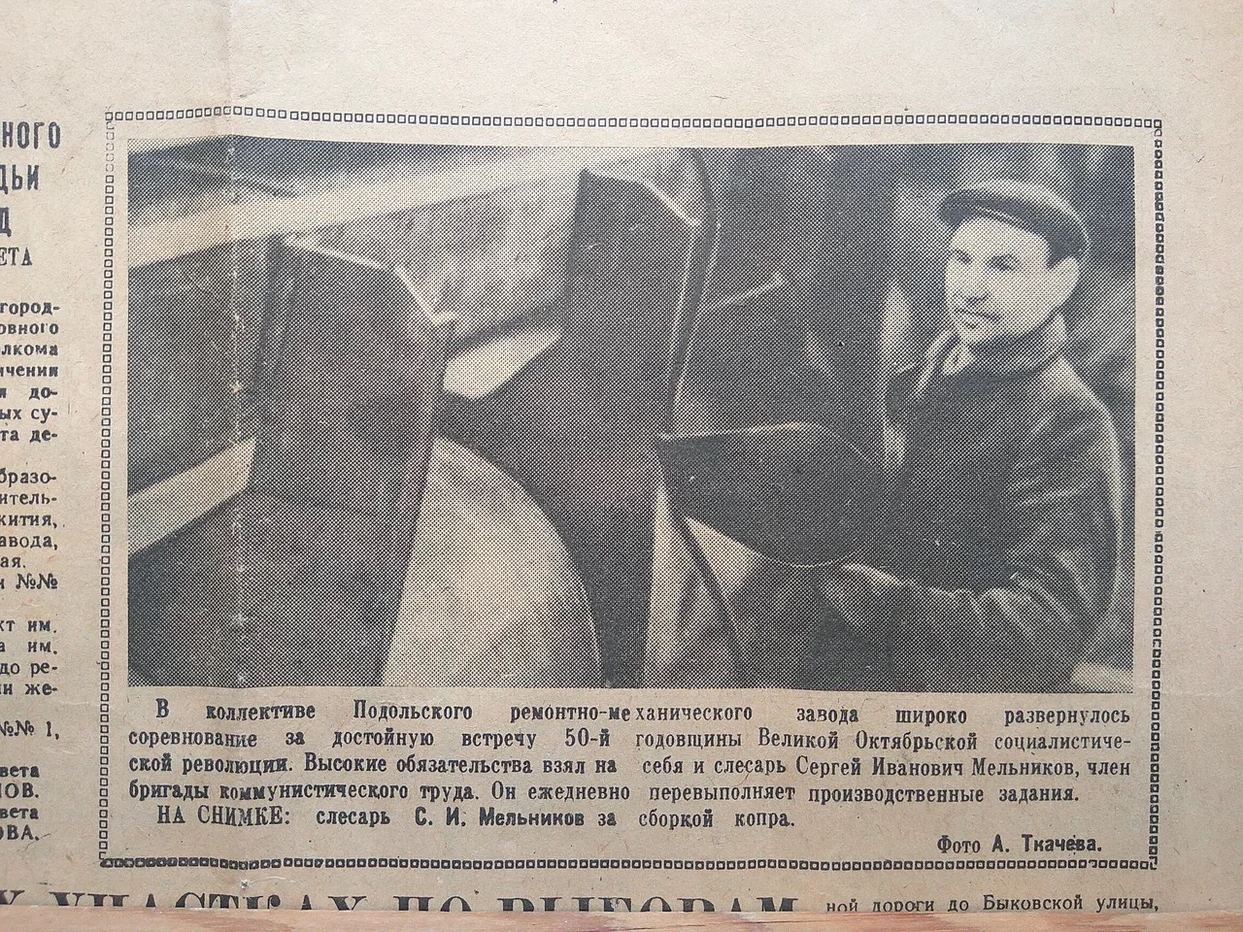
Fitter S. I. Melnikov assembling a pile driver, about 1967.
«Fitter S. I. Melnikov assembling a pile driver». The newspaper «Podolsky Rabochy», about 1967. Source and full document

Валентина Алексеевна started as an accounting clerk and became a senior economist at the regional office of Gosbank: she checked how big plants borrowed and repaid loans.

Ask Grandad Valera: what did his parents tell him about how they met? And where did they marry — the documents do not show that yet.

Chapter 7The house where ten children grew up

Dad's other branch leads to Kapaklia, a village in Moldova. Here lived your great-grandparents, Grigore Călugăreanu and Maria Pleshu.
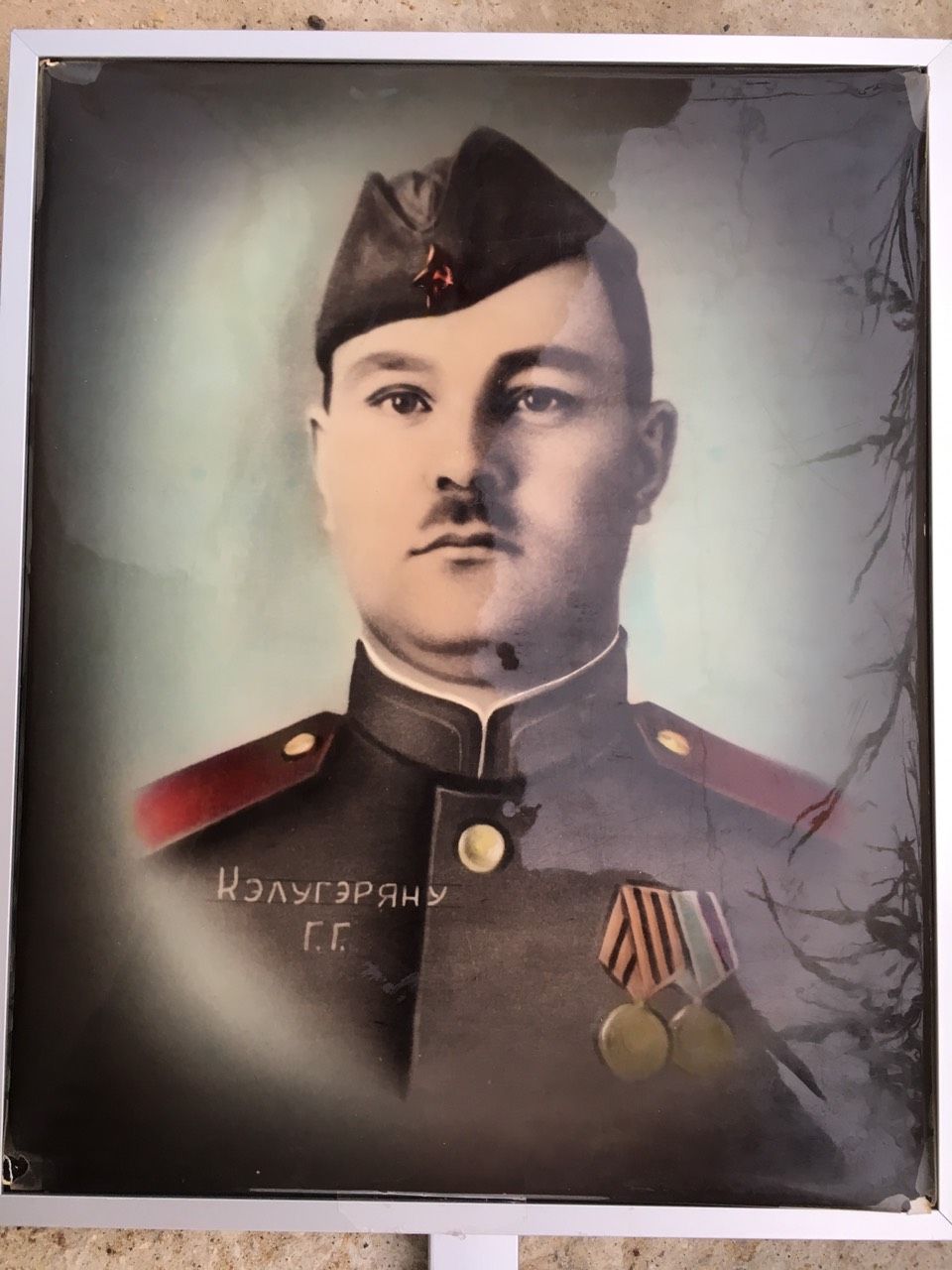
Grigory Calugareanu. Post-war painted portrait from the family archive.
Grigore Călugăreanu. Post-war painted portrait from the family archive. Source and full document

They raised ten children. One of their daughters, Екатерина, is your grandmother, Dad’s mother.

Imagine gathering the parents and ten children for one photograph, and then their husbands and wives, children and grandchildren too. That is why our tree has so many names.

The surname of Grigore is spelled differently in documents: Călugăreanu, Кэлугэряну, Калугарян. Мария is recorded before her marriage as Pleș, while at home her surname was pronounced «Pleshu». That is why we search several spellings at once and compare dates, places and the names of close relatives.

Grigore fought in the war, was badly wounded and received the medal «For Courage» for the battles for Berlin. His award record mentions his wife Мария, and this short line told us we had found the document of our own Grigore.

After the war, his life was again connected with Kapaklia and his large family. Grigore died in 2011, Мария — in 2013. They are buried side by side.

Chapter 8From Ashgabat to Norilsk

The childhood of Mum’s dad, your grandfather Vadim, was spent in two very different cities — Ashgabat and Norilsk.

His mother, Людмила Петровна, née Zamyatina, was a medic. In the early 1960s she left Ashgabat for the far north, for Norilsk, with her two sons, Dmitry and Vadim; Vadim, as the family remembers, was then about two or three. Both brothers finished school in Norilsk.

Look at the map: Ashgabat — in the south, in Turkmenistan, while Norilsk — in the north of Siberia, beyond the Arctic Circle. One family move drew a line between them.

Later Людмила Петровна and her husband, Viktor Alexandrovich Egorov, returned to Ashgabat, and later settled in Strunino in the Vladimir region.

Галина Павловна remembers the father of Lyudmila, Pyotr Petrovich Zamyatin, who visited — she saw him with her own eyes. Such memories are especially precious to us: behind a name in the tree stands a living person whom someone in the family knew.

We still know little about this branch. Sometimes the best next step is to ask someone close to tell you about their home, their guests, a family trip — and to write down their words.

Chapter 9Portrait with an Unsolved Story

The family archive has an old photograph of a man in uniform. It bears the inscription: “Kubekov Magomed Magomedovich — great-grandfather of L. P. Zamyatina”.
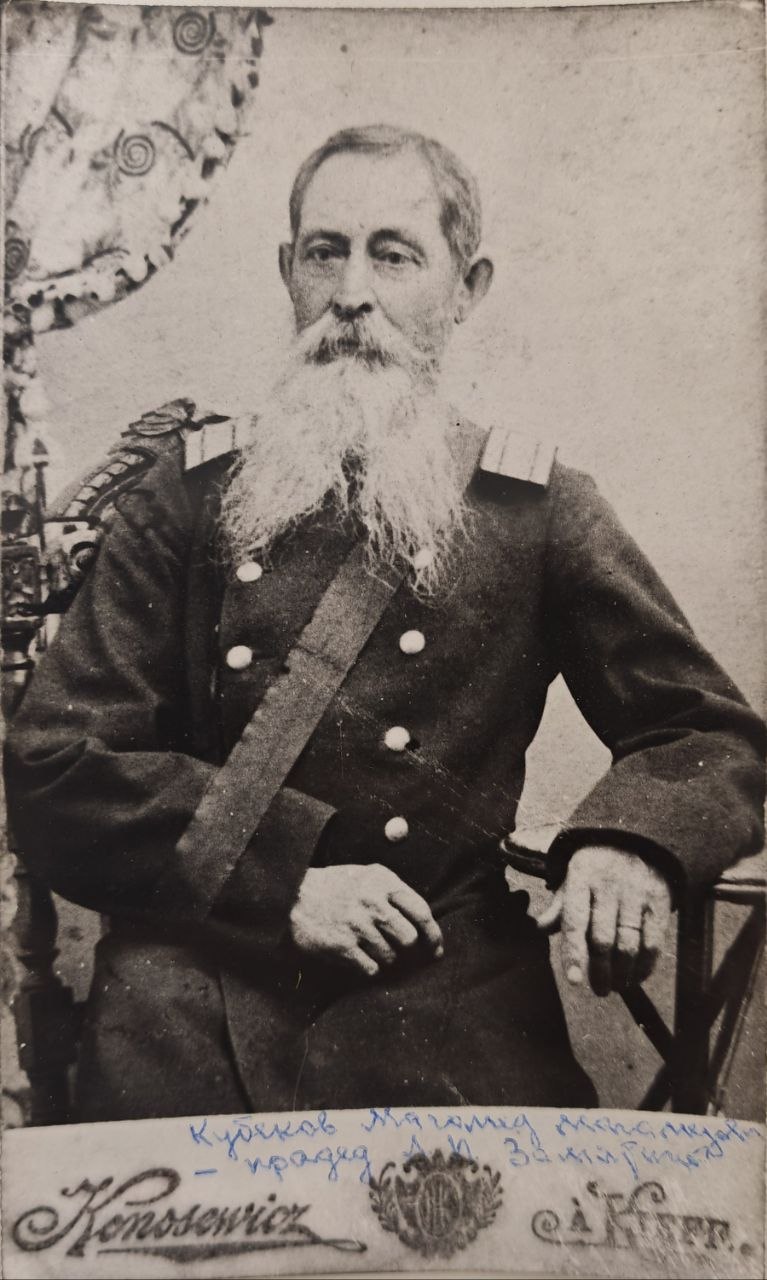
Kyiv portrait with a family signature about Magomed Magomedovich Kubekov.
Kyiv portrait with a family signature about Magomed Magomedovich Kubekov. Source and full document

It was taken in a Kyiv studio. The inscription links the portrait to Lyudmila Petrovna, whom you have just read about, but we are still finding out through whom this kinship runs.

There is also a surviving document of Vera Alexandrovna Kubekova, who studied in Kyiv at the end of the 19th century. How to put this evidence together into one story is still unclear.

This riddle shows well how real research works. We examine the photographer’s imprint, read a school certificate, look for the surname in an old city directory. Every find answers one question and at once raises several new ones.

When the riddle is solved, this chapter will have a sequel.

Chapter 10What will remain after us

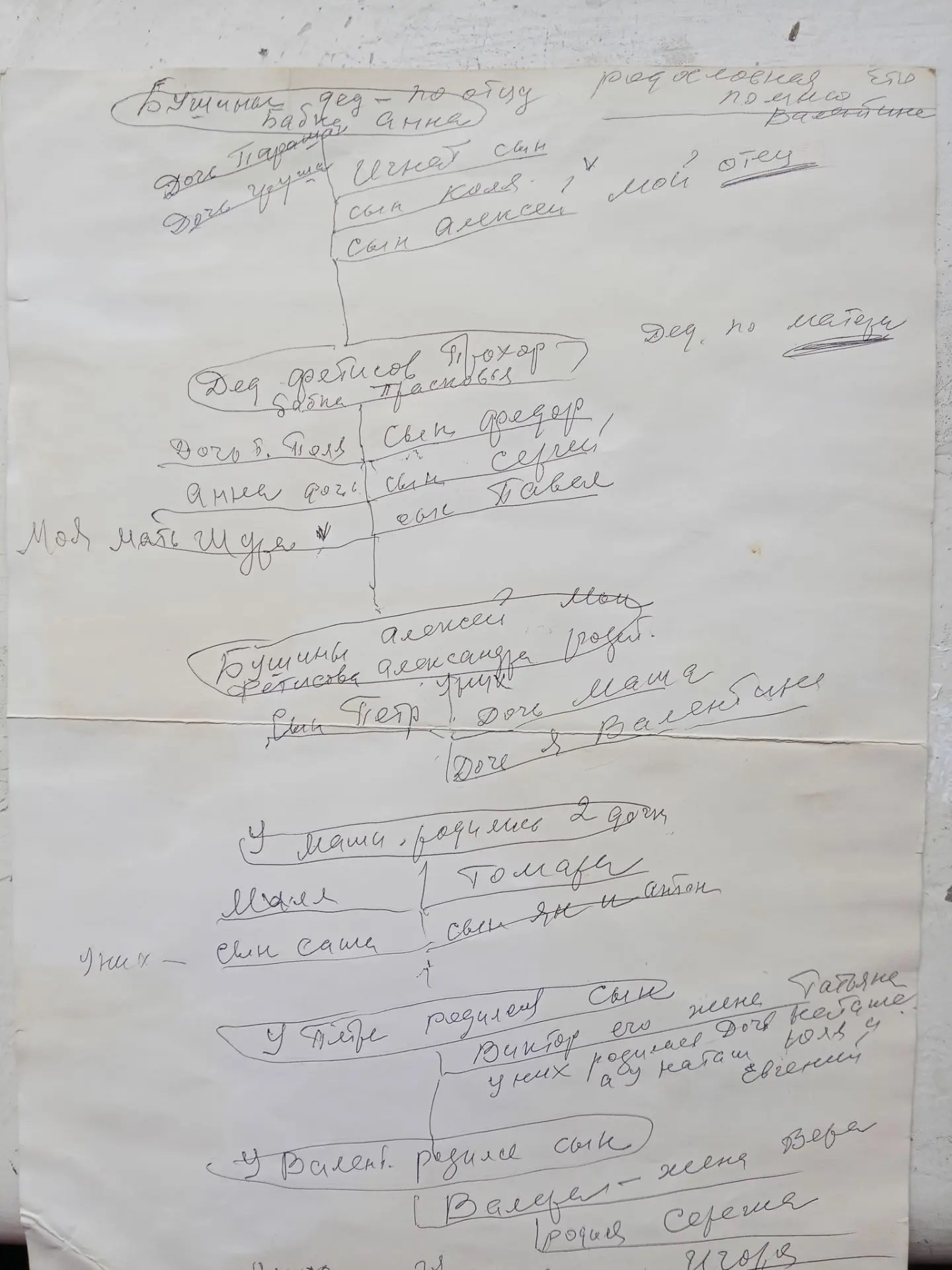
In March 2001 Екатерина Константиновна took a sheet of graph paper — paper with a fine grid — and drew the family tree on it. Next to it she wrote down her memories: who lived where, who worked as what, whom they helped, what happened to the family during the war.

At that time neither Mashanor Alisa had been born yet. And now you can read her words and see the faces of the people she wrote about.

Our family had teachers and doctors, tailors and engineers, soldiers, a librarian and a geologist. Some lived their whole lives in their native village, others moved across the whole country. There were heavy losses, illness, injustice — and there was study, work, weddings, children and help from relatives.

We will never learn everything about them. But what can still be saved is worth saving: label a photograph, write down Grandma’s story, ask what the street was called and who is sitting by the window in an old picture.

And write something about yourselves. What is your ordinary day like? What do you like doing together? Which family trip do you remember most often?

Perhaps one day someone will open these notes and say: «So this is what they were like, Маша and Alisa».

Open the 2001 handwritten tree and Ekaterina Konstantinovna’s memoirs. Almost all of our search began with these sheets.
Family stories

The family against the backdrop of Russian history

Each chapter begins with a story of the times — how people lived, what they believed, what new things they saw — and then our families in those same years. Names open person cards, place names open the map.

How to read this page

Each chapter is one stretch of history. First comes the story of the times: how people lived and made a living, what they ate, what they believed in, what made them ill, what new things appeared in their world — and how a Tula village, a Bessarabian village, a Cossack stanitsa and a small Volga town differed from one another. Then our families in that same time: the Melnikovs, Bushins and Fetisovs from Tula land; the Călugăreanus and the Pleș family from Bessarabia; the Kolodins from the Volga; the Figurovskys from Kostroma; the Chebanovs, Zamyatins and Kubekovs from the Caucasus and from Kyiv; the Kamyshanovs from the Don. For some families the documents speak as early as the 18th century, for others only from the late 19th, so in the early chapters two or three families stand beside the era, and in the later ones all of them.

Everything said about the family rests on the documents and stories collected in this archive; where a relationship is only probable, it says so. The story of the times draws on historians’ research and on sources of the period found during the search: the memoirs of Andrei Bolotov, provincial memorial books, diocesan records, household censuses. It is here to help understand the world our ancestors lived in, not to replace a textbook.

Chapter 1 · before 1725Peter I and his forefathers

Time

Russia in the second half of the 17th century is a country of villages. Nine out of ten of its inhabitants are peasants, and after the Law Code of 1649 almost all of them are bound to the land for ever: runaways are now hunted with no time limit. Alexei Mikhailovich reigns, then his sons; in 1689 the young Peter takes power into his own hands. The Tula region is then still a recent frontier: south of the Oka, for a hundred years, the Zasechnaya line of defences stood against Crimean raids, and Bogoroditsk was founded in 1663 as a fortress on that line.

A peasant hut of this time is heated “black”: the stove has no chimney, the smoke escapes through a small sliding window under the ceiling, and the walls and ceiling are covered with soot. Light comes from a burning splinter. People sleep on the stove, on sleeping shelves and benches — the whole family in one hut, in hard frosts together with a newborn calf. They eat rye bread, cabbage soup, porridge and turnips, and drink kvass; there are no potatoes yet. About two hundred days a year are fast days. Clothes are woven and sewn at home from flax and wool; on their feet people wear bast shoes.

The year is measured by the church calendar: ploughing, haymaking and weddings are set by the feast days. In the 1650s Patriarch Nikon reformed the rites, and the country split: those who held to the old faith were persecuted, and many fled to the borderlands — to the Don, to the Terek, to the forests of the Volga region. On the Terek the Grebensky Cossacks will remain Old Believers. There are no parish registers yet: they will be introduced only in 1722, so we know the people of this time only from censuses.

Peter changes everything within his reach. From 1705 recruits are taken for life — for the village this is a farewell for ever. A poll tax replaces the household tax, and to collect it all men are registered by name in 1718–1724: that is how the “revisions” (poll-tax censuses) came about, from which we know the first Melnikovs. From 1700 the year is counted from 1 January rather than from September. In 1712 a state arms factory is built in Tula, and hired workmen come to the surrounding villages. On the Don the Bulavin uprising is crushed in 1707–1708, and the Don Cossack Host loses some of its liberties. Bessarabia at this time is land of the Ottoman Empire and of the Principality of Moldavia dependent on it, and in the south, in the Budjak, roam the Nogais — kin in language and faith to those Nogais of the Kuban from whom, a century and a half later, Prince Kubekov will descend.

Discoveries

While the grandfathers and fathers of Matvei Semyonov were plowing the land in the Tula region, modern science was being born in Europe. In 1628 William Harvey proved that blood moves in a circle rather than “flowing in.” Galileo turned a spyglass to the sky and saw mountains on the Moon and the moons of Jupiter. In the 1670s the Dutchman Leeuwenhoek spotted “tiny little animals” — bacteria — through his homemade microscope, although it took another two hundred years to understand that they are what cause disease. In 1687 Isaac Newton published the “Principia” with the laws of motion and universal gravitation, and together with Leibniz he devised differential calculus.

The first machines of the new world also appeared: Huygens’s pendulum clock, Fahrenheit’s thermometer (1714) and Newcomen’s steam engine, which pumped water out of English mines from 1712 — the very year an arms factory was founded near Tula. In 1724 Peter signed the decree establishing the Academy of Sciences. None of this would reach the village for a very long time: there people told the time by the sun and the church bell, and treated illness with herbs and charms.

In the family

The Melnikovs. The oldest known ancestor is Matvei Semyonovich, born around 1690 and dead before 1745. He is a peasant of the Ievlevo volost of Bogoroditsk uyezd. According to parish tradition, Chernyaevka was settled by exiles who had worked on building the Tula arms works — a Petrine building site a few days' journey from the village.

Bushins and Fetisovs. The earliest of them are Maxim (around 1706) and Kharlam (around 1712). No document names them directly: they are known only from their sons' patronymics in the revision of the village of Baranovka in the same uyezd. Their descendants will move from Baranovka to Lidinka.

Cossacks. The Chebanovs' ancestors are Terek Cossacks; the stanitsa of Ishcherskaya will appear on the Terek in the 1770s, but the Greben Cossack settlements have stood there since the 16th century. The Kamyshanovs' ancestors are Don Cossacks of Pyatiizbyanskaya, one of the old stanitsas of the Don Host. We have no documents about the people of this time — only the world they lived in: service, campaigns, the Old Belief.

Chapter 2 · 1725–1801The age of empresses

Time

The 18th century after Peter is the age of palace coups: in forty years the throne passed to Catherine I, Peter II, Anna Ioannovna, Elizabeth, Peter III. In 1762 Catherine II took power and ruled until 1796. For the nobility this is a golden age: back in 1762 Peter III had freed them from compulsory service. For the peasants it is the harshest period of serfdom: a landlord can sell a person apart from his family, send him to the army as a recruit, or have him exiled. Only in 1793 will a soldier’s term of service be limited to twenty-five years.

On Tula land everything depends on whom you belong to. A landlord’s peasant works three or four days a week in the master’s field or pays quitrent; a court or state peasant only pays taxes. The Bogoroditsk estate went to Alexei Bobrinsky, Catherine’s son, and was managed by Andrei Bolotov — an agronomist and a tireless memoirist. He laid out a park in Bogoroditsk and was one of the first in Russia to plant potatoes, persuading the peasants to eat them; but for another seventy years or so the village will make do with bread, porridge and turnips.

The hut is still smoke-filled; in winter women spin and weave by the light of a burning splinter, and young people gather for evening get-togethers. The most dreaded disease is smallpox: in 1768 Catherine had herself inoculated to set an example, but inoculation will reach the village only in the next century. In 1764 the church lost its lands, and monastery peasants were transferred to the state. The clergy is becoming a closed estate: a sexton’s son studies at the seminary and serves in a church himself, and at the seminary he is often given a new, “learned” surname — that is how surnames like Figurovsky came about.

In the south the empire is at war with Turkey. Russian armies twice march through Moldavia; in December 1790 Suvorov takes the Turkish fortress of Izmail — the very town whose district Capaclia and Porumbești will later belong to. A Don Cossack from Zimoveyskaya stanitsa, Emelyan Pugachev, in 1773 raises on the Yaik the largest uprising of the century, and it rolls all the way to the Volga. On the Terek the Caucasus Line is being built — a chain of fortresses and stanitsas — and in the 1770s Volga Cossacks are resettled there: that is how Ishcherskaya stanitsa appears on the left bank of the Terek.

Discoveries

The 18th century was the Age of Enlightenment. Carl Linnaeus gave every plant and animal a two-part Latin name and sorted the living world into neat categories. Benjamin Franklin proved that lightning is electricity and invented the lightning rod. Mikhail Lomonosov, the son of a Pomor from near Arkhangelsk, discovered the atmosphere of Venus and in 1755 secured the founding of Moscow University. Antoine Lavoisier worked out what combustion is and formulated the law of conservation of mass; in 1781 Herschel found a new planet, Uranus, and in 1783 the Montgolfier brothers lifted a person into the sky in a hot-air balloon for the first time.

Two discoveries of this century would in time reach our villages too. In England James Watt improved the steam engine, and spinning and weaving machines launched the Industrial Revolution — which a hundred years later brought cheap factory-made calico into every peasant hut. And in 1796 the English doctor Edward Jenner inoculated a boy with cowpox and showed that afterwards a person does not catch smallpox. This is how the vaccine came about — the word itself comes from the Latin vacca, “cow”; half a century later, peasant children would be vaccinated against smallpox too.

In the family

The Melnikovs get their surname. In 1745 the Ievlevo volost records the children of the late Matvei Semyonov — Mikhaila, Nikita and Pyotr. Later the Bogoroditsk volost became the estate of Alexei Bobrinsky, Catherine II's son, and from 1776 to 1797 it was managed by Andrei Bolotov, agronomist and memoirist. In his notes the village of Chernevka stands next to Ievlevo: in 1779 the measure millers used to take flour for grinding was checked, in 1787 there was famine, in 1788 peasants cut someone else's forest, and in neighbouring Ozerki children were dying of smallpox. In the 1782 revision Matvei's descendants are already “Melnikovs”; Nikita Matveevich died in 1792, and his son Grigory and grandson Aksyon (around 1787) live in Chernyaevka, now a count's village.

Bushins and Fetisovs. Egor Maximovich Bushin (1733–1808) and Samson Kharlamovich Fetisov (1739–1806) are Catherine's contemporaries; their sons Prokhor Bushin and Safon Fetisov were born in 1775, the year Pugachev was executed. They are serfs of the same Bogoroditsk uyezd.

Bessarabia is still Turkish. The lands between the Prut and the Dniester belong to the Ottoman Empire; Orthodox Moldavian țărani pay tribute to Turkish pashas and the Budjak Tatars. The eldest Pleș named by the revision, Dmitry Fyodorovich, was born around 1770 in Porumbești. Whether he is our ancestor is not yet proved, but it is the very same village. Russia will arrive here forty years later.

Cossacks. On the Terek in the 1770s the Mozdok regiment is formed from resettled Volga Cossacks, and Ishcherskaya becomes one of its stanitsas. On the Don the Cossacks of Pyatiizbyanskaya serve in regiments leaving for the Turkish wars.

Chapter 3 · 1801–1861Serf Russia

Time

The 19th century began with wars. In May 1812, a month before Napoleon’s invasion, the Treaty of Bucharest gave Russia Bessarabia — the land between the Prut and the Dniester. Then came the burning of Moscow and Borodino, the Decembrist uprising of 1825, the thirty-year reign of Nicholas I and the Crimean War of 1853–1856, lost with all its consequences. Through all these years the foundation of life does not change: serfdom stands, and every ten to fifteen years the state counts the “souls” anew.

The Tula village lives crowded and in large families: under one roof live the father, his married sons, their wives and children — sometimes twenty people. People marry early, at eighteen or even younger; many children are born, and roughly one in four does not live to the age of one. More and more huts are built “white”, with a chimney, and the well-off acquire samovars — Tula is just then becoming their capital. Potatoes gradually come into everyday use: in the 1830s–1840s their planting was forced on state peasants, and in places this ended in “potato riots”. Cholera in 1830 and 1848, a disease unknown before, mows down whole villages.

Bessarabia is organized differently from Tula province. There is no serfdom here: the Moldavian tsarane (peasants) live on landlords’ or monastery land and work off the required days for it, but they themselves belong to no one. Alongside them are the răzeși, small free landholders; the name Capaclia-Răzeși means “Capaclia of the răzeși”. The south of the region, the Budjak, is settled after the Nogais leave by Bulgarians, Gagauz and German colonists — hence Kongaz and the neighbouring villages. At home people speak Moldavian, church services are in Slavonic, birth records are written in Russian. After the Crimean War, in 1856, the Cahul region together with Capaclia passed to the Principality of Moldavia, and in 1859 it united with Wallachia — that was the beginning of Romania. There, in 1864, Prince Cuza carried out his peasant reform: the tsarane received allotments as their own property.

In the Caucasus the war with the mountaineers goes on for half a century. A Terek stanitsa is a fortress: a ditch, a rampart, a wattle fence, a watchtower; the Cossacks plough with a rifle on their backs and go off to the cordons. They serve at their own expense — with their own horse, weapons and uniform. On the Don the service is the same, only the war is far away: Don regiments go against Napoleon, to the Caucasus and to the Crimea. But in the small towns of the Volga and Kostroma regions life is quiet: townspeople keep shops and workshops, sextons and sacristans serve in the churches, and their sons study at the Kostroma seminary.

Discoveries

The first half of the 19th century gave the world electricity and steam. Alessandro Volta built the first battery in 1800, and Michael Faraday discovered electromagnetic induction in 1831 — every power station still runs on it today. In 1825 Stephenson’s first locomotive ran in England, and in 1837 trains began running from St. Petersburg to Tsarskoye Selo. Morse’s telegraph transmitted its first words in 1844. In 1839 the Frenchman Daguerre presented the first photographs, daguerreotypes; half a century later, provincial studios would be photographing our great-grandparents. In Kazan, Professor Nikolai Lobachevsky created non-Euclidean geometry — in the very university city where Konstantin Figurovsky would later study veterinary medicine.

In these years medicine learned not to cause needless pain. In 1846 in Boston an operation was performed under ether anesthesia for the first time, and as early as 1847 Nikolai Pirogov used ether in field conditions — at the siege of the aul of Salty in Dagestan, in the very Caucasian War in which the Terek Cossacks served; then came the Crimean War and Pirogov’s plaster casts. In 1854 the London doctor John Snow realized that cholera spreads through water from a contaminated well. In 1859 Charles Darwin published “On the Origin of Species,” and the world began to argue about where humans came from.

In the family

The Bobrinskys' Chernyaevka. Chernyaevka is now a count's village. Aksyon Grigoryevich Melnikov's sons are growing up, the eldest being Fedot (1807). In the 1850 revision Fedot's household stands next to that of his brother Dmitry; Fedot died in 1852, leaving sons Avraamy and Kozma. The parish of Chernyaevka, with its church of the Archangel Michael, includes the villages of Ozerki, Shcheglovka and Lidinka. In 1857 the peasant Yakov Evdokimov had a daughter, Tatiana — the first of the children among whom will be Nadezhda, Igor's great-great-grandmother.

Lidinka. Lidinka does not yet appear in the 1811 revision; the village on the Mutnaya stream appears later, and in 1857 it is recorded as “Lidinka, or Baronovka” — peasants from Baranovka moved there. Here live Martyn Prokhorovich Bushin (1805) and Anton Safonovich Fetisov (1796–1850); in the 1830s Timofei Bushin and Timofei Fetisov, the great-great-great-grandfathers, were born to them. Kresty (Zinovyevo), the Sokolovs' home, is a similar serf village 50 versts away.

Bessarabia. From 1812 Capaclia and Porumbești belong to the Russian Empire, Izmail uyezd. The țărani Pleș (Dimitry Petrovich, 1817) and Călugăreanu (Vasily, around 1825) are free peasants on landlord and răzeș land, not serfs. In 1850 the revision counted twelve Pleș households in Porumbești. After the Crimean War, in 1856, the Cahul region passed to the Principality of Moldavia, and until 1878 the families live in the Moldavian principality and then in Romania.

Kostroma and the Volga. The sexton Ivan Figurovsky (around 1805) and his son Ivan Ivanovich (1832–1899) serve in the village of Tatyanino near Kostroma. In Puchezh on the Volga live the townsfolk Kolodins; Semyon will be born around 1860.

The Caucasus and the Don. In 1802 the Ishcherskaya roll lists four Chebanov households, headed by Ivan, Yakov, Ivan and Pavel Semyonovich. The stanitsa is at war: the Caucasian War is close by. The Nogai prince Magomed Kubekov serves as a cadet in His Majesty's Convoy; in 1860 he will be commissioned an ensign in the infantry. On the Don the Cossacks of Pyatiizbyanskaya, the Kamyshanovs among them, serve with their own horse and arms.

Chapter 4 · 1861–1894Emancipation

Time

On 19 February 1861 Alexander II abolished serfdom. Freedom came neither at once nor for free: for another twenty years the peasants remained “temporarily obligated” and paid the landlord for the land, and then for forty-nine years made redemption payments to the treasury. They were given less land than they had ploughed before the reform — in Tula province the “cut-offs” became a grievance for generations. But now the peasant is his own master: he can go to court, trade, leave to work elsewhere. Other reforms followed: the zemstvos (local self-government) with their schools and hospitals (1864), trial by jury, and in 1874 universal military service: instead of twenty-five years a soldier serves six and is then listed in the “reserve”.

The world is getting faster. In 1866–1868 a railway was laid from Moscow through Podolsk, Lopasnya and Serpukhov to Tula — eighty years later our families too will move along this line from the Tula village to near Lopasnya. In 1862 the first railway on the Don opened — from Tsaritsyn to Kalach — and in 1875 trains reached Vladikavkaz. The village sends men away to seasonal work: to Moscow, to factories, as cab drivers, herdsmen, tailors. The kerosene lamp appears, calico instead of homespun, factory-made shawls. In 1884 the church begins opening parish schools in the villages, and alongside them come zemstvo schools and literacy schools.

But hunger and disease did not go away. The crop failure of 1891 turned into famine in some twenty provinces, and Tula province was among the worst hit; in those months Leo Tolstoy opened free soup kitchens in the districts neighbouring Bogoroditsk. Then, in 1892, came cholera. Half of those who died in the village were children under five — of “diarrhoea”, “fever”, “convulsions” and smallpox, as the parish registers put it.

In 1878, after a new war with Turkey, Bessarabia is Russian again — together with Capaclia and Porumbești. In the rest of the province the tsarane (Moldavian peasants) received allotments under the reform of 1868, but in Capaclia and neighbouring villages they kept their land under the Romanian law of 1864. In Kyiv, Vladikavkaz and Baku a new class is growing — professionals: doctors, teachers, judicial investigators, engineers, and with them their wives — midwives, schoolteachers. The nobility of the borderlands enters imperial service: that is how the Nogai prince Magomed Kubekov becomes a Russian officer and an Orthodox Christian. After the reforms of the 1860s the clergy ceases to be a closed estate — a deacon’s son may now choose a secular path as well.

Discoveries

In the second half of the 19th century, scientific discoveries began changing life within just a few years. Dmitri Mendeleev compiled the periodic table of the elements in 1869, James Clerk Maxwell described electromagnetic waves, and Heinrich Hertz detected them in 1887. In Brno the monk Gregor Mendel worked out the laws of heredity by crossing peas — they would only be noticed in 1900. Alexander Graham Bell spoke over the telephone in 1876, and Edison recorded a voice on the phonograph; Pavel Yablochkov and Alexander Lodygin in Russia and Edison in America invented electric lighting. In 1886 Karl Benz built an automobile.

But the main change came in medicine: it became clear that diseases are caused by microbes. Louis Pasteur proved this, and in 1885 he saved a boy bitten by a rabid dog with the first rabies vaccination. Joseph Lister began washing hands and instruments with carbolic acid before surgery, and deaths after operations dropped sharply. Robert Koch found the agents of tuberculosis (1882) and cholera (1883), and Ilya Mechnikov found the cells that protect the body from infection. That is why, unlike earlier outbreaks, people already knew how to stop the cholera of 1892: boil water, isolate the sick, disinfect wells.

In the family

Chernyaevka. In September 1864 Nadezhda was born to Yakov Evdokimov, “a temporarily obligated peasant of Count Bobrinsky”; a year later, on 19 September 1865, Sergiy, Igor's great-great-grandfather, was born to Avraamy Fedotov. On 9 November 1883 they married, both aged eighteen; in the record the groom is already a “peasant-proprietor”. Fyokla, Matfey, Vera, Vassa and, on 18 August 1895, Ivan were born to them. By 1887 Chernyaevka had a parish school, and Ozerki and Lidinka had literacy schools.

Lidinka. Loggin Bushin (1864) and Prokhor Fetisov (1870) belong to the first free generation. Loggin married Anna Afanasyevna in 1882, Prokhor married Evdokia Morozova in 1888, aged eighteen. In Kresty the peasant Timofei Sokolov married Tatyana Domanova in 1894; he is a “reserve private”, having served under the new law.

Bessarabia: there and back. The children of Stefan and Matvei Călugăreanu are born in Capaclia-Răzeși from the late 1870s — again in Russia, to which the region returned in 1878; in 1889 Stefan's son Georgy, Igor's great-grandfather, was born. In Porumbești Ioann Dimitrievich Pleș has a large family; his son was probably Ivan (around 1896), the future miller and father of grandmother Maria. Services and registers are in Russian and Church Slavonic; at home people speak Moldavian.

Kostroma, the Volga. The deacon Fyodor Figurovsky serves in the Saviour church beyond the Volga, from 1896 in the Exaltation of the Cross church. Semyon and Anna Kolodin keep a tailoring workshop with hired workers in Puchezh and send their children to school in Yuryevets.

The Caucasus and Kyiv. Prince Kubekov is baptised and is now Alexander Nikolaevich; in 1877 he is wounded in Bulgaria, in 1882 he retires as a major and settles in Kyiv as a member of the city duma. His daughters grow up in Kyiv, among them Vera. In Ishcherskaya in 1891 Dmitry Chebanov was probably born, and on the Don, in the khutor of Kachalin, around 1869 — Ignat Kamyshanov, Stepan's probable father.

Chapter 5 · 1894–1917The last emperor

Time

Nicholas II was crowned in May 1896, and the celebration began with a deadly crush on Khodynka Field. In 1897 the first general census was held: the empire had 126 million people, almost nine-tenths of them in the countryside, and roughly one in five could read and write. The Trans-Siberian Railway is being built, factories are growing. In 1900–1902 the American company Singer builds a sewing-machine factory in Podolsk — the very one that under Soviet rule will become the Kalinin Plant, where Sergei Melnikov and Valentina Bushina will meet. Sewing machines bought in instalments appear in the village too.

The village is overpopulated: there is not enough land for all the sons, and the young go to the city for the winter, or even for good. In Moscow they are met by the electric tram (since 1899), factory whistles, the cinematograph, newspapers for a kopeck. The otkhodnik (seasonal migrant worker) brings home money, a city jacket, a watch and new words. The hut is now “white”, with a kerosene lamp and often a samovar; on feast days there is tea in the hut, sipped through a lump of sugar held in the teeth. The head of the family still goes to confession once a year, and the priest enters the whole household in the confession register. The revolution of 1905 swept through Tula province with the burning of landlords’ manors; after it came the State Duma, freedom of the press and, from 1906, the Stolypin reform: one can leave the commune, take one’s land as a separate farmstead, or move to Siberia as a settler.

The borderlands have a life of their own. In Bessarabia most people speak Moldavian, but school, court and birth records are in Russian. In the North Caucasus the abrek (outlaw) Zelimkhan is hunted until 1913, and Vladikavkaz’s best investigators work on his case. Don Cossacks serve the old way, with their own horse, and in 1914 whole stanitsas go off to the front. And in the district towns of Kostroma province young ladies finish gymnasium and become teachers, priests’ sons go to seminary — and more and more often they come out not as priests but as teachers, doctors and veterinarians.

August 1914 takes men from every household: some fifteen million were mobilized during the war. Women, old people and teenagers remain in the village; the first notices of the wounded and killed arrive, refugees from the west walk the roads, bread and sugar grow dearer. In February 1917 the tsar abdicates, and in the autumn the Bolsheviks seize power.

Discoveries

The turn of the century was the time of the most astonishing discoveries in history. In 1895 Wilhelm Röntgen saw the bones of his own hand, and Alexander Popov and Guglielmo Marconi transmitted a signal by radio. The Lumière brothers showed the first films, and within a year screenings were held in Moscow. Becquerel and Marie and Pierre Curie discovered radioactivity and radium. In 1903 the Wright brothers took to the air in an airplane, and in 1913 Igor Sikorsky built the “Ilya Muromets,” the largest airplane of its time. Henry Ford put the automobile on an assembly line. In 1904 Ivan Pavlov became the first Russian Nobel laureate, for his research on digestion; later he discovered conditioned reflexes.

Albert Einstein proposed the theory of relativity in 1905, Ernest Rutherford discovered the atomic nucleus in 1911, and Konstantin Tsiolkovsky of Kaluga derived the equation of rocket motion. The German chemist Fritz Haber learned to make ammonia from air — this gave rise to mineral fertilizers, which decades later would reach the collective-farm fields too. The war of 1914 turned science against people: poison gas, machine guns, armored cars and reconnaissance planes. But it also made X-rays in hospitals and blood transfusion routine.

In the family

Chernyaevka and Lidinka. The 1910–1912 household census finds Sergiy Melnikov working as a herdsman who, with his fifteen-year-old son, has been going to the Moscow province for work for four years. In Login Bushin's yard there are four sons, two horses and a cow; a thirteen-year-old boy is already a tailor in Moscow, sending money home. In Kresty Timofei Sokolov lives in Moscow all year round; his daughter Praskovya (1895) will marry Ivan Melnikov. The war: Ivan, a private of the 99th Ivangorod Regiment, is wounded in autumn 1916; Tikhon Bushin is wounded twice.

Bessarabia. On 1 October 1913 in Capaclia a son, Grigory, Igor's grandfather, was born to Georgy Călugăreanu.

The Volga and Kostroma. Arseny Kolodin is a village teacher, from 1913 a zemstvo instructor for cooperatives; his sister Alexandra finishes the Yuryevets gymnasium in 1915 and gains the right to teach mathematics. Konstantin Figurovsky finishes the Kostroma seminary in 1916 but will not become a priest — he will become a veterinarian.

The Caucasus, Kyiv, the Don. Pyotr Petrovich Zamyatin, husband of Princess Vera Kubekova, is an investigator for major cases in Vladikavkaz; in 1911 he handles the case of the abrek Zelimkhan. Their son Pyotr was born in Kyiv in 1907. In 1915 the Cossack Dmitry Chebanov graduates as an ensign from the Tashkent military school and commands the machine-gun team of a Terek battalion in Persia and Anatolia. In 1898 Stepan Kamyshanov was born in the khutor of Kalach; Savely Kamyshanov from neighbouring Kachalin, probably his brother, is a cornet-sergeant in the war.

Chapter 6 · 1917–1941Revolution and the new order

Time

The Civil War of 1918–1920 swept through all our regions. On the Don, Cossacks fought both for the Reds and against them; in January 1919 the Bolsheviks proclaimed “de-Cossackization” — executions and deportation of those who had served the Whites. In the autumn of 1920 the last units of the Russian Army left the Crimea by ship: to Gallipoli, to Lemnos, then to Bulgaria and Serbia. Typhus killed no fewer people in those years than bullets did. In 1921–1922 there was a terrible famine on the Volga and in the south, and only the NEP gave the village a few quiet years: one could sell grain at the market and keep a shop.

The new government changed the very fabric of life. From 1918 births and marriages are recorded not by a priest but by the civil registry office, and the letter “yat” and hard signs disappeared from spelling — which is why documents from the twenties look quite different from the fathers’ birth records. Estates were abolished, and women gained equal rights and divorce. Churches are closed and priests arrested; from 1929 the country introduces the “continuous” work week — first a five-day and then a six-day week — and for ten years Sunday ceases to be a day off. The Christmas tree, banned as a “priestly custom”, will return only in 1936, now as a New Year tree.

In 1929–1933 the village is herded into kolkhozes (collective farms). The strongest farmers are declared kulaks and deported to the Urals, Siberia and Kazakhstan; horses and cows are driven into a common yard, and many slaughter their livestock rather than hand it over. The famine of 1932–1933 hit Ukraine, the Kuban, the Don and the Volga region hardest. Collective farmers are not given the internal passports introduced in 1932 — one can leave the kolkhoz only for a construction site, through labour recruitment, or for the army. On the other hand, the village gets a tractor from the MTS (machine-tractor station), a radio speaker, literacy classes and a village school. In 1937–1938 the Great Terror takes teachers, engineers, priests, former officers — everyone with the “wrong” past.

For these twenty-two years Bessarabia lives in another country. In 1918 its parliament voted for union with Romania; the border ran along the Dniester and was sealed shut. The Romanian land reform divided the large estates among the peasants; school now teaches in Romanian and in the Latin alphabet, birth records are written in Romanian, and surnames are recorded the Romanian way — Pleș, Călugăreanu. In June 1940 the region was occupied by the Red Army, and as early as June 1941 the first thousands of “socially alien” people were deported from Bessarabia.

Discoveries

Between the two wars medicine gained weapons it had never had before. In 1921–1922 insulin was isolated in Canada, and diabetes stopped being a death sentence. In 1928 Alexander Fleming noticed that mold kills bacteria — this was penicillin, though it would only be used for treatment during the war. In the 1930s sulfonamides appeared, the first drugs against blood poisoning. Physicists built quantum mechanics, Edwin Hubble proved that the Universe is expanding, and in 1938 German chemists split the uranium nucleus.

In the USSR, science went hand in hand with repression. Nikolai Vavilov traveled half the world, assembled the world’s largest collection of cultivated plant seeds and explained where wheat and barley came from — and in 1940 he was arrested and died in a Saratov prison. Geneticists were pushed out by the followers of Trofim Lysenko. In the same years the country took pride in the Chelyuskin crew, Papanin’s drifting station at the North Pole and Chkalov’s nonstop flights to America. In the village, science arrived as tractors from the machine-tractor stations, a loudspeaker on a pole and vaccinations at the rural school.

In the family

From Tula to near Moscow. In spring 1926 Valentina Bushina was born in Lidinka, and on 1 October 1928 Sergei Melnikov in Chernyaevka. During collectivisation, as Valentina told it, her father Alexei Bushin was taken away with other men of the village, and none came back; her mother soon died, and relatives took the girl in. By the late 1930s the Bushins had moved to near Lopasnya; later the Melnikovs too moved there, to the timber-works settlement.

Bessarabia under Romania. According to his granddaughter, Ivan Pleș built mills all over Moldavia and was rich; on 8 February 1921 his daughter Maria was born in Capaclia. Registers are now kept in Romanian, and the surname is written Pleș. On 5 June 1938 Maria, aged seventeen, married Grigory Călugăreanu. Two years later, in 1940, Soviet rule will come, and later, as the family tells it, the Pleș family will be dispossessed as kulaks.

The Volga, Kostroma, garrisons. In 1917 Arseny Kolodin heads the Kineshma revolutionary committee and the zemstvo; in December hungry peasants beat him; in 1937 he will be arrested and will die in prison. Alexandra loses her first husband to typhus and in 1925 marries the army veterinarian Konstantin Figurovsky; in 1926 Ekaterina was born in Ostrogozhsk. In 1937 Konstantin is imprisoned for a year as an “enemy of the people”, then the family leaves for Arkhangelsk. His uncle, the priest Mikhail Figurovsky, was shot in November 1937.

Cossacks on different sides. In the Civil War Dmitry Chebanov is a voiskovoi starshina with the Whites; then he studies medicine in Moscow, where his son Yuri was born on 1 October 1925; then Grozny and Ashgabat. From the family of Ignat Kamyshanov in Kachalin, Stepan's probable kin, Savely and Alexander leave Crimea with the Russian Army for Lemnos and Bulgaria; Ignat himself, as the descendants tell it, is killed during dekulakisation, and his son Mikhail is deported to Kazakhstan. Stepan marries Anastasia Mikhailovna from the Grodno region in Novorossiysk; in 1925 Pavel was born “into a locksmith's family”. In Ashgabat on 15 October 1929 Lyudmila was born to Pyotr Petrovich Zamyatin the younger.

Chapter 7 · 1941–1945The war

Time

On 22 June 1941 Germany attacked the USSR. By autumn the Germans had reached Moscow and approached Tula; part of the region, including Bogoroditsk, was occupied, but Tula itself was never taken, and in December the front rolled back west. In the summer of 1941 Romanian rule returned to Bessarabia — until August 1944; the region’s Jews were deported across the Dniester, to Transnistria, and many of them perished there. The Germans took Novorossiysk in September 1942, and for almost a year there was fighting around the city — with the Malaya Zemlya beachhead and the liberation on 16 September 1943. At Stalingrad in November 1942 the ring of encirclement closed at Kalach-on-Don — in the very places where the Kamyshanov family comes from.

The home front lives on ration cards: a worker is entitled to more bread, a dependant to less, and the rest is whatever you grow in your vegetable plot. Factories were evacuated to the east: in Vyatskiye Polyany, where the Figurovsky family went, Shpagin submachine guns were made throughout the war. In the winter of 1941–1942 not only besieged Leningrad went hungry but also Arkhangelsk, where the Arctic convoys with the Allies’ military cargo were arriving. Women took their places at machine tools and in the fields, teenagers at workbenches: a fifteen-year-old metalworker became an ordinary thing. The country’s main post became letters from the front and death notices.

Bessarabia changed hands again in August 1944, after the Iași–Chișinău operation. Men were called up at once, by field enlistment offices, and many were sent with almost no training to rifle units advancing west — through Poland towards Berlin. In the occupied lands whole families were driven off to forced labour in Germany and Ukraine. In all, the war took some twenty-seven million lives.

Discoveries

The war sped up science like nothing before. Britain and the USA set up mass production of penicillin, and by 1944 it was being used to treat the wounded; in the USSR, Zinaida Yermolyeva produced her own penicillin, krustozin, in 1942–1943. The American Selman Waksman discovered streptomycin, the first drug against tuberculosis, in 1943. It was such new medicines, blood transfusion and field surgery that returned to service most of the wounded who passed through evacuation hospitals like the one where Dmitry Chebanov served.

Things also appeared that would change the whole world after the war. Radar found planes in the clouds, German V-2 rockets rose to the edge of space, and the first jet aircraft took to the sky. In England the Colossus computing machine broke German ciphers, and at the end of 1945 ENIAC, one of the first electronic computers, began working in the USA. In 1944 Oswald Avery showed that heredity is stored in DNA. And in August 1945 the first atomic bombs exploded over Hiroshima and Nagasaki.

In the family

Tula and Moscow region. Pyotr Bushin was drafted on 10 June 1941, fights on the Leningrad Front, is wounded and receives two Orders of the Red Star. His uncle Sergei Fetisov went missing in December 1941, and Fyodor Fetisov died as a prisoner in Finnish Kemi. From 1943 fifteen-year-old Sergei Melnikov works as a fitter at a factory.

Bessarabia. In September 1944, when the front passed through Capaclia, Grigory Călugăreanu was drafted into the Red Army. A machine-gunner of the 74th Guards Division, he was badly wounded near Poznań on 4 February 1945, returned to his regiment and received the medal “For Courage” for Berlin. His brother Ion, according to the “Book of Memory”, went missing in March 1945.

The Figurovskys. From 23 June 1941 Konstantin is an army veterinary doctor on the Leningrad Front. Alexandra and Katya survived a hungry winter in Arkhangelsk and in summer 1942 left for Vyatskiye Polyany. Yuri, a technician-lieutenant of a bomber regiment, was killed on 5 September 1942 in an air raid on an airfield near Moscow; two of his letters and his daughter Irina, born in 1941, remain. In 1944 Katya received a school certificate with nothing but top marks.

Novorossiysk and Ashgabat. The Kamyshanovs were driven from occupied Novorossiysk to Ukraine, to Staraya Mayachka. There, after liberation, eighteen-year-old Pavel was drafted: a chest wound in November 1943, then a tank crewman in the 79th Brigade, Crimea, the Baltic, the Order of Glory. Stepan Ignatyevich fought as a Red Army private and in early 1944 was treated in a hospital in Tbilisi. From December 1942 Dmitry Chebanov headed the ENT department of evacuation hospital No. 1688 from Stalingrad to the 3rd Ukrainian Front — 9,647 wounded, the Order of the Red Star; his son Yuri was drafted in 1943 and reached Berlin.

Chapter 8 · 1945–1991The Soviet age

Time

Victory brought no relief. In 1946–1947, after a drought, there was famine again — worst of all in Moldavia, Ukraine and the Black Earth region. In Moldavia, on the night of 6 July 1949, tens of thousands of people were deported to Siberia and Kazakhstan — “kulaks”, former traders, those who had served under the Romanians — and full collectivization followed. On the night of 6 October 1948 an earthquake almost wiped Ashgabat off the face of the earth; the newspapers gave it a few lines at the time, and only much later did it become known that tens of thousands of people had died.

With Stalin’s death in 1953 came amnesties and rehabilitations, and in everyday life — what would later be called the Soviet way of life. Work at one factory for a lifetime, a work-record book with commendations and certificates, an honour board, a trade-union voucher to a sanatorium. From the late 1950s — Khrushchev-era apartment blocks: one’s own flat with a bathtub instead of a room in a barracks. A refrigerator, a washing machine and a television appear in the home, later a Moskvich or a Zhiguli car and a garden plot of six hundred square metres. Collective farmers received passports only in 1974. After college a young specialist is assigned to a job in another city — that is how a graduate of the Ivanovo Power Engineering Institute ended up in Novorossiysk.

The map changes before people’s eyes. In the 1950s old Puchezh went under the waters of the Gorky Reservoir, and the town was moved higher up the slope. On the Don the Volga–Don Canal and the Tsimlyansk Sea were built. In Norilsk, which grew out of a labour camp, by the 1960s the residents are free hired workers — there for the northern pay bonuses. Under Khrushchev the church went through another wave of closures, but at home people still dye eggs at Easter and secretly have children baptized at their grandmothers’. In the Moldavian SSR Moldavian is written in Cyrillic; in 1989 a law returned it to the Latin alphabet and made it the state language.

Discoveries

After the war, science became the main contest between the two superpowers. In 1954 the world’s first nuclear power plant delivered electricity in Obninsk. On October 4, 1957, the first satellite went up, on April 12, 1961, Yuri Gagarin, and in 1969 Americans set foot on the Moon. In 1947 the transistor was invented, in 1953 Watson and Crick deciphered the double helix of DNA, and in 1960 the first laser began working — the Soviet physicists Basov and Prokhorov also received a Nobel Prize for it. The television, the tape recorder and, by the end of the century, the personal computer came into ordinary apartments.

Medicine defeated diseases that had killed children for centuries. In 1955 a polio vaccine appeared, and in 1959 Soviet virologists led by Mikhail Chumakov vaccinated millions of children with Sabin’s live vaccine. In 1958 the USSR proposed to the World Health Organization that smallpox be eradicated worldwide — and in 1980 it was declared defeated: the very smallpox that two hundred years earlier had mowed down children in Chernyaevka. In 1967 a heart was transplanted, and in 1978 the first “test-tube” baby was born. In 1989 Tim Berners-Lee invented the World Wide Web — thirty years later this site would stand on it.

In the family

Podolsk. Sergei Melnikov and Valentina Bushina met at the Kalinin mechanical works; on 1 July 1949 their son Valery was born in the timber-works settlement near Lopasnya. Until 1990 Sergei Ivanovich is a sixth-grade fitter and welder at the pile-driving equipment works, written up in “Podolsky Rabochy”; Valentina Alekseevna rises from assistant bookkeeper to senior economist at the State Bank. Ivan Sergeevich (died 1958) and Praskovya Timofeevna (1968) lie in Satino-Russkoye.

Capaclia. Grigory and Maria Călugăreanu spent their whole lives in their home village; they raised ten children, the eighth being Ekaterina (1953), Igor's mother. On 5 April 1981, at the Telyakovo village council near Tula, she married Valery Melnikov; on 9 September 1981 Igor was born, and in 1983 Vladimir.

Novorossiysk. Pavel Kamyshanov came back from the army in 1950; after a quarrel his father left for the Don and died in Morozovsk in 1964. Ekaterina Figurovskaya graduated from the Ivanovo Power Engineering Institute and was assigned to the Novorossiysk power industry; they married in 1951, and Yuri (1952) and Galina (1956) were born. Her father Konstantin was arrested a second time in 1952 — 25 years under Article 58, reduced in 1955; he died in Kovrov in 1981 and was rehabilitated in 1992. The grandfather's brother Alexander Kamyshanov returned from Bulgaria in 1956 to Kalach-on-Don; Savely stayed in Sofia and, as the descendants tell it, died there in 1970.

Ashgabat, Norilsk, Strunino. On the night of 6 October 1948 the Ashgabat earthquake, as the family tells it, killed the doctors Dmitry and Anna Chebanov. Their son Yuri married Lyudmila Zamyatina; Dmitry (1952) and Vadim (1958), Elena's father, were born. Lyudmila Petrovna took her sons to Norilsk, then returned to Ashgabat and later settled in Strunino. In 1982 Elena was born to Galina Kamyshanova and Vadim Chebanov.

Chapter 9 · 1991–2026Our days

Time

In December 1991 the Soviet Union collapsed, and for the first time our relatives found themselves in different countries: Moldova had declared independence back in August, and in the spring and summer of 1992 there was war on the Dniester. The nineties meant unpaid wages, vouchers, shuttle traders, the default of 1998, and vegetable plots feeding the family once again. In the 2000s life settles down, and things become possible that were not before: going to work in another country, corresponding with relatives in Australia, bringing back church weddings and christenings.

For family history our time is unprecedented. In 2007 the “Memorial” database opened with records of those killed and missing in the war, and in 2015 “Memory of the People” with award citations; FamilySearch and state archives have put online millions of pages of parish registers, revisions (poll-tax censuses) and censuses. For the first time one can see a great-great-grandfather’s signature without leaving home — and almost all of this site has been put together from those scans.

Discoveries

Over the last thirty years the world has become more transparent than ever. In 2003 scientists read the entire human genome, and soon a DNA test became available to anyone — it is with such a test that our family now searches for distant relatives. In 1995 the first planet around another star was found, in 2012 the Higgs boson, and in 2015 the gravitational waves predicted by Einstein were detected. Since 2007 almost everyone carries a smartphone in their pocket, and GPS satellites show the way to any village. The discovery of CRISPR in 2012 taught us to correct genes, and in 2020 mRNA vaccines against COVID were made in less than a year.

And from the 2020s came artificial intelligence that reads manuscripts, translates and searches through millions of pages. The AlphaFold program predicted the shapes of almost all known proteins, and AI agents learned to work with archives: they look through scans of parish registers, cross-check entries and find what was missed. This archive was put together with their help — but every fact found is still checked by a person against the document.

In the family

In 1993 Yuri Pavlovich Kamyshanov died young, and in 2001 Pavel Stepanovich. In March 2001 Ekaterina Konstantinovna drew a five-generation family tree and wrote notes to it — this archive began with them. In 2010 Masha was born to Igor and Elena, and in 2016 Alisa. In 2011 Grigory Călugăreanu died in Capaclia, in 2013 Maria Ivanovna; in 2017 Valentina Alekseevna passed away, in 2022 Vadim Yuryevich. In 2016 Andrei Chebanov moved to Australia.

On 25 September 2026 Ekaterina Konstantinovna turned a hundred. Tula peasants, Bessarabian țărani, Volga townsfolk, Kostroma clergy, Terek and Don Cossacks and Nogai princes all meet in two girls — this whole page.

The making of a family archive

How it came together

How family papers, letters and relatives’ stories became this site.

Igor Melnikov collects the memory of his family: he questions relatives, orders archive files and returns again and again to illegible lines. Claude, Codex and research agents help him piece the finds together into a coherent story.

Where it began ↗
279people with known names
97families in the tree
215sources in the archive
85research log entries
The first pages

At first we just wanted to lose nothing.

Photographs, certificates, letters and stories existed long before the site. They had to be gathered in one place, and we had to work out who was related to whom and how.

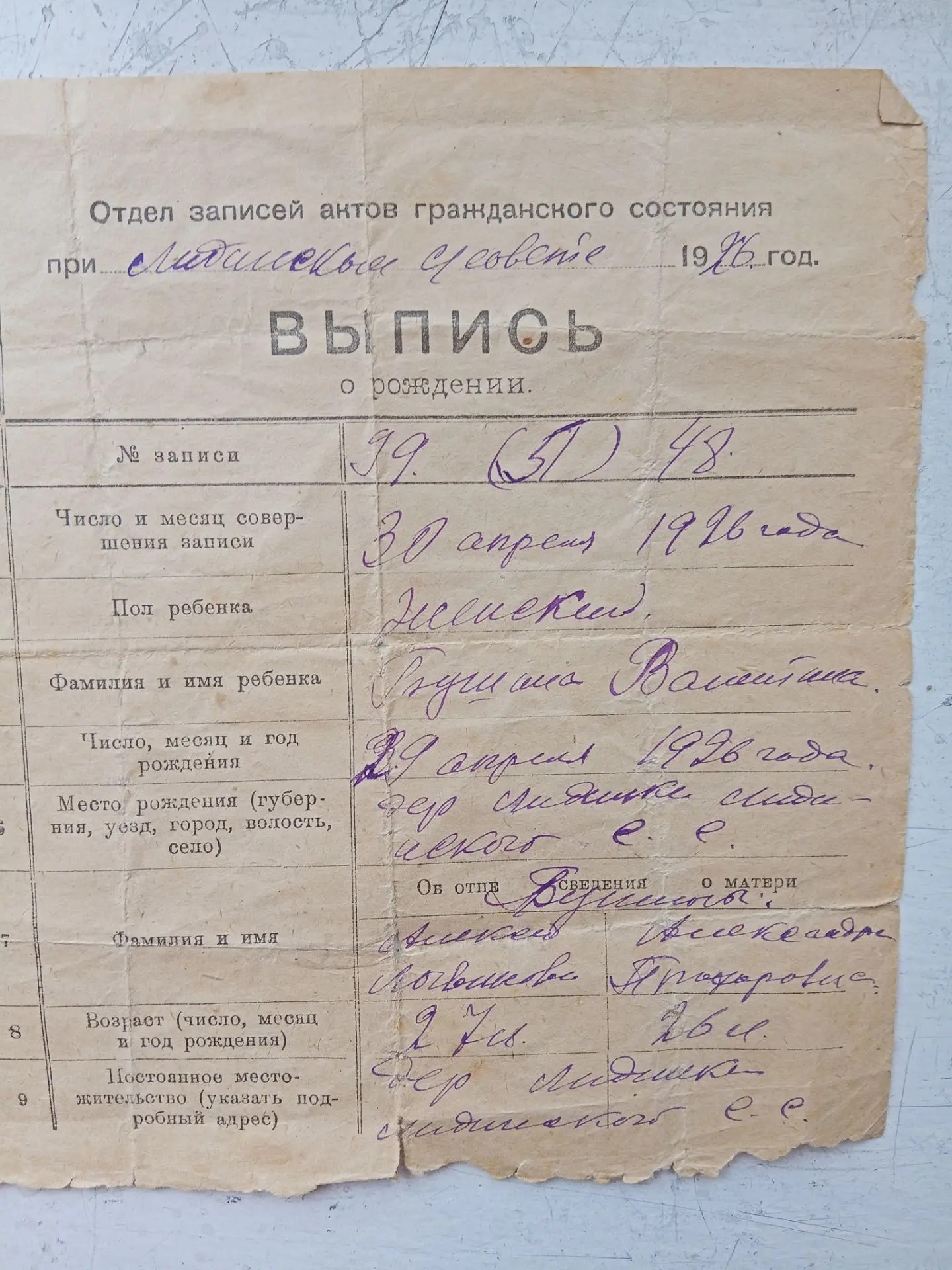
Birth record extract for Valentina Bushina, 1926
A single record like this names the parents and the place of birth. S9

Memory written by hand

In March 2001 Ekaterina Konstantinovna Figurovskaya drew a five-generation family tree and wrote down everything she remembered about the Kolodins, Figurovskys and Kamyshanovs. Another branch was preserved on a sheet marked «this I remember, Valentina». These manuscripts gave us both the first connections and the first questions.

The other documents were gathered gradually: the Moldovan certificates turned up in a 2023 letter, copies of the parents’ documents arrived in August 2026. In September it all finally came together into one piece of research.

Collect and reread

Certificates and hand-drawn charts were turned into data. Kulakovo, the maiden name Bushina and the location of Lidinka were clarified. The first military records and an index of Moldovan parish registers turned up. The site was opened to relatives.

Beyond the family album

Relatives’ comments began to change the tree. The search moved into Moscow parish registers, military databases, lists of the repressed and burial records. Every find got a source, every doubt a note.

Checking other people’s trees

Russian and English-language sources, FamilySearch, MyHeritage and Geni were reviewed. 39 Smart Matches for nine people were checked. For Geni the export had to be fixed separately: surnames and death markers.

Open the original files

Paid sessions at GATO yielded household cards, land files and maps; 431 images were saved at original quality from seven files. Kresty, Chernyaevka and Lidinka were sorted out, and the site gained family routes and a new map of places.

Reading line by line

In GAIO we found the 1882 marriage record of the Kolodins and the birth records of their nine children. After reading the original, the patronymic «Kirillovich» was corrected to «Kornilovich». Meanwhile the search went on for the Kubekovs, Zamyatins and Chebanovs, and relatives sent new photographs and corrections.

See the wider family

N. A. Figurovsky’s memoir added 49 people, 14 families and nine photographs to the tree. Biographies of our contemporaries appeared, as did English and Romanian versions of the site. Matches whose kinship has not been proven are kept separately.

Letters to archives

Requests went to archives in several cities and countries; we keep track of whether the letters arrived, what the replies said and what access costs. A family calendar appeared on the site. The sorting of downloaded materials continues, as does the search for traces of Stepan Kamyshanov in the Civil War.

Igor Melnikov

Every find raised a new question.

My work on the project is to gather the source materials, choose the direction of the search, check details that only the family can recognise, pay for archive access and keep asking relatives.

Collect the family archive

Photographing and sending certificates, school reports, military IDs, gravestones and manuscripts. Going back to old letters and the backs of photographs. Keeping the original next to the transcription.

Ask relatives and correct

Discussing names and faces with Mum, Galina Pavlovna, Elena and Dmitry Chebanov: whose child is in the photo, what someone’s maiden name was, what the family really remembers. And reworking the tree when a correction arrives.

Set the research questions

Finding out where Sergei Melnikov and the Bushins came from, who Maria Pleș’s parents were, how many children the Kolodins had, which clergy family the Figurovskys came from, who the Kubekovs of Kyiv were, how the lives of the Zamyatins and Chebanovs turned out. Asking for a separate check when an attractive version lacks proof.

Open archive doors

Registering in personal accounts, arranging access, paying for sessions. Finding out which archive holds the needed period and which file to look at first. Writing precise requests instead of a vague «find everything about the surname».

Shape the website

Asking for convenient links between sections, a tree that is easy to use on a phone, a full history of finds, a new «Places» section. Adding the calendar, explanations for relatives, chapters for Masha and Alisa. Bringing what the agents found into the cards and the story.

Keep the search open

Finishing reading what has been downloaded. Telling a relative from a namesake. Recording unsuccessful searches too: where we looked and what we did not find. Coming back to a question when a document, an archive reply or a new memory arrives.

Full research activity log 85

The log is built from the project data: date, task, result and what exactly was checked. It shows both the finds and the searches that have not yet produced anything.

Contributors

Who worked on this

Relatives recognise faces in photographs and remember how things were. Igor brings the evidence together and decides what to trust. Artificial intelligence helps to read, search, compare, write and double-check.

Galina Pavlovna KamyshanovaKeeper of the Figurovsky and Kamyshanov family archive

The largest contribution to the archive from the family. Galina Pavlovna sent documents that cannot be found anywhere else: Alexandra Semyonovna Kolodina's gymnasium papers of 1915–1916, Ekaterina Konstantinovna's 1944 school certificate, marriage and death certificates, the certificate of her father's wound, her mother's notes on the family graves. She sent dozens of old photographs with inscriptions on the back and Yuri Figurovsky's letters of 1942. She shared family memories of the Kamyshanovs, Chebanovs, Zamyatins and Panchevs and gave the exact dates of life of dozens of relatives. She writes comments on the site herself, corrects mistakes, answers questions and says what still needs to be done.

ClaudeMain conversation partner and site developer

In the saved project sessions the model was Claude Opus 5.5. Together with Igor it gathered data, read documents, wrote stories, built the interface, prepared GEDCOM and brought to the site what other research had found.

CodexResearch, engineering and verification

In some tasks Codex deepened the archival search, saved originals and reports, checked kinship and discrepancies. In others it worked on photographs, translations, sources, the calendar and the quality of the site. Everything it did was then checked and integrated into the common archive.

MendelMilitary records and archive maps

Searching «Memory of the Heroes of the Great War», GATO materials, plans of Lidinka and land files of Chernyaevka. Originals were saved for later reading, and frames that could not be downloaded were noted separately.

gwar_search
MaxwellKresty: household census

Analysis of the Kresty household cards of 1910–1912: heads of families, household make-up, occupations, seasonal work in Moscow. A search for the Sokolovs and Domanovs — without counting every namesake as kin.

kresty_index
FeynmanKubekovs: Kyiv and emigration

French death records of Alexander Kubekov and Nina Ivanova were found, along with an obituary in «Chasovoy», pre-revolutionary directories and Yugoslav materials. The link with Vera Kubekova remains an open question, and the discrepancies in names and dates have been recorded rather than smoothed over.

kubekovy

These are the names of three separate agents from the session history. Below are the other lines of research and editing; their names describe tasks, not made-up participants.

Kolodins and Ivanovo archive

Puchezh parish books, the 1882 marriage, nine children’s records and Alexandra’s school documents.

Figurovskys and memoirs

The clergy lineage, Fyodor’s siblings, the memoir “I Remember…”, new families and photographic sources.

Melnikov, Bushin, Fetisov

Chernyaevka and Lidinka, household censuses, military cards, Sergey’s origins and forestry settlement household books.

Călugăreanu and Pleș

Surname variants, Capaclia-Răzeși and Capaclia Nouă, collection 211 and original records from 1913 and 1921.

The Kamyshanovs

The Don, Kuban, Novorossiysk, Anastasia’s western Belarusian origins and records of deported residents.

Zamyatins and Chebanovs

Kyiv, Ashgabat, Moscow and Kamchatka; family corrections, parentage checks and Dmitry Chebanov’s biography.

The family today

Searches for missing relatives, professional and creative biographies, and careful checks of public matches.

Website and preservation

Photo restoration, the places map, family questions, Russian, English and Romanian editions, the calendar and link checks.

The evidence behind the story

Every story has a source.

The archive holds documents from different eras, and they deserve different degrees of trust. A family story, a line in a search index and an original civil record answer different questions.

Family papers

Photographs with captions on the back, hand-drawn family trees, memoirs, certificates, school reports, military IDs, gravestones. Mum, Galina Pavlovna, Elena and Dmitry help read what no search engine will find.

Digital archives

GATO, GAIO, the Kostroma and Krasnodar archives, Moscow and municipal inventories, the National Archives Agency of Moldova. Parish registers, censuses, clergy records, land maps and household books.

Genealogy platforms

FamilySearch provides catalogues, indexes and page images; Geni, MyHeritage and Familio help compare branches. A match in someone else’s tree is only a lead, which we check ourselves.

Wars, losses and repression

«Memory of the People», the OBD «Memorial» database, «Memory of the Heroes of the Great War», «Open List», «Memorial» lists, the Butovo synodikon, memorial books and burial records. We look at the record itself, the names of relatives and the places, not just one line in the search results.

Books, newspapers and overseas traces

N. A. Figurovsky’s memoirs, local history, the newspaper «Zarya», «Chasovoy», the André Savine collection, Internet Archive, French civil records, Serbian and Yugoslav directories. Yandex Archive helps find the right lines in recognised books.

Living people and new testimony

Family correspondence, comments on the site, public pages about work and creative projects. A contemporary with the same name is not yet a relative. Any correction can change a story already written.

All project sources 215

The list grows with the archive. Each link opens the source card and the original, if there is one.

    Beyond open search

    Archives reply. Not always right away.

    Here the search turns into correspondence: you have to give the fond, inventory, file, years and a specific person, find out the price and wait for a reply. Below is the state of affairs on 1 October 2026.

    Chekhov Municipal ArchiveSent · awaiting reply

    The Melnikovs in the Lopasnya forestry settlement. A search and digital copies of household books were requested: collection 2, inventory 3, files 17, 25 and 43, covering 1945–1951.

    KostromaReply received · applicant details required

    A search for the Figurovskys in clergy registers. The archive requested a postal address and phone number to process the application. Catalogue leads are known; viewing originals requires paid time, which Igor postponed purchasing.

    Moldova · ANASent · awaiting reply

    Digital copies of original Capaclia-Răzeși records were requested: Grigore Călugăreanu’s birth in 1913 and Maria Pleș’s in 1921. References were checked against the official inventory of collection 211. The requested entries have not yet been read.

    MoscowSent · awaiting reply

    Chebanov and Kondratyeva families: housing documents and residents of Bolshaya Yakimanka in 1924–1926. The aim is to check household members and kinship through records rather than infer them from patronymics.

    Krasnodar and NovorossiyskRequest received · registration confirmed

    The archive account confirms registration of a thematic request about the Kamyshanovs, the parents’ marriage, Pavel’s birth and deported residents. Relevant Novorossiysk books and mismatches between catalogue descriptions and images need clarification. A preliminary quote was requested; paid research work has not been ordered.

    Rostov and GrodnoSent · receipt not yet confirmed

    The Rostov archive was asked about the Kamyshanovs and Pyatiizbyanskaya village. The historical archive in Grodno was asked whether biographical research on Anastasia Mikhailovna is possible: her maiden name and exact birthplace remain unknown.

    Ivanovo and TulaDifferent delivery outcomes

    The Ivanovo archive confirmed receipt of the letter and passed it on for registration. A letter to one of the Tula addresses bounced with «mailbox not found». We distinguish between a letter sent, delivered, registered, and a substantive reply received.

    KyivInitial request sent · correspondence stopped

    The request concerned Vera Alexandrovna Kubekova and the teaching class of 1898/99. At Igor’s decision, further correspondence with the Kyiv archive was stopped. The kinship hypothesis still needs documentary evidence.

    Access was part of the work too

    Tula: archive sessions were paid for; 431 JPEGs were saved during the second session. Ivanovo: paid access enabled reading the original Kolodin parish records. Krasnodar: a three-hour subscription was paid for and activated. Kostroma: registration and catalogue leads are available; Igor postponed paying for image access.

    Access to Voronezh’s historical collections was clarified separately: the personnel archive account and the general archive are not interchangeable. The project materials do not contain a complete total of all expenses.

    How the site works

    From an archive page to a living website.

    The site is built from a single set of family data, so a verified fact appears everywhere at once: in the tree, in a person’s card, in the history, on the map and in the calendar.

    Original and reading

    PDF · JPEG · PNG

    We save scans, backs and every page. We enlarge images, read lines by hand, and text search helps us find our way. Restored copies are kept next to the originals.

    Connected data

    JSON · GEDCOM

    family_tree.json holds people, families, sources, places, open questions and discrepancies. Python builds a GEDCOM from it; for Geni there is a separate export that takes married surnames and death markers into account.

    Build and images

    Python · Pillow

    During the build, documents are copied to the site, thumbnails are made, and data.json, people pages, the sitemap and language versions are created. Then links, names, dates and family relationships are checked separately.

    Interface and geography

    HTML · CSS · JavaScript · Leaflet

    Ordinary web technologies draw a tree you can move, open documents and link sections together. Leaflet and OpenStreetMap show family places and routes on the map. Animation helps read the story in order.

    Publishing and feedback

    Python · SQLite · Caddy · systemd · Git

    The site runs on Igor’s server. Python serves pages and comments; SQLite stores relatives’ messages. Caddy routes requests, systemd keeps the service running and Git records the project’s changes.

    The main language of the site is Russian. The English and Romanian versions are built from ready-made translations, while documents, names in their original spelling and relatives’ comments stay as they are. The visitor’s browser translates nothing itself.

    The scale of the work
    million tokens

    Claude + Codex

    That, by my overall estimate, is how much this work took. Behind the number are long conversations, reading the same documents many times over, searching through name variants, the agents’ work, corrections and the site itself.

    893,000,000 tokens is Igor’s combined figure for Claude and Codex. It is the author’s estimate of volume, not a built-in meter reading or a cost calculation.

    An evolving idea

    How the idea changed

    At first we simply wanted to work out who was related to whom. Then we wanted to see the lives behind the names. Now the site keeps both the family’s history and the story of how we learned it.

    Gather what exists

    The family album and letters. Documents that used to lie in different folders or live only in conversation ended up side by side. Each photograph keeps its caption, its back and the story of how it reached us.

    Explore the archive ↗

    The story is not finished

    The next layer is already in sight: archive replies, unread pages, unknown maiden names, what became of people after they moved, and stories nobody has written down yet. Open questions stay on the site so that a new find can reach its person.

    Add your memory ↗