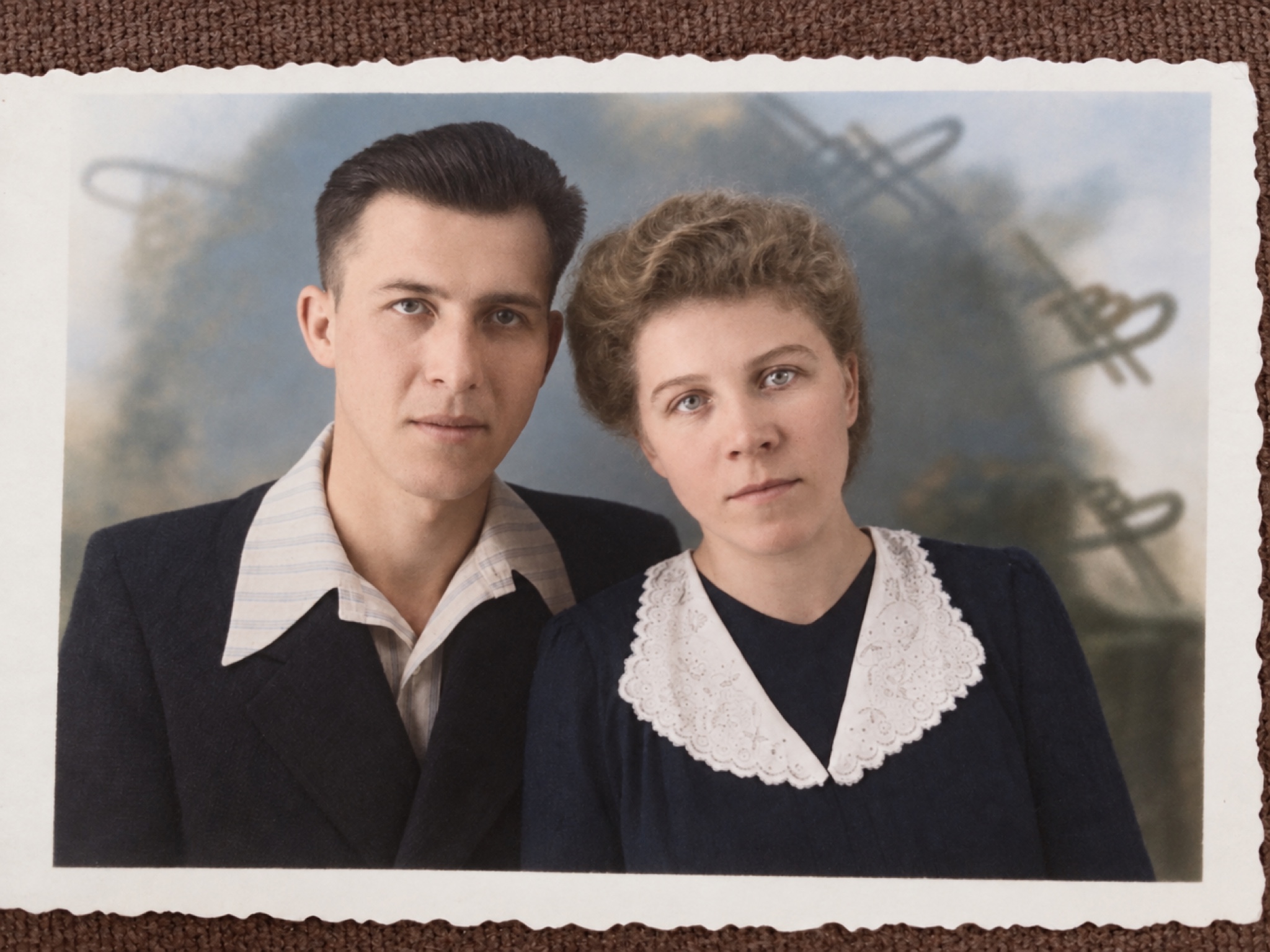
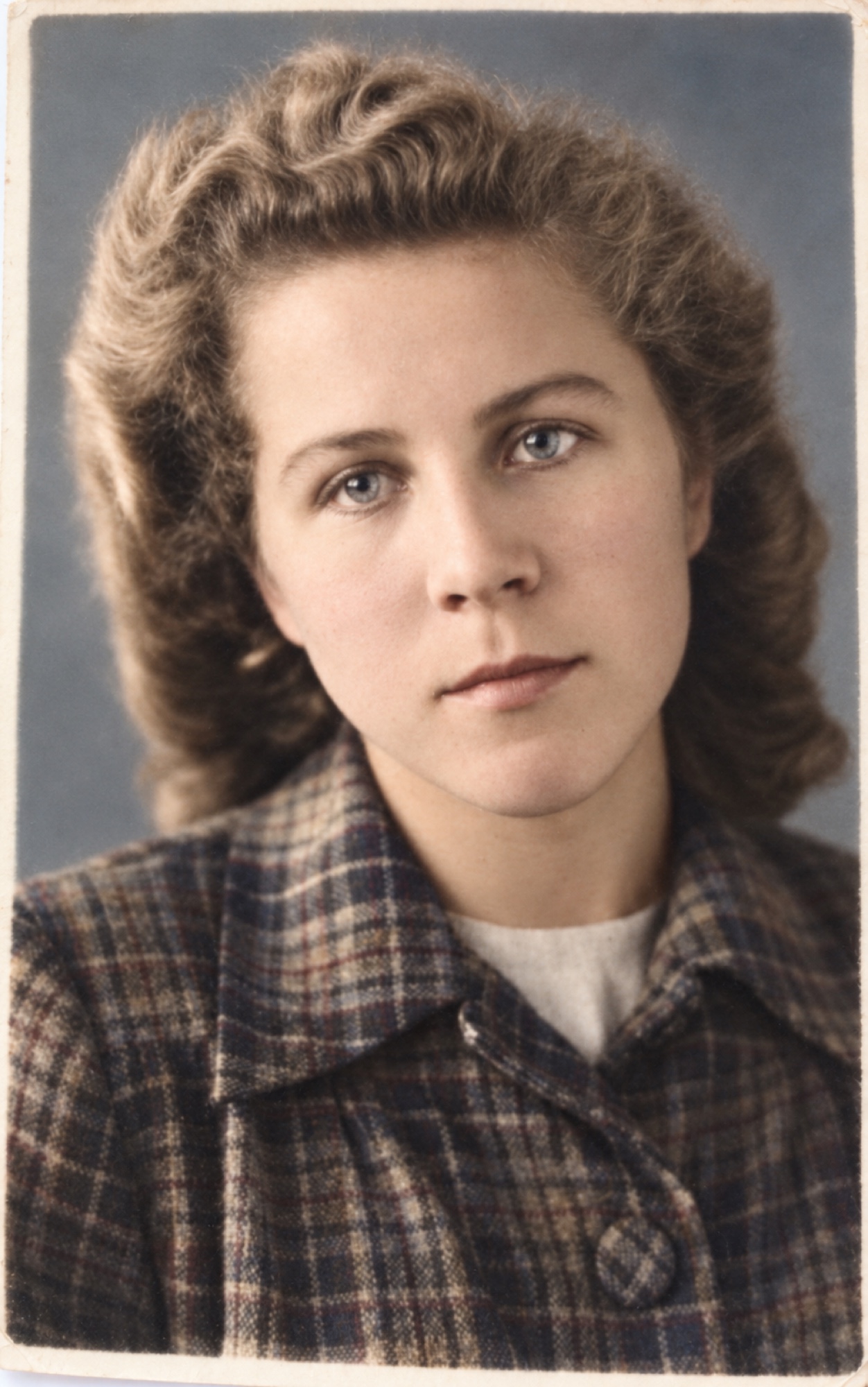
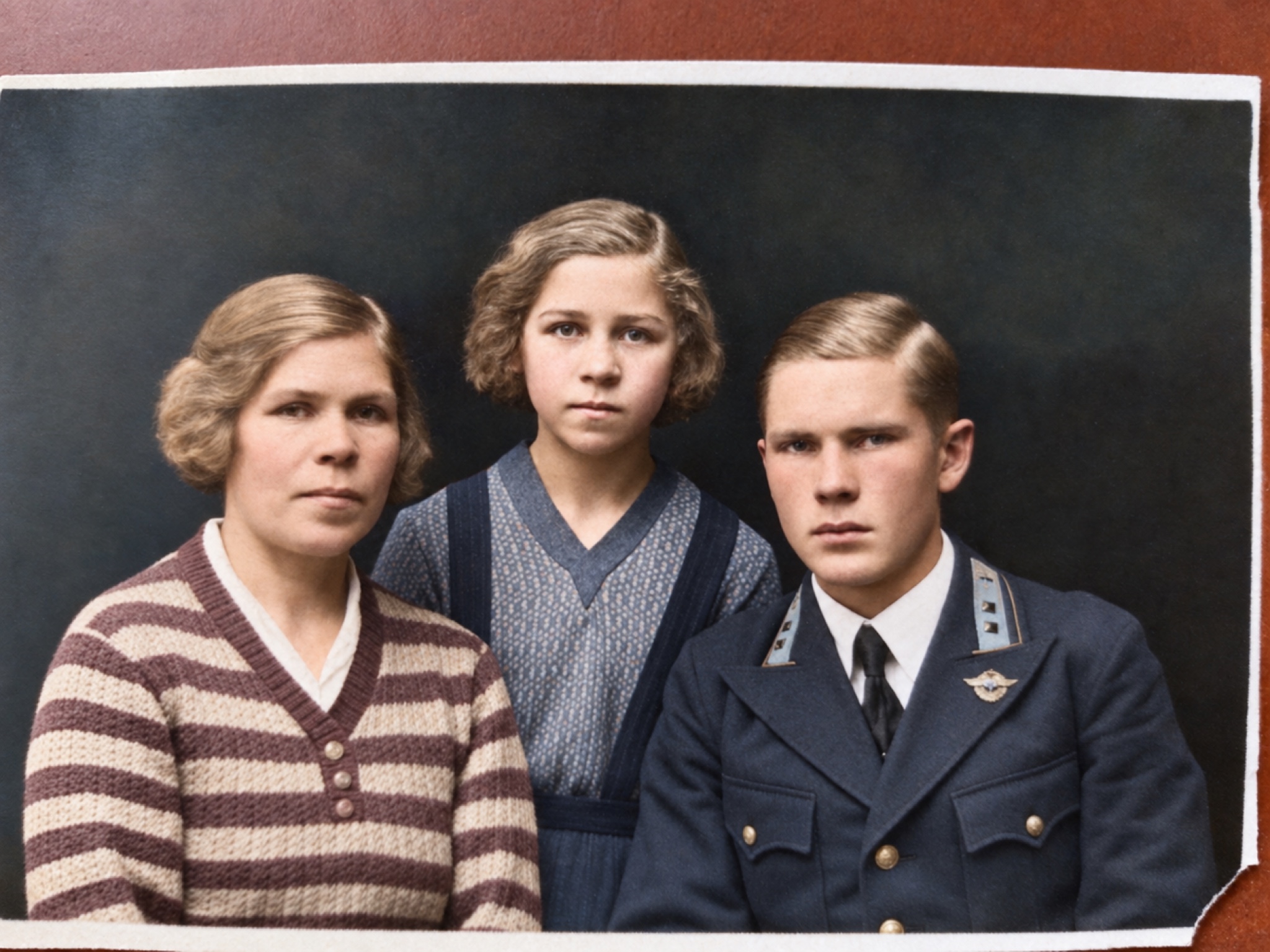
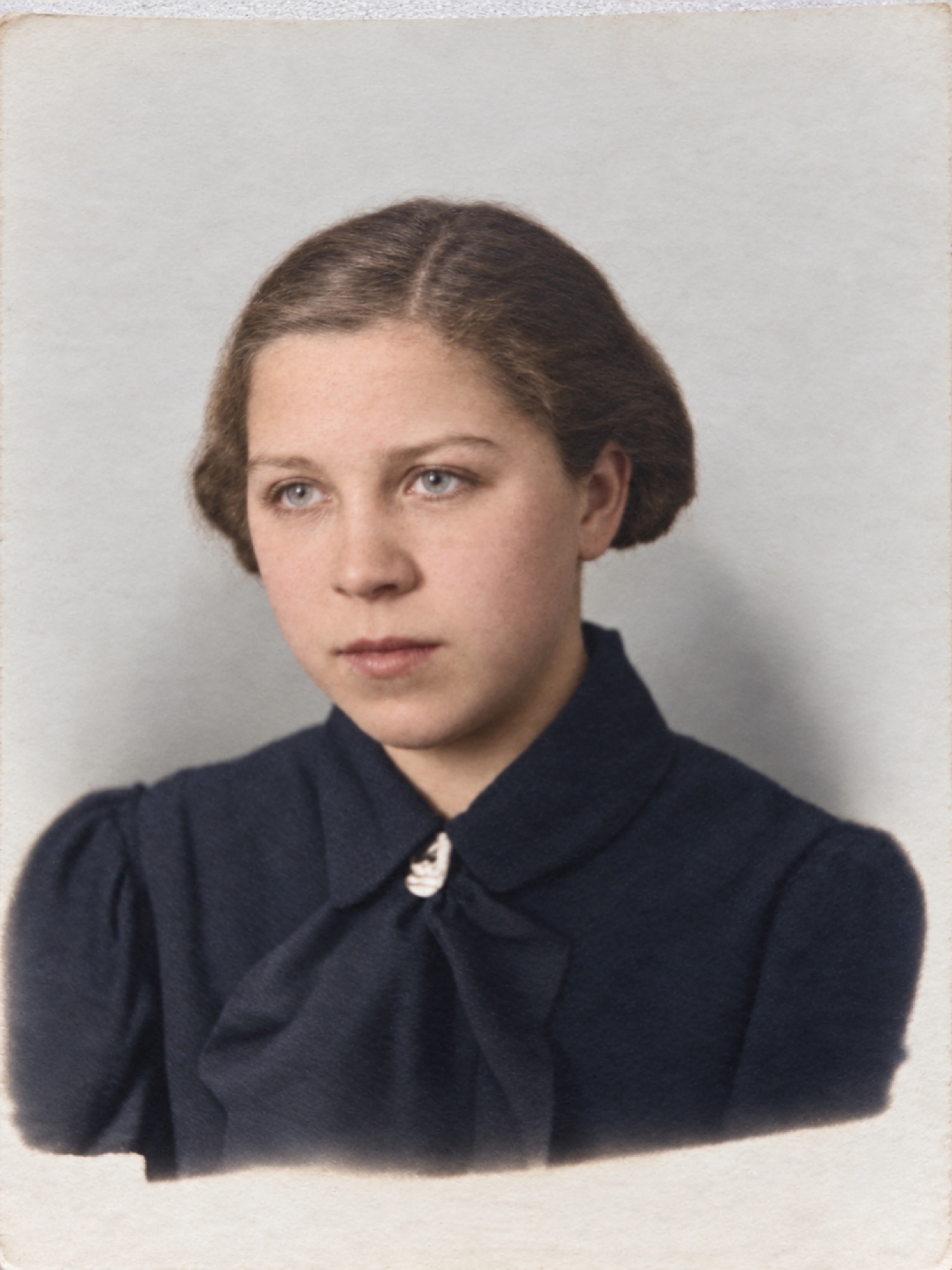
Here are detailed life stories of Igor's and Elena's grandparents. Everything said here rests on archive documents and relatives' memories; where information is uncertain, the text says so.
Igor's grandparents
Sergei Ivanovich Melnikov
1 October 1928 — 1 July 1990
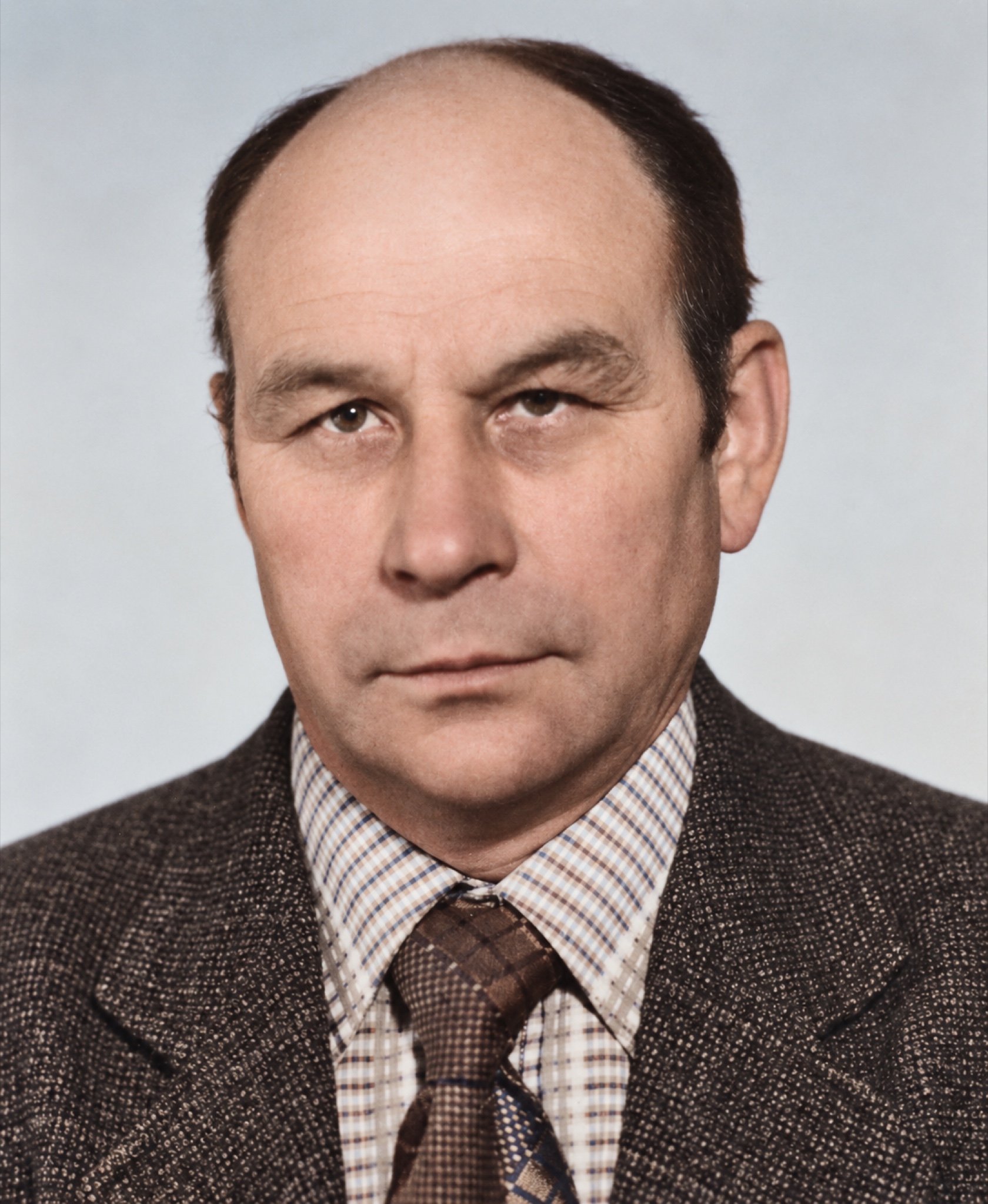
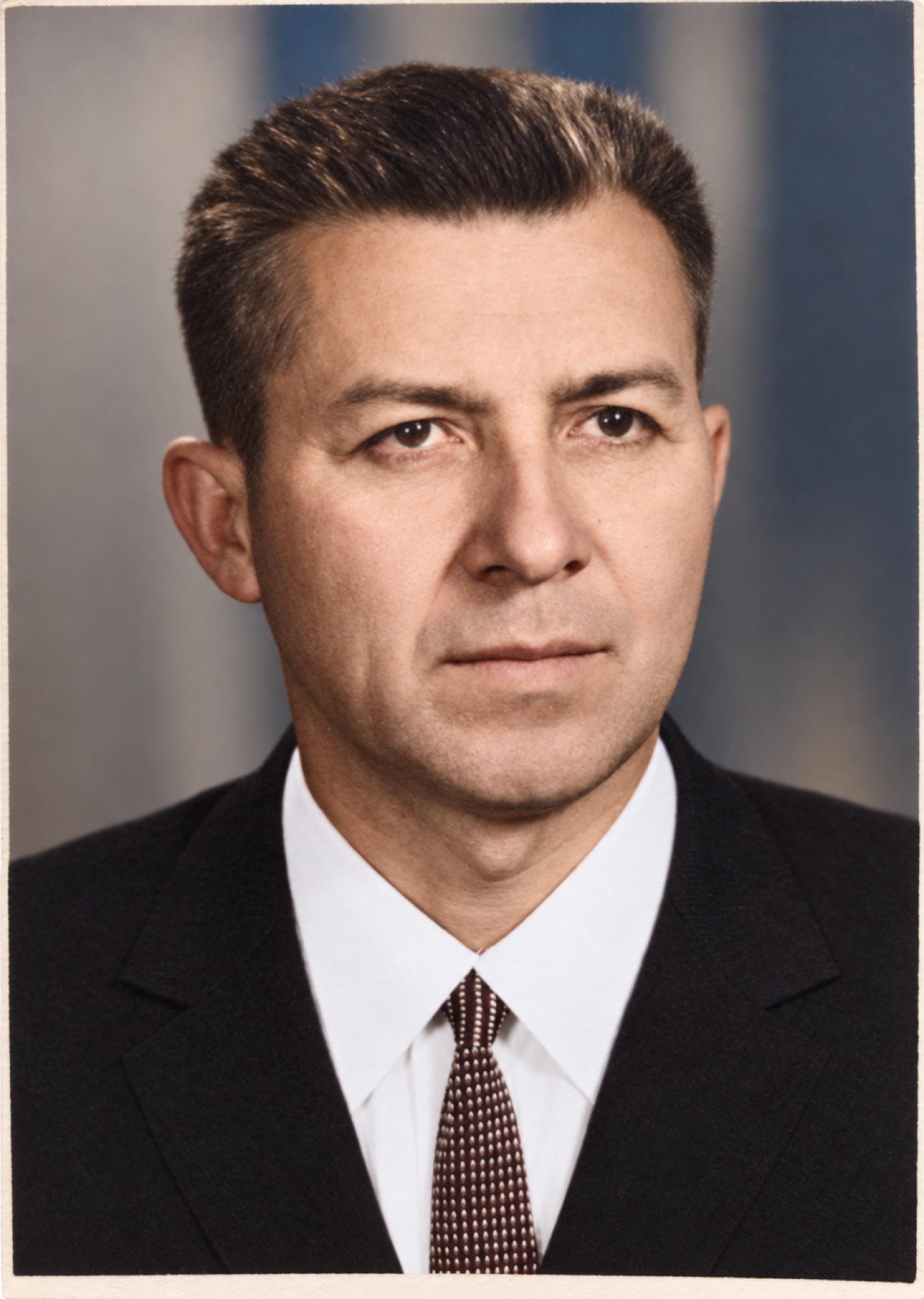
Sergei Ivanovich, probably late 1970s — 1980s. Restored copy, colours are conjectural (S33)
Sergei Ivanovich Melnikov is Igor's paternal grandfather. A village boy from Chernyaevka in the Tula region, he started working at fifteen, was a fitter all his life, spent almost forty years at the factories of Podolsk, and the local newspaper called him one of the best craftsmen.
Chernyaevka
Sergei was born on 1 October 1928 in the village of Chernyaevka, Volovo district, Tula region (S231, S44). His birth certificate names his parents, Ivan Sergeevich and Praskovya Timofeevna Melnikov; the birth was registered the same day as record no. 58 (S231). Sergei was the middle of three brothers: the eldest, Ivan, was born in 1926, the youngest, Anatoly, in 1935.
Chernyaevka is an old village with a church of the Archangel Michael. It was founded in the mid-18th century by settlers from the village of Ievlevo; in 1796 Paul I granted these lands to Count Alexei Grigorievich Bobrinsky, and until the 1861 reform the local peasants were serfs of the Bobrinskys (S55). The Melnikovs are recorded in Chernyaevka in the revision lists from 1745, and the earliest parish register entry found for the family is the birth in May 1807 of Fedot, son of Aksyon Grigoriev, probably Sergei's great-great-grandfather (S594). The neighbouring village of Lidinka, where the Bushins lived, also belonged to the same church's parish (S596), so Sergei Ivanovich and his future wife Valentina Alekseevna came from the same parts.
Sergei's father, Ivan Sergeevich (1895–1958), was born in Chernyaevka on 18 August 1895, the son of the peasant Sergii Abramov Melnikov and Nadezhda Yakovlevna (S529); the family kept his birthday on 10 June. He is probably the fifteen-year-old who went with his herdsman father to work as a hired shepherd boy in Moscow governorate (S406). Ivan Sergeevich apparently fought in the First World War: private Ivan Sergeevich Melnikov of the 99th Ivangorod Infantry Regiment, from Chernyaevka volost, was wounded in the autumn of 1916 on the Romanian front, most likely on 2 November, after the battles for heights in the Carpathians. One card names the Neman as the place of the wound, but the regiment was not there at the time — it is a clerk's error (S114, S555). In the regimental list he is already recorded as married (S114).
His mother, Praskovya Timofeevna (1895–1968), was probably born on 21 October 1895 in the village of Kresty in today's Kurkino district, the daughter of the peasant Timofei Sergeevich Sokolov (S54). The family said she could charm away toothache for the whole village: when her little grandson Valera cut his foot on a bottle in a lake, his grandmother bandaged the wound, whispered over it, and it was all gone (S342). The family called Efrosinya Ionovna Pushkina (1867–1953) Sergei's grandmother (S339). The parish registers do not confirm this: Ivan Sergeevich's mother was Nadezhda Yakovlevna (S529), while Evfrosinia Ionovna married Timofei Pushkin in November 1894, her first marriage (S528). What she was to the family is yet to be found out.
The war and first job
When the war began, Sergei was twelve. In 1943 he finished seven years of school and qualified as a fitter (S44). The work record in his labour book also starts in 1943, when he was fifteen (S235). He was too young to fight. His elder brother Ivan went to war: he was called up by the Podolsk military office at sixteen and a half and served as a clerk in a sapper battalion in the war against Japan (S402). The call-up lists say that Ivan lived in Satino-Russkoye near Podolsk with his mother and brother, so during the war the family had already moved from the Tula region to the Moscow region.
On 23 December 1947 Sergei joined the Kalinin mechanical plant in Podolsk as a repair fitter (S235). In town the plant was called “Mekhanka”, and before the revolution it had been the Singer factory (S353). Valentina Bushina had worked there as an accounting clerk since June 1946 (S236). The labour books show that this is most likely where they met.
The army
On 14 December 1948 Sergei was called up into the army, and he served until 1952 (S235). His military booklet records under family: “wife: Melnikova Valentina Alekseevna” (S44). There are no documents yet on where and when they married. While Sergei was serving, Valentina Alekseevna lived and worked near Lopasnya, today's Chekhov, and on 1 July 1949 their son Valery, Igor's father, was born there, in the forestry settlement (S233).
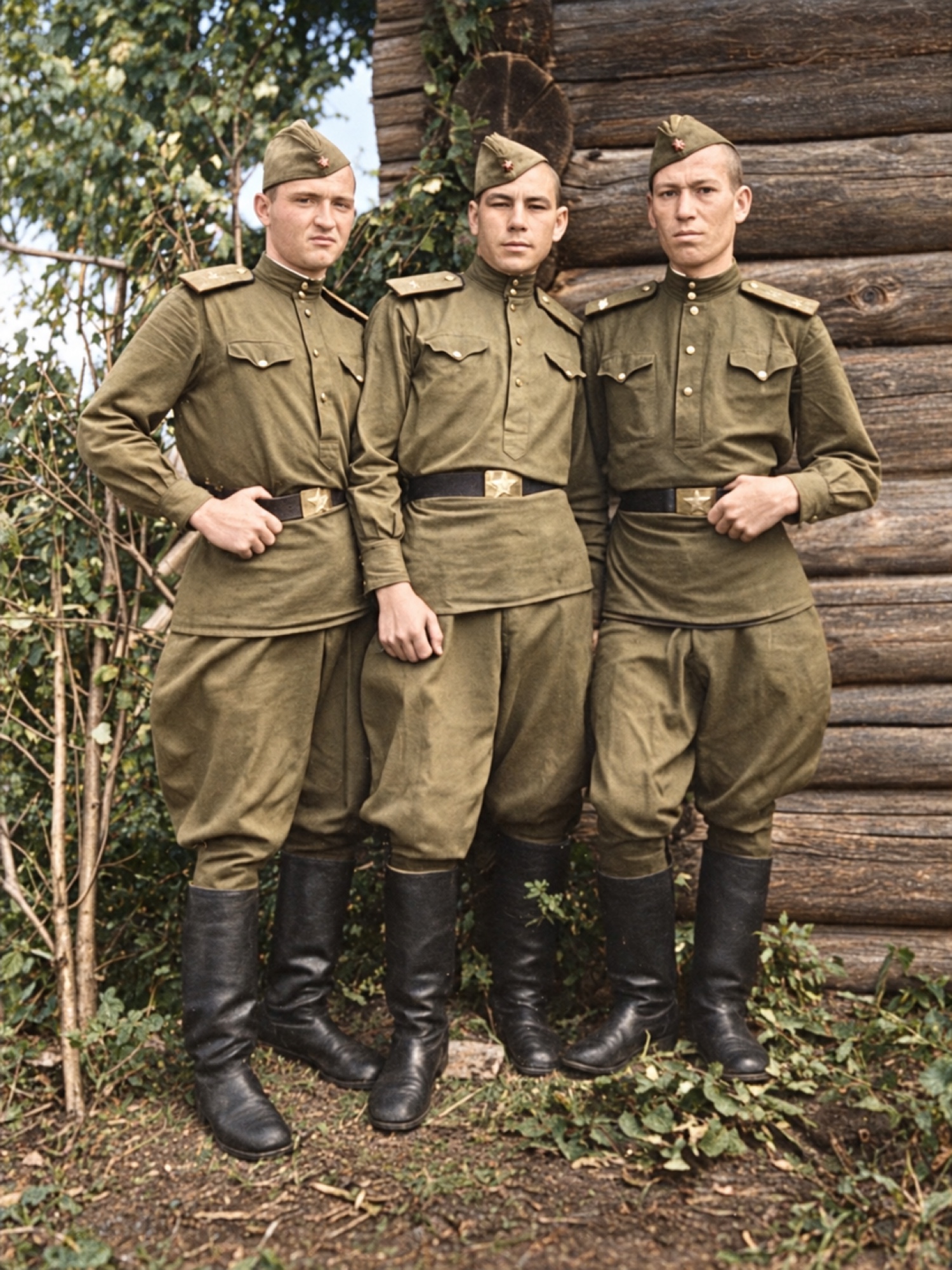
Sergei Ivanovich in the army with two fellow soldiers, probably 1948–1952; which of the three is him is not noted. Restored copy (S421)
A photograph survives from his army years: three soldiers in tunics with shoulder boards, forage caps, breeches and boots stand by a log wall. One of them is Sergei Ivanovich, but which one is not noted (S421).
Podolsk
On 24 November 1952 Sergei Ivanovich returned to the same Kalinin plant (S235). Around the same time, in 1952 or 1953, the family settled in Podolsk, at Krasnaya Gorka, on Sadovaya Street (S353). Valery Sergeevich remembers one of two identical two-storey houses with eight flats between Chapaeva and Furmanova streets. Opposite was a field, and beyond it a cemetery; water was fetched from the pump at the corner of Kolkhoznaya and Chapaeva (S294). He also remembers March 1953, when Stalin's death was announced: the town was very quiet, and everyone spoke in whispers (S353).
Sergei Ivanovich and Valentina Alekseevna treated her niece Lyudmila, “Milya”, the daughter of her sister Maria, as their own daughter, although the girl's parents were alive (S26). Igor's father remembers how once in Podolsk Aunt Marusya gave Milya a painful smack for some mischief, and Sergei Ivanovich in anger struck Aunt Marusya herself. After that Aunt Marusya never came to visit them again (S26).
Sergei Ivanovich with his son Valera and his younger brother Anatoly, 1950s. Restored copy (S247)
The fitter
In October 1958 Sergei Ivanovich moved to the Podolsk battery plant as a grade 6 fitter, and in 1959–1960 he was a fitter-installer with the Tekhnomontazh trust (S235). After that, for the rest of his life, he worked at the Podolsk experimental plant of pile-driving equipment of the Gidrospetsfundamentstroy trust. There he was a grade 6 fitter, from 1976 he also took up the trade of electric welder, and from 1987 he was a toolmaker (S235). Pile-driving equipment means pile drivers, machines that drive piles into the ground, and the diesel hammers for them.
The local newspaper, most likely “Podolsky Rabochy”, wrote about him more than once. Around 1967: “fitter Sergei Ivanovich Melnikov, member of a communist labour brigade” at the Podolsk repair and mechanical plant, shown assembling a pile driver (S48). On 9 September 1969: “Sergei Melnikov, an assembly fitter at the repair and mechanical plant, is never short of hard work. He always fulfils his shift targets by 150–170 per cent”; he readily shares his methods with young workers (S47). Another undated note calls him the best toolmaker at the experimental plant of pile-driving equipment: he made tooling for assembling pile drivers and diesel hammers (S49).
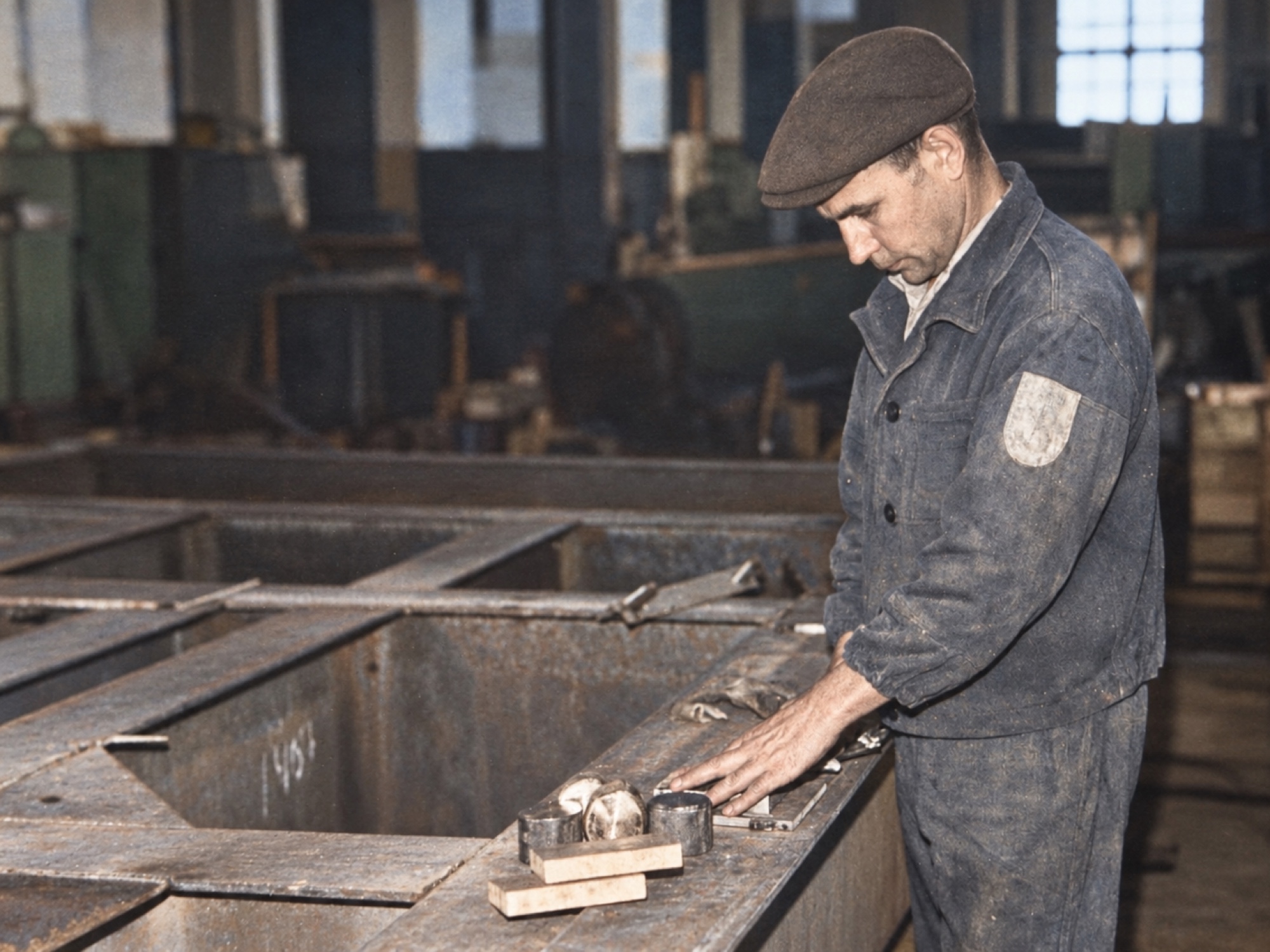
Sergei Ivanovich at a machine tool, 1950s–1960s. Restored copy (S284)
Sergei Ivanovich's labour book lists dozens of commendations and certificates of honour from 1960 to 1989, an entry about the Board of Honour, and on 28 September 1988, for his sixtieth birthday, a certificate of honour and a gift (S235). The book also bears a stamp granting him a pension.
Family
His son Valery graduated from the Podolsk industrial technical college, served in the army and worked first in Podolsk, then in Moscow (S237). Sergei Ivanovich had three grandsons: Sergei (1975), from Valery's first marriage, and Igor (1981) and Vladimir (1983), from his marriage to Ekaterina Grigorievna from Capaclia in Moldova (S4).
In their last years Sergei Ivanovich's parents lived in the settlement of the Lopasnya forestry enterprise. His father died in 1958, his mother in 1968, and in 1970 his younger brother Anatoly died at thirty-five. All three are buried at the Satino-Russkoye cemetery under a shared monument with portraits (S25). His elder brother Ivan Ivanovich lived until 2010 and is buried there too (S329).
According to Valery Sergeevich, Sergei Ivanovich did not have a single bad tooth until the day he died (S342).
Memory
Sergei Ivanovich died on 1 July 1990, aged sixty-one. The next day the last entry appeared in his labour book: “employment contract terminated due to death” (S235). He was on the staff of the experimental plant until his last day.
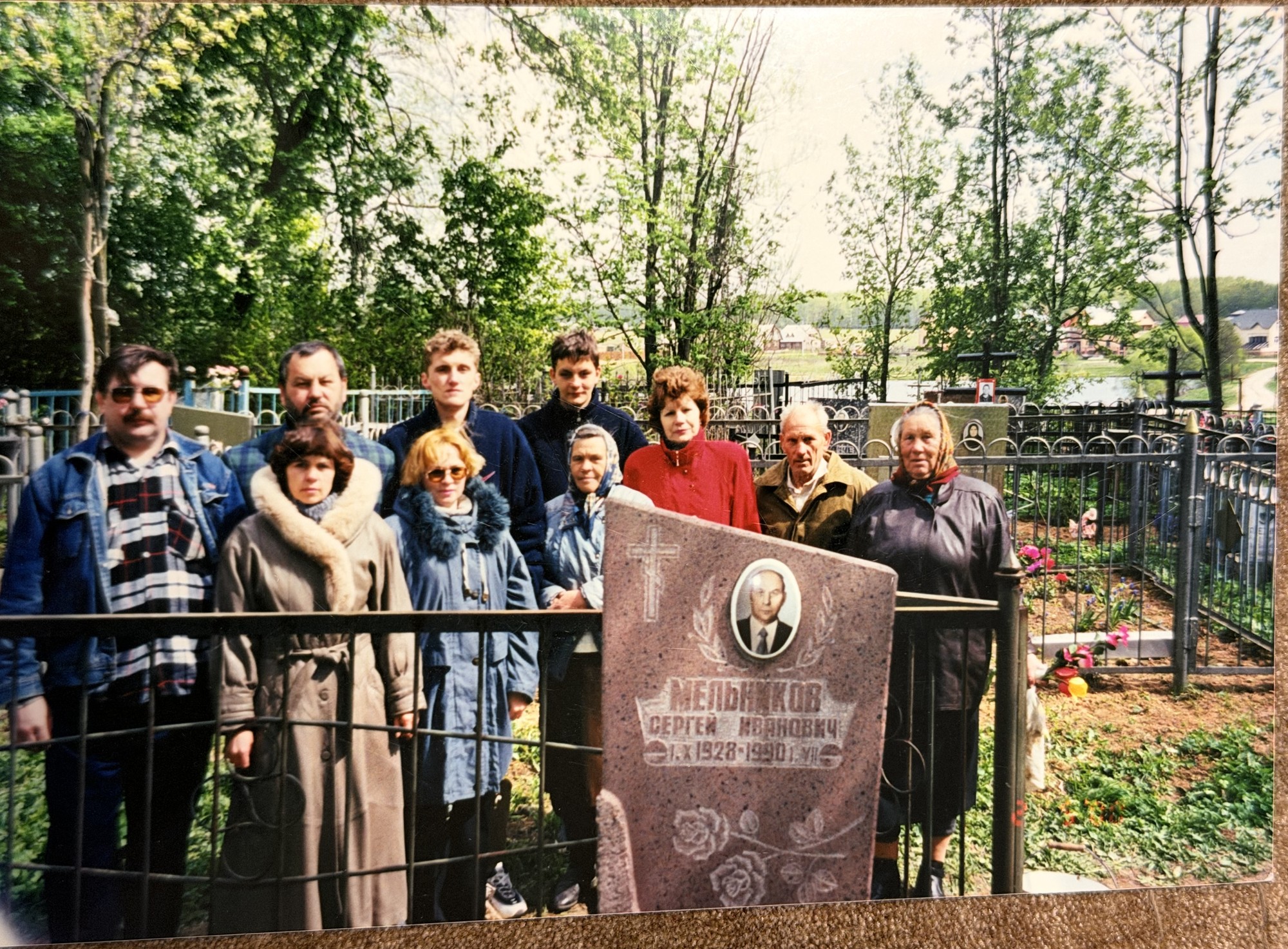
He was buried at the Satino-Russkoye cemetery near Podolsk, where his parents and brother already lay. The first gravestone bears a portrait and the inscription “Melnikov Sergei Ivanovich 1.X.1928 – 1990.VII”; a photograph from the 1990s shows twelve people at the railing, but who they are is not noted (S459). Later a shared monument to Sergei Ivanovich and Valentina Alekseevna was put up on the grave (S2).
Relatives at Sergei Ivanovich's first gravestone at the Satino-Russkoye cemetery, 1990s. If you recognise anyone, please leave a comment (S459)
What we do not know yet
Year of birth. The family long believed that Sergei Ivanovich was born in 1926. The birth certificate and the gravestone give 1928 (S231, S2), and so does the labour book (S235).
Which Chernyaevka. The military booklet gives the village of Chernyaevka in Volovo district (S44), while the parish village of Chernyaevka with the church of the Archangel Michael, to which Lidinka belonged, is now in Bogoroditsk district. Whether this is the same village still has to be checked against the old district boundaries.
Two names of the plant. Newspapers of 1967 and 1969 call his workplace the Podolsk repair and mechanical plant (S47, S48), while the labour book calls it the experimental plant of pile-driving equipment (S235). How the two names relate is not yet clear. The records of his education also differ: seven years of school in the military booklet (S44), primary education in the labour book (S235).
The wedding. The civil record of the marriage of Sergei Ivanovich and Valentina Alekseevna has not been found. The family mentioned the village of Kurilovo, but this is only a guess.
According to Valentina Alekseevna, Sergei Ivanovich may at one time have been imprisoned because of some incident near Podolsk. The year and circumstances are unknown and there are no documents about it; a request to the archive of the Podolsk city court has been prepared to check this.
Valentina Alekseevna Melnikova (née Bushina)
6 April 1926 — 11 January 2017
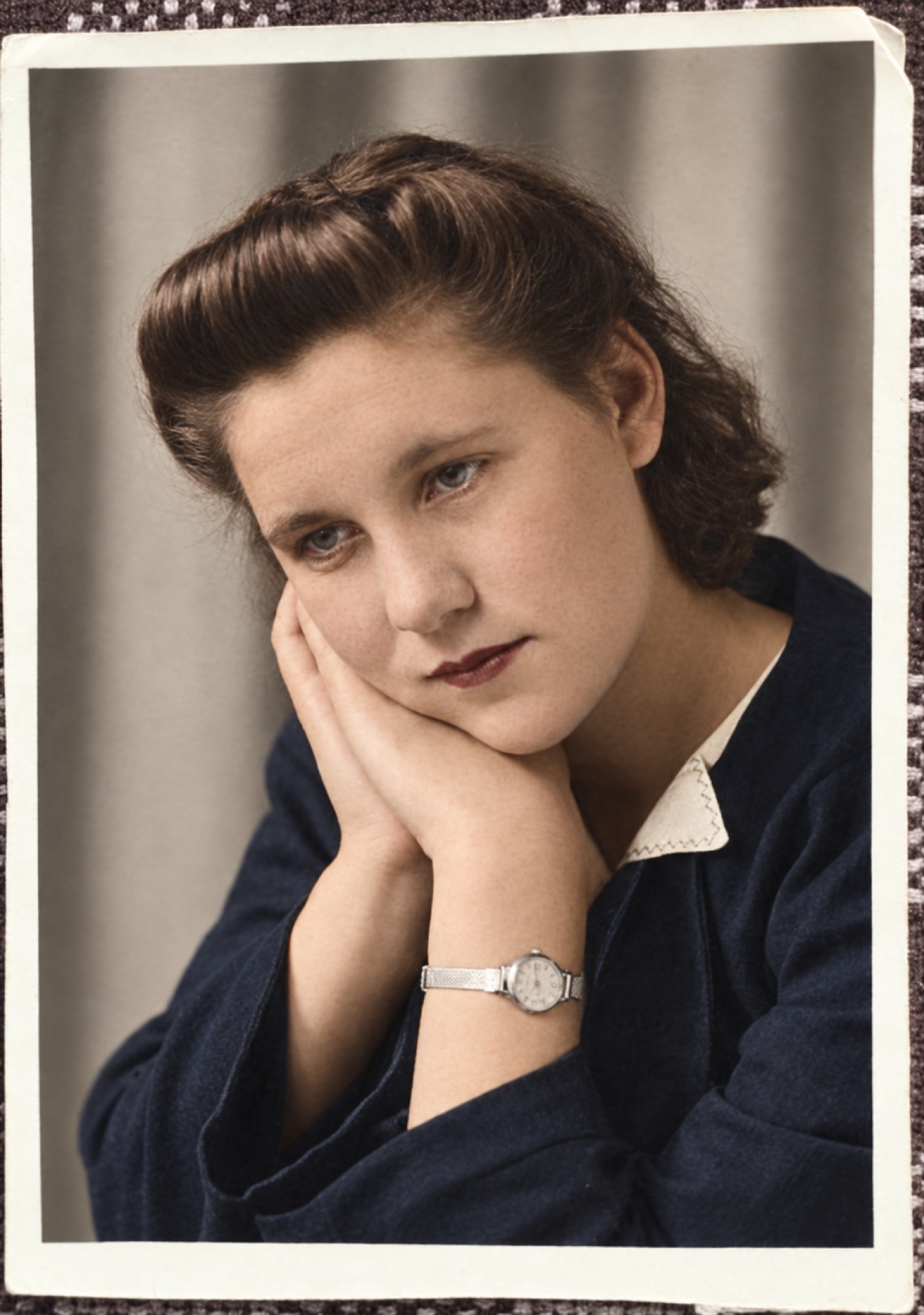
Valentina Alekseevna as a young woman, probably late 1940s. Restored copy, colours are conjectural (S35)
Valentina Alekseevna Melnikova, née Bushina, is Igor's paternal grandmother. A girl from the village of Lidinka in the Tula region, she lived to ninety, worked with figures for almost half a century, as an accounting clerk, bookkeeper and Gosbank economist, and wrote down her family's pedigree from memory herself.
Lidinka
Valentina was born in 1926 in the village of Lidinka, Bogoroditsk district, Tula region (S232). This is the Lidinka on the Mutnaya stream, in the former Bogoroditsk uezd, now Teplo-Ogaryovo district; reference books list both Bushins and Fitisovs among its inhabitants, Fitisov being the old spelling of Fetisov (S9, S11, S12). Her father was Aleksei Logginovich Bushin, her mother Alexandra Prokhorovna (S232). When their daughter was born, the father was twenty-seven and the mother twenty-six (S9). Her mother's maiden name was Fetisova: that is how Valentina Alekseevna herself wrote it in her pedigree (S10). Valentina had an elder brother, Pyotr (1922), also a native of Lidinka (S577), and a sister, Maria.
Lidinka is a small village: in 1859 it had 43 households and 367 inhabitants. It belonged to the parish of the church of the Archangel Michael in neighbouring Chernyaevka (according to some guides, also to Bolokhna), and both Bushins and Fetisovs appear in the Chernyaevka parish registers. Like Chernyaevka, Lidinka was part of the Bogoroditsk volost, which Paul I granted to Count Bobrinsky in 1796; in 1880 the land passed to the peasants (S108).
Valentina's paternal grandfather was probably Loggin Timofeevich Bushin. In the household census of Lidinka of 1910–1912, Login Timofeev Bushin has a thirteen-year-old son recorded: literate, working as a tailor in Moscow and sending twenty roubles home. By age this could be Aleksei, but the card gives no names (S105).
An unusual story was told at home about her mother's family. Valentina Alekseevna herself said that her mother or grandmother “waited on some gentry” (S1). Valery Sergeevich explains that this was Alexandra Prokhorovna: as a child she was a servant to landowners in St Petersburg and was dismissed for mistreating the owners' dog. “She was very beautiful,” he adds (S347). Igor adds that the dog belonged to the prince: Alexandra apparently served at the grand-ducal court, where her uncle Vasily Timofeevich may have found her the place. This has not yet been confirmed by documents.
Childhood and the war
Of her childhood Valentina Alekseevna said that her father, together with other men of the village who had not supported collectivisation, was rounded up and taken away, and none of them came back. Her mother died early, and the girl was taken in by relatives (S580). There are no documents about this yet. The «Open List» has Aleksei Loginovich Bushin, born in 1892, and Ignat Loginovich in the same case — both from Satino-Russkoe near Podolsk; her father's brother was also called Ignat. But the year of birth differs, and it is not proven that this is her father (S407).
By the end of the 1930s the Bushins had apparently moved near Lopasnya, today's Chekhov. Her brother Pyotr was called up by the Podolsk military commissariat on 10 June 1941, before the war began, and the address in his unit's lists is Lopasnya station, State Bank (S13, S577). Pyotr went through the war as a sergeant of the 122nd Rifle Regiment, 201st Rifle Division, on the Leningrad Front, was wounded, and received two Orders of the Red Star and two medals «For Courage» (S13, S577). Where Valentina herself spent the war is unknown; when the war began she was fifteen.
Her birth record later had to be restored: the civil record was drawn up anew on 29 August 1942, and a duplicate certificate marked “Age restored” was issued by the Podolsk registry office in January 1953 (S232). The family always celebrated her birthday on 6 April, as in the certificate and on the gravestone (S232, S2).
The Kalinin plant
On 6 June 1946 twenty-year-old Valentina joined department no. 119 of the Kalinin mechanical plant in Podolsk as a tally clerk and accounting clerk, and from January 1947 she was a senior accounting clerk (S236). Before the plant she had one year of work record. In December 1947 Sergei Melnikov came to the same plant as a fitter (S235), and this is most likely where they met.
Lopasnya
On 6 January 1949 Valentina left the plant “due to a change of residence” (S236). Sergei Ivanovich was already serving in the army. According to Valery Sergeevich, a cousin of one of her parents, who was “some kind of boss in Lopasnya”, found her a job as an accounting clerk at the Lopasnya food plant (S343); according to the labour book, from 20 March 1949 she worked as an accounting clerk in the Lopasnya district (S236). On 1 July 1949 her son Valery was born in the settlement of the Lopasnya forestry enterprise (S233).
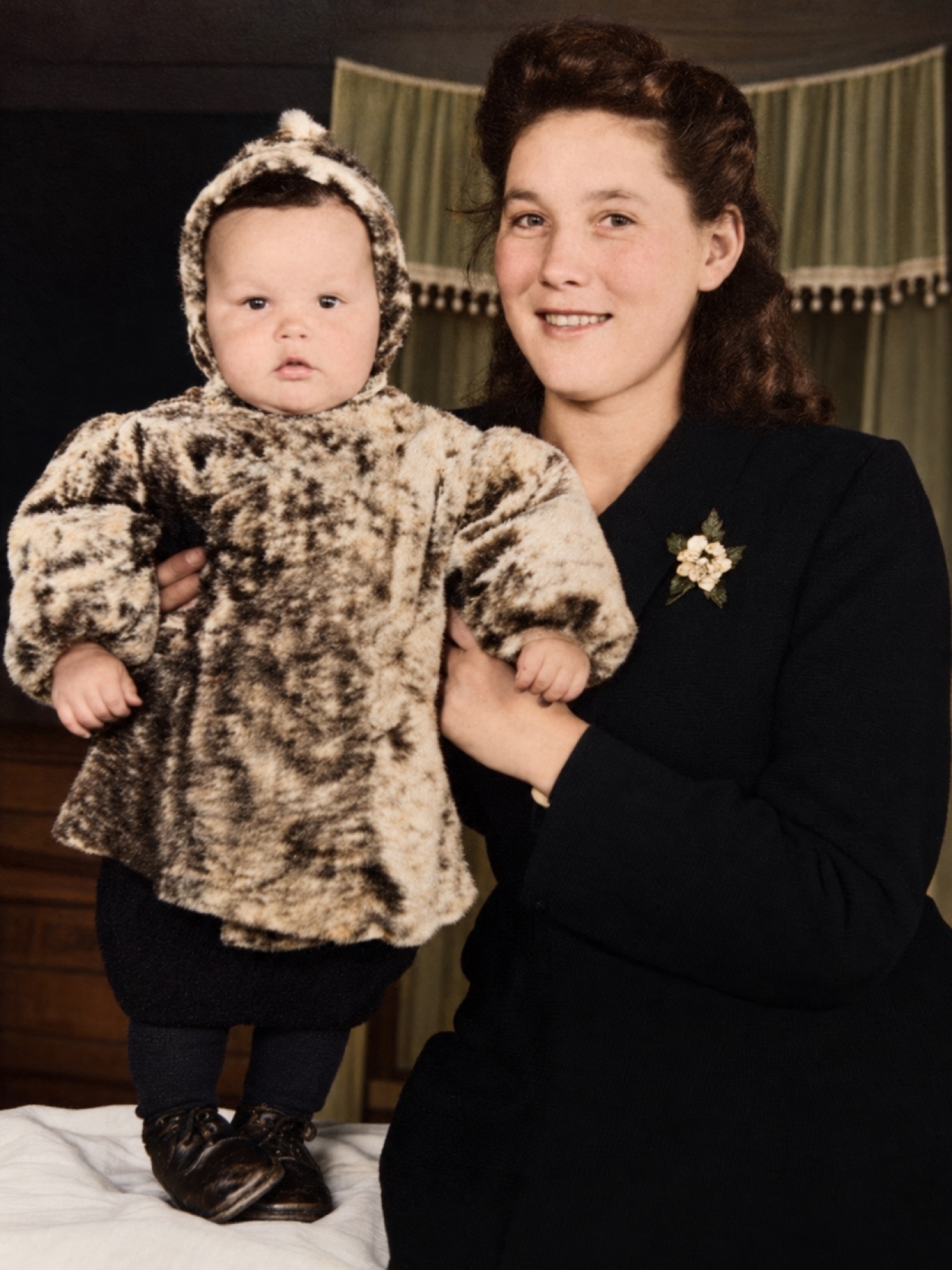
Valentina Alekseevna with her son Valery. On the back: “1950. Valera is not yet one year old.” Restored copy (S239)
According to Valentina Alekseevna, the boy got his name thanks to her relative Valentina Pushkina, also Melnikova by marriage, the wife of the pilot Valery Melnikov. So the family ended up with two Valery Melnikovs (S344). As a child Valery Sergeevich stayed with relatives in Kulakovo, near the St Nicholas church, perhaps even lived there, in winter and in summer (S352). The family said that this same aunt found a gold cross with diamonds in her vegetable garden. They prised out one stone and tested it on a window pane, and it turned out to be real, but then they dropped it on the floor and never found it again (S343).
Podolsk and Gosbank
In November 1952, when Sergei Ivanovich returned from the army, the family moved to Podolsk and settled at Krasnaya Gorka, on Sadovaya Street (S353, S294). Valentina Alekseevna took a job as an accounting clerk at the Podolsk district finance department, and from September 1953 she worked at the Podolsk branch of Gosbank: as an assistant bookkeeper, from 1955 as a bookkeeper, from 1962 as a credit inspector (S236). In 1963 she received a diploma of specialised secondary education (S236).
On a forest path: Valera in a sailor suit, Valentina Alekseevna arm in arm with Sergei Ivanovich, 1950s. Restored copy (S246)
In July 1967 she was transferred to the Moscow regional office of Gosbank; from 1969 she was a senior economist in the heavy industry lending department (S236). On 5 April 1981 Valentina Alekseevna retired, on the very day when her son Valery and Ekaterina Grigorievna registered their marriage at the Telyakovsky village council in the Tula region (S236, S4). But in 1982 she went back to work and until September 1994 worked at the Odintsovo branch of Gosbank, later Agroprombank and the Vozrozhdenie bank (S236). The last entry in her labour book was made when she was sixty-eight.
Travels
The family album keeps her photographs from trips in the 1970s. June 1970: the Pushcha-Vodytsia holiday camp near Kyiv (S283). 1971: the “Lady's Whim” footbridge in Kislovodsk (S285) and the site of Lermontov's duel in Pyatigorsk (S286). 1 May 1975: a gorge near Dushanbe (S288), and on 14 May of the same year, by a monument in Ashgabat (S282).
Valentina Alekseevna at the Pushcha-Vodytsia holiday camp near Kyiv, June 1970. Restored copy (S283)
Family
Sergei Ivanovich and Valentina Alekseevna treated her niece Lyudmila, “Milya”, the daughter of her sister Maria, as their own daughter (S26). Her sister Maria, Stoykova by marriage, lived in Laptevo (now Yasnogorsk), her brother Pyotr in the village of Lyutoretskoye, three kilometres from Chekhov, and Valentina Alekseevna herself in Podolsk (S343).
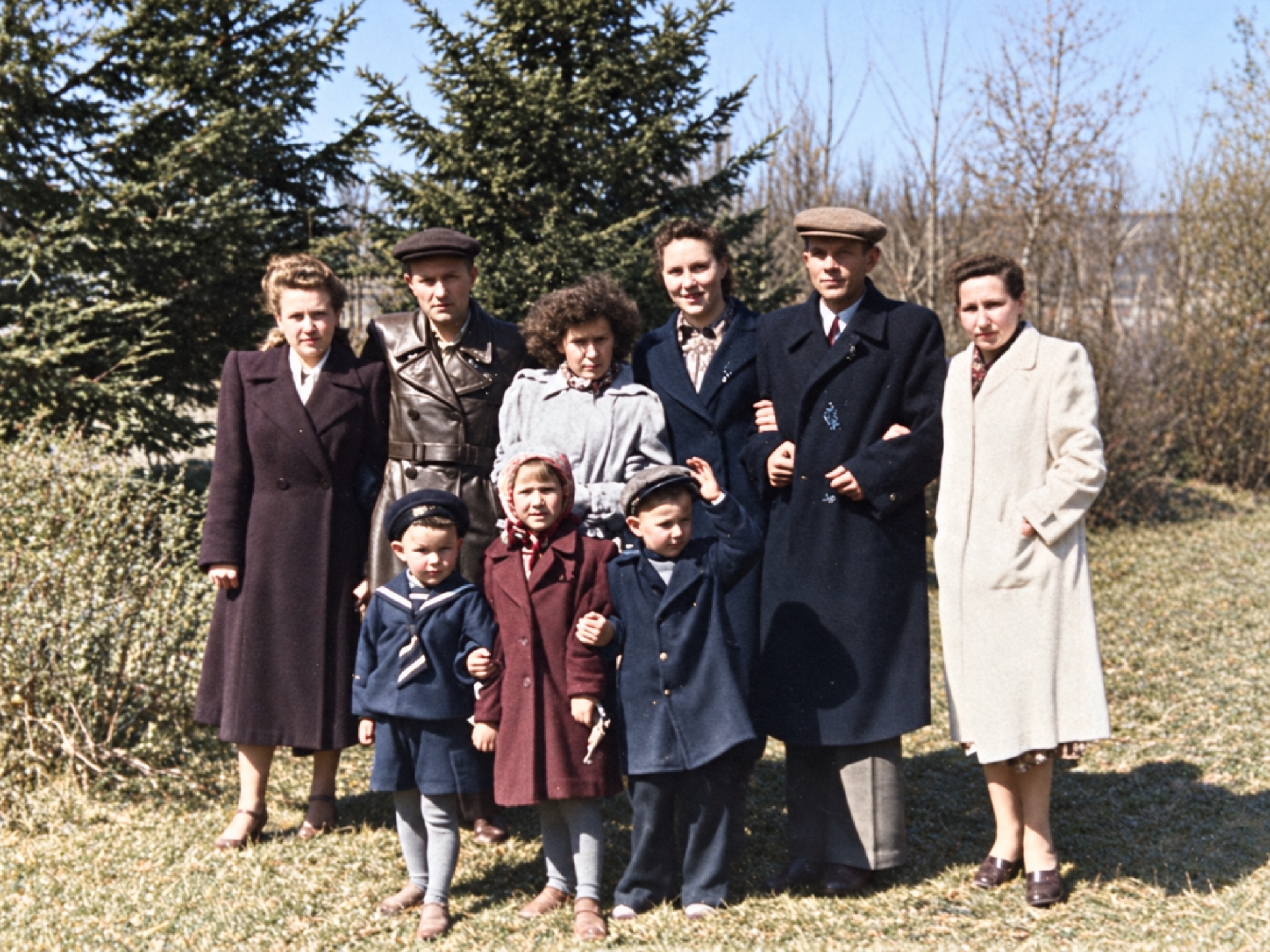
She has three grandsons: Sergei (1975), Igor (1981) and Vladimir (1983). There is a 1977 photograph of her with her grandson Sergei on a festive street for the sixtieth anniversary of the October Revolution (S279), and one from the 1980s with Valery Sergeevich and all three grandsons (S280). Other photographs from the 1980s show her with relatives: in a room by a carpet with the Melnikovs and Călugăreanus (S278), at a big family gathering in a courtyard (S244), on a station platform by a carriage with Aunt Mila and her husband (S466). One more photograph shows her at the funeral of her brother Pyotr in Lyutoretskoe; the year is not written. The picture used to be taken for the funeral of her father, Aleksei Logginovich, but Valery Sergeevich recognised it as Uncle Petya's funeral (S289, S581).
Sergei Ivanovich died in 1990. Valentina Alekseevna outlived him by twenty-six years.
Memory
Valentina Alekseevna wrote down her family's pedigree from memory, on a sheet headed “this is what Valentina remembers” (S10). It names her grandfather Bushin without a first name and grandmother Anna, their children Praskovya, Grusha, Ignat, Kolya and Aleksei; grandfather Prokhor Fetisov and grandmother Praskovya with their children Polya, Anna, Shura, Fyodor, Sergei and Pavel; her own brother and sister, son and grandsons. There are no dates, but it was this sheet that started the search for the Bushins and Fetisovs in the Tula archives. The parish registers later corrected one detail: her maternal grandmother was actually called Evdokia Kondratyevna.
Valentina Alekseevna died on 11 January 2017, in her ninety-first year. She was buried next to Sergei Ivanovich at the Satino-Russkoye cemetery near Podolsk, under a shared monument (S2), although the family did not come from there.
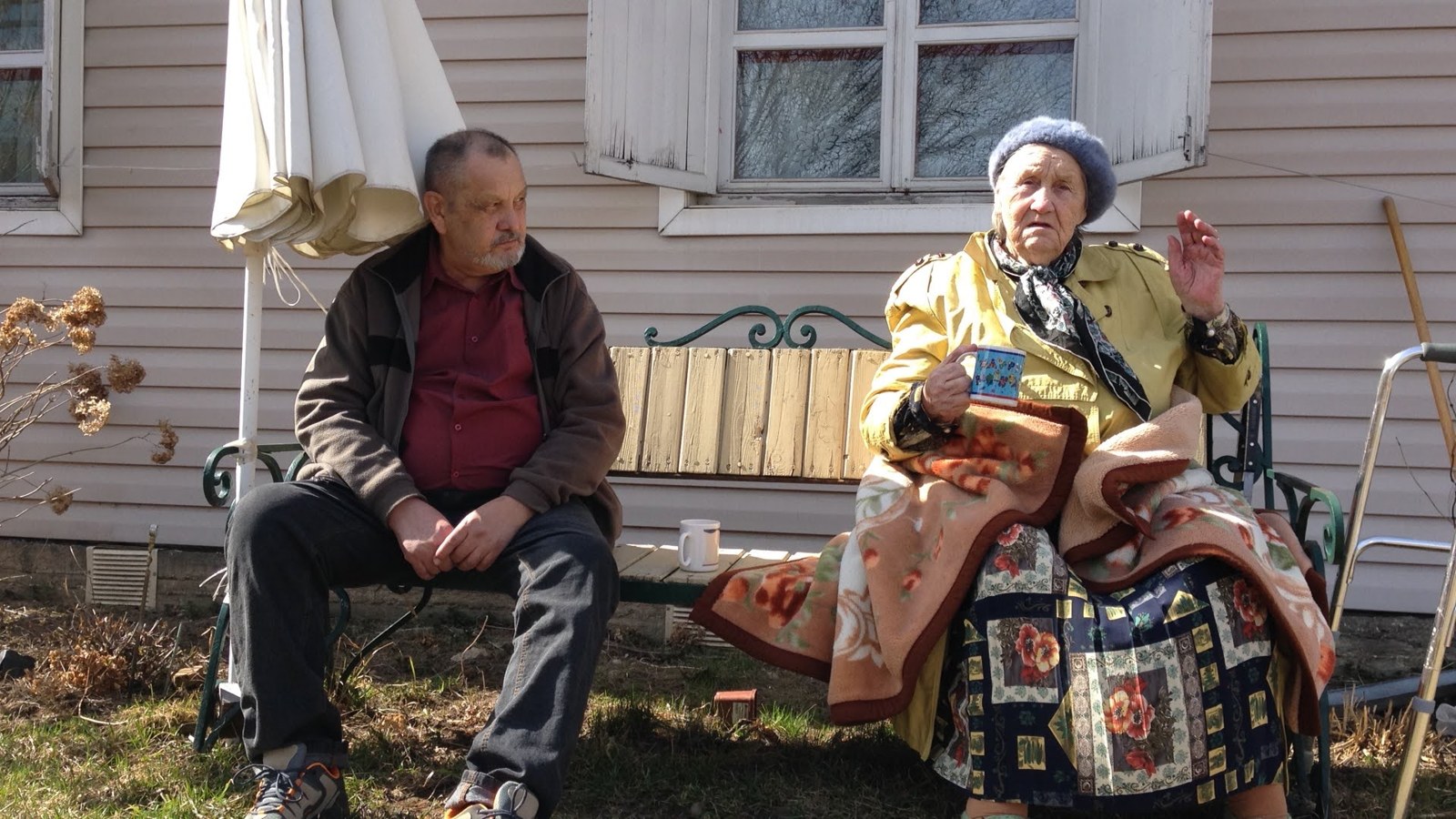
Valentina Alekseevna with her son Valery Sergeevich on a bench by the house in spring, in her old age (S38)
What we do not know yet
Date of birth. The 1926 extract gives 29 April, with the first digit corrected (S9); the duplicate certificate and the gravestone give 6 April (S232, S2). Perhaps the “29” came into the papers from the date the record was restored, 29 August 1942. Both dates are kept. The earlier birth year of 1924 in the tree was a mistake.
It is not yet known where Valentina spent the war, where and when she married, what the Lopasnya enterprise was called — in the work record book the name is hard to read (S236) — or whom her mother served in Petersburg. In the parish registers of the court church in Pavlovsk for 1907–1913, 1916 and 1917 no Fetisovs appear among the godparents. Valentina Alekseevna's stories about her father's fate and her mother's early death are not confirmed by documents either (S580).
Grigore Gheorghievich Călugăreanu
1 October 1913 — 17 April 2011
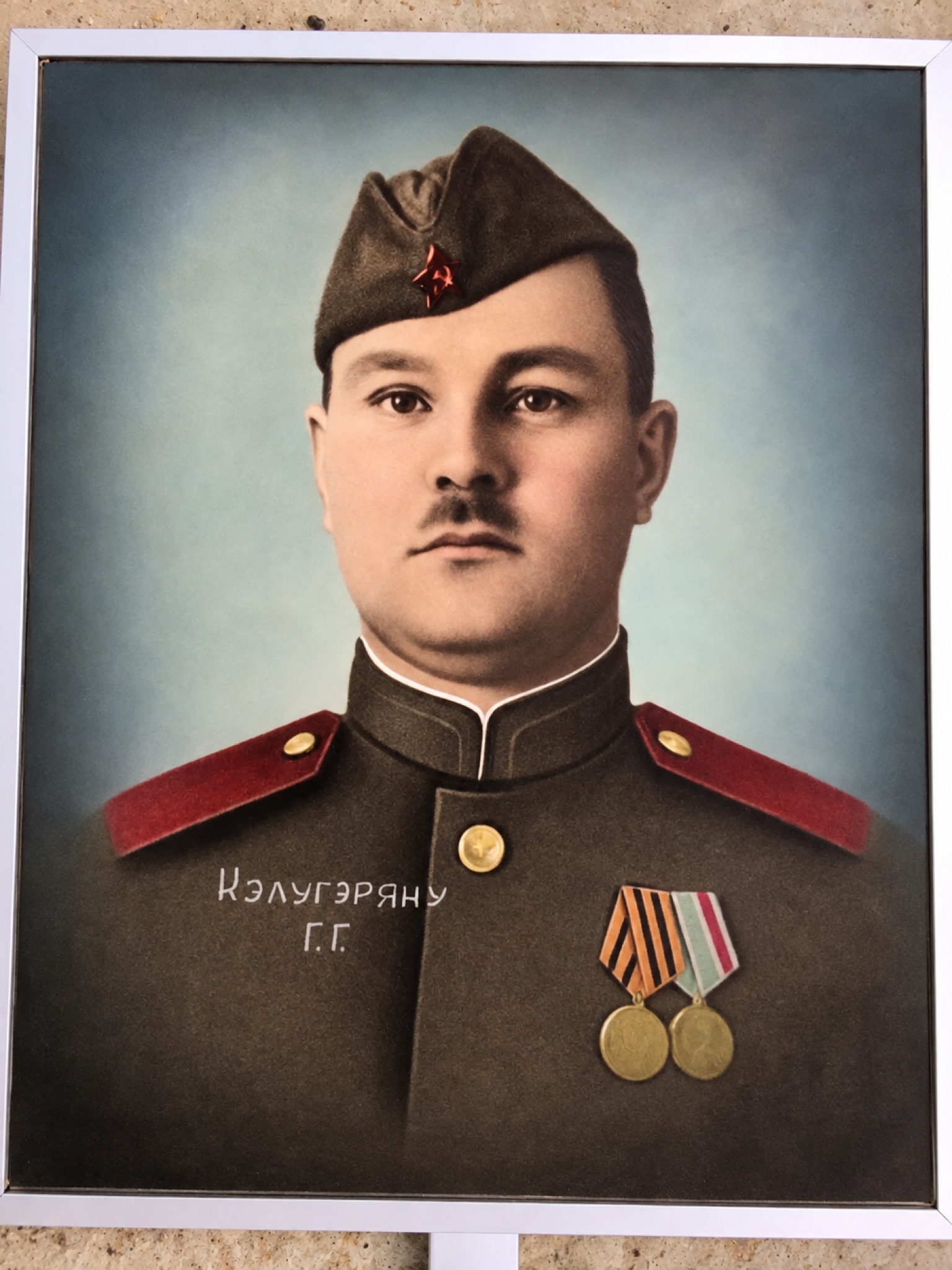
Hand-coloured post-war portrait signed “Călugăreanu G. G.”: forage cap with a star, shoulder boards, two medals, one of them “For the Victory over Germany”. Restored copy (S36)
Grigore Gheorghievich Călugăreanu is Igor's maternal grandfather. He lived for almost a hundred years in the Bessarabian village of Capaclia: born a subject of the Russian Empire, he grew up in Romania, went to war as a machine gunner at thirty-one, reached Berlin and came back to his native village, where he and Maria Ivanovna raised ten children.
Capaclia
Grigore was born on 1 October 1913 in Capaclia — so it is written in the marriage and death certificates (S6, S7). The village lies in the south of present-day Moldova, by the Codrii Tigheciului forests; at that time it was Izmail uezd of Bessarabia governorate. According to local tradition, răzeși — free peasants — settled here at the end of the 18th century (S85). The parishioners built the brick church of St Demetrius of Thessalonica with their own money in 1805 and renovated it in 1893 — so say the «Chișinău Diocesan Gazette» of 1908 and the diocesan yearbook of 1922 (S620, S614). According to the gazette, the village received the addition «Răzeși», meaning «landowners», when the local peasants were given land under Prince Cuza (S620).
Of Grigore's father only the name is known — Gheorghe, and that only from his son's patronymic. His mother's name has not survived. His daughter Ekaterina Grigorievna remembers a grandmother Natalia, but did not say on which side (S323). Grigore had brothers Pavel, Stepan and Gheorghe; Gheorghe went missing (S50). Pavel Gheorghievich, born in 1922, also from Capaclia, was a war veteran: in 1985, like Grigore, he received the Order of the Patriotic War, 2nd class (S630).
Grigore's childhood and youth fell in the years when Bessarabia, after 1918, was part of Romania. That is why his early documents are Romanian: the surname is spelled Călugăreanu, the village Capaclia, județul Cahul (S6).
Marriage
On 5 June 1938 Grigore married Maria Pleș, daughter of Ioan and Ecaterina Pleș, in the parish church of Capaclia (S6, S5). The groom was twenty-four, the bride seventeen. Their marriage is entry no. 4 in the parish register (S6). After the wedding both became Călugăreanu.
After that Bessarabia changed hands more than once: in 1940 it was annexed by the USSR, in the summer of 1941 it came under Romanian rule again, and in August 1944 the Red Army returned.
The war
In September 1944 the thirty-year-old Grigore was called up by the Baimaclia district military commissariat (S15). He became a machine-gunner in the 2nd Machine-Gun Company of the 236th Guards Rifle Regiment, 74th Guards Rifle Division, 8th Guards Army. He was at the front from 14 January 1945 — from the first days of the great offensive from the Vistula to the Oder. On 4 February 1945 he was seriously wounded (S15). In those days his division was storming encircled Poznań — fighting there went on from late January until 23 February — so he was probably wounded near Poznań. For these battles his regiment received the honorary name «Poznań» (S474).
After hospital Grigore returned to his regiment and fought in Berlin. The award sheet for the medal “For Courage” describes the battle for the city: machine gunner Guards Private Kalugaryan, “moving in the infantry's battle order, reliably supported it with his machine-gun fire and killed up to 15 enemy soldiers and officers” (S15). The award order was signed on 15 October 1945. He also had the medal “For the Victory over Germany”, and in 1985 he received the Order of the Patriotic War, 2nd class (S15).
The award sheet also records his home address: his wife, “Kalugaryan Maria Ivanovna” (S15). This line is what shows that the document is about him. After the war a hand-coloured portrait was made: Grigore in a forage cap with a star and a tunic with shoulder boards, two medals on his chest, and below the signature “Călugăreanu G. G.” (S36).
Home and ten children
Grigore Gheorghievich lived in Capaclia all his life. He and Maria Ivanovna raised ten children: Ivan, Vladimir, Tamara, Stepan, Mikhail, Alexander, Natalia, Ekaterina, Georgy, called “Uncle Grisha” at home, and Lyubov. The order of their births has yet to be established; exact dates are known so far for Ekaterina, 28 March 1953 (S3), and for Stepan, born in 1960.
Post-war Moldavia went through the famine of 1946–1947 and the deportations of 1949. The documents do not yet say how these events affected the family (S101); the database of the repressed and deported lists no Călugăreanus from Capaclia (S16).
His daughter Ekaterina married in Russia: on 5 April 1981 she registered her marriage to Valery Melnikov (S4), and they had Igor and Vladimir. Valery apparently visited Capaclia: a photograph from the 1970s–1980s shows him with Ekaterina's brothers Ivan and Vladimir among grapevines, probably there (S267).
Old age
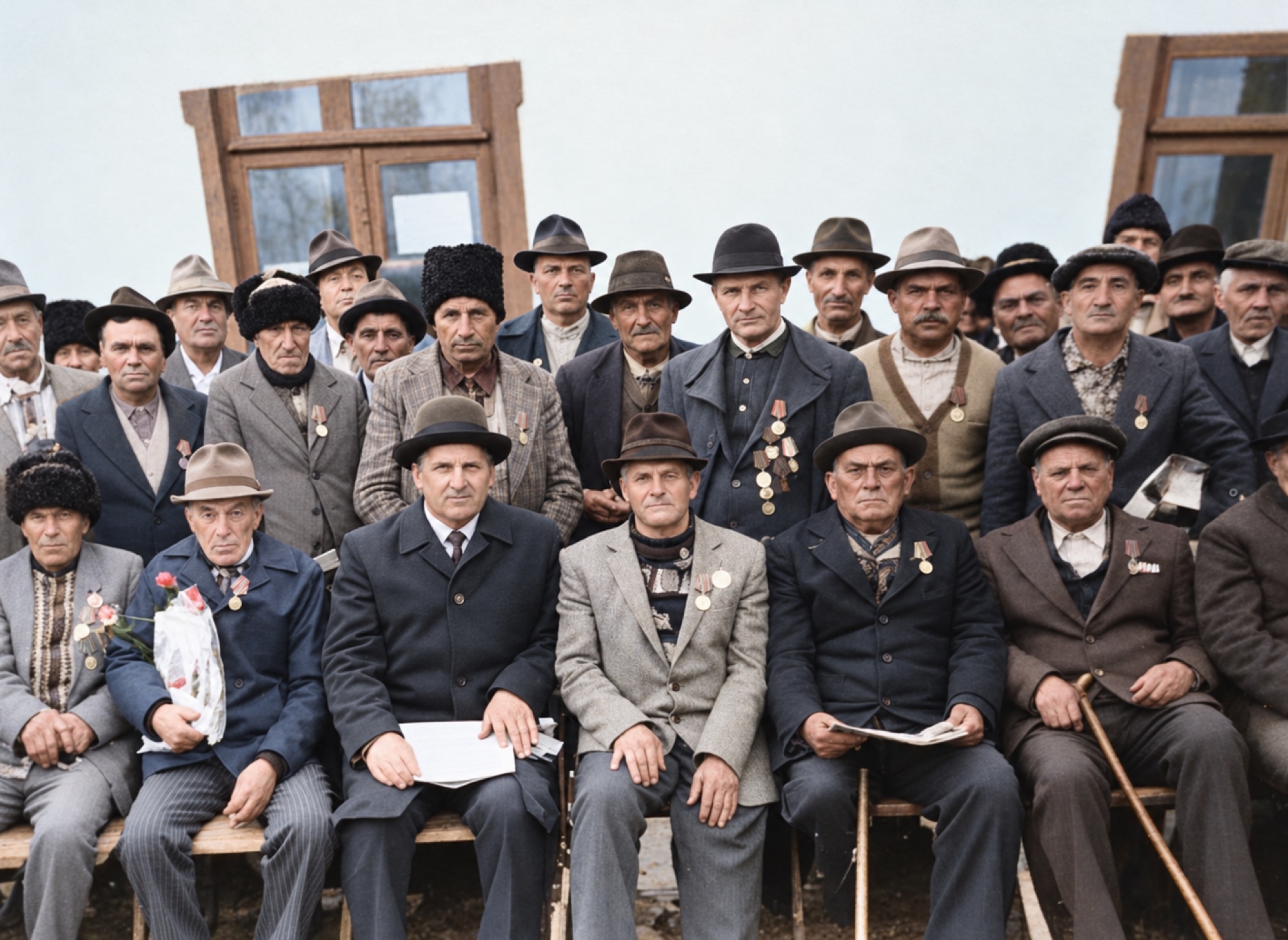
In a photograph from the 1970s–1980s Grigore Gheorghievich stands in the middle of a group of elderly men in coats and hats; many wear medals and badges, so it is apparently a meeting of war veterans. The place and year are not noted. The copy has been processed by a neural network, so small facial details may have changed (S172).
Grigore Gheorghievich (centre) with war veterans, probably 1970s–1980s. Restored copy (S172)
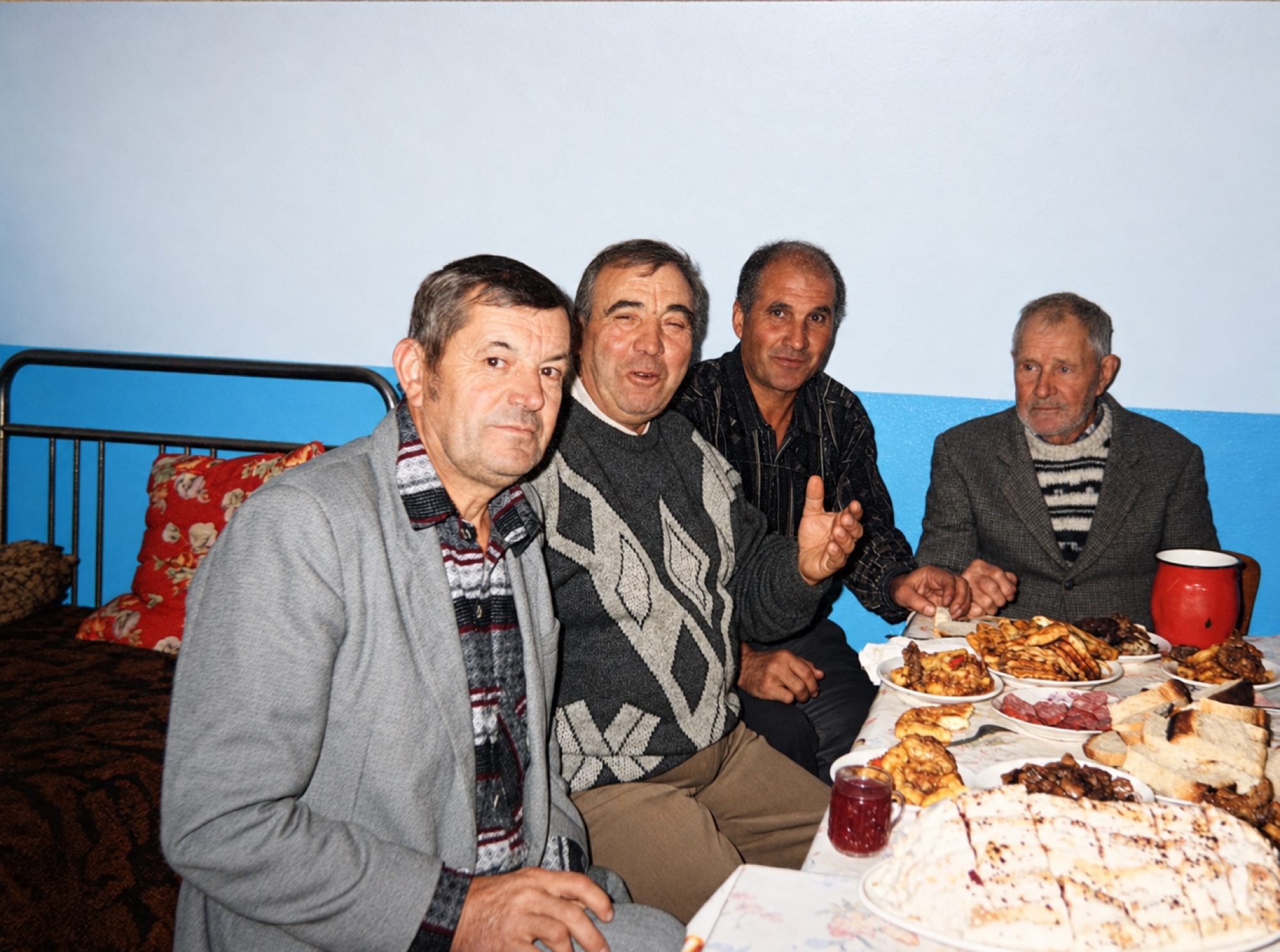
There is also a colour photograph from the 1990s: Grigore Gheorghievich at a festive table with pies, with his sons Vladimir and Georgy and his son-in-law Dmitry, the husband of his daughter Lyuba (S432).
At a festive table: Vladimir Călugăreanu, Uncle Grisha (Georgy Grigorievich), Dmitry, the husband of Aunt Lyuba, and Grigore Gheorghievich, 1990s. Restored copy (S432)
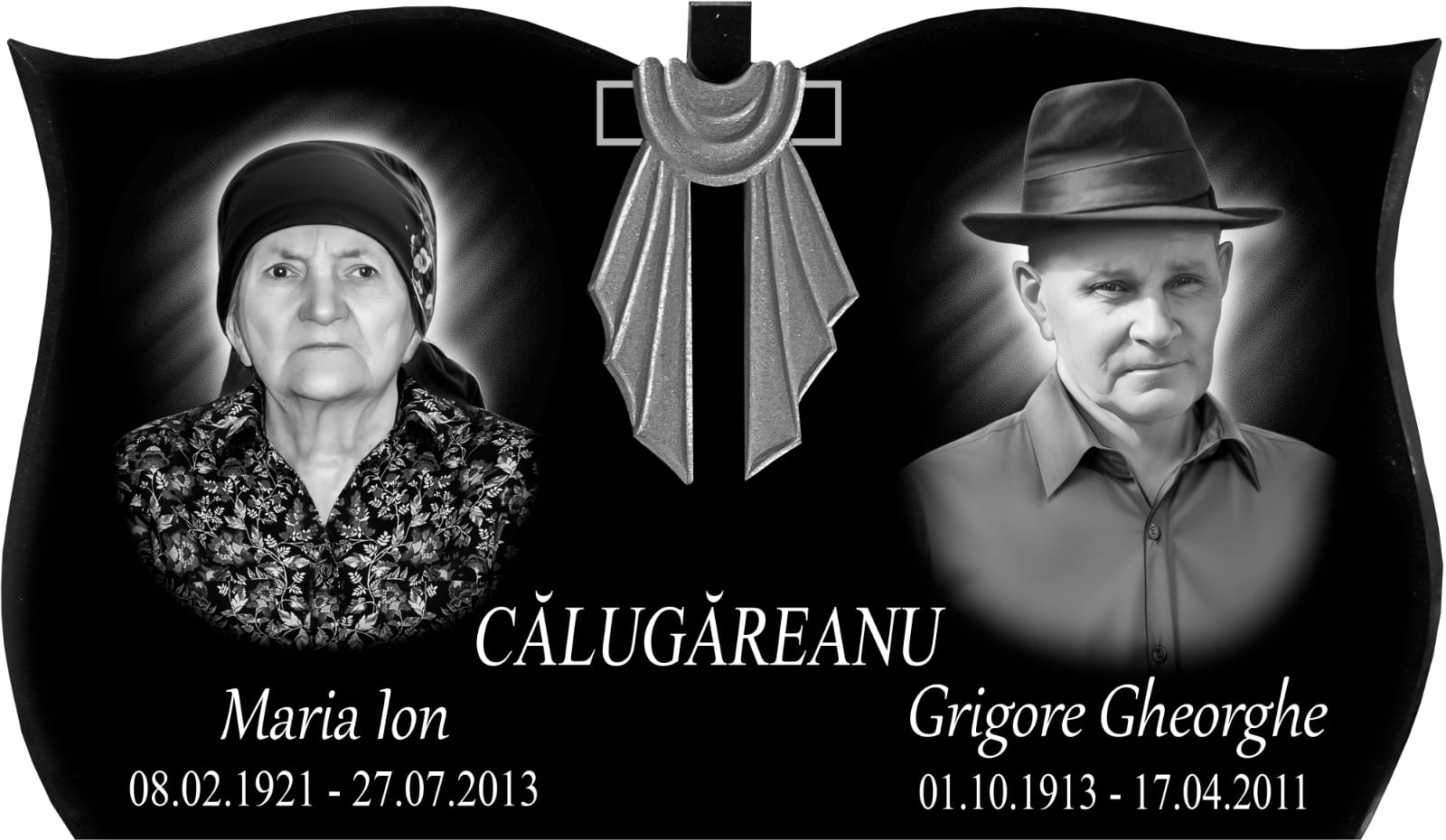
Grigore Gheorghievich died in Capaclia on 17 April 2011, in his ninety-eighth year (S7). Maria Ivanovna outlived him by two years. They are buried together in Capaclia. The shared slab with a cross and portraits reads “Grigore Gheorghe 01.10.1913 – 17.04.2011”: by Romanian custom the father's name follows the person's own (S177).
Shared gravestone of Maria Ivanovna and Grigore Gheorghievich in Capaclia (S177)
How the surname is spelled
In Russian the tree uses the Moldovan Cyrillic spelling (transliterated Kelugeryanu), as his portrait is signed (S36) and as the surname is spelled in the 2002 dissertation abstract of Natalia Vladimirovna Călugăreanu (S149). The Romanian original is Călugăreanu (S6, S7), Soviet military documents have “Kalugaryan” (S15), and his daughter Ekaterina's papers have “Kalugoryanu” (S3, S4).
What we do not know yet
Year of birth. The family used to say 1911, but the marriage and death certificates and the gravestone give 1913 (S6, S7, S177).
Parents. The names of his parents have not yet been found in documents; the patronymic Gheorghievich tells only his father's first name. The 1913 birth record should be sought in the Capaclia parish registers at the National Archives of Moldova.
A brother missing in action. The Moldovan «Book of Memory» lists among the natives of Capaclia Ion Gheorghievich Călugăreanu, born in 1911, missing in action in March 1945 (S304). By his patronymic he may be Grigore's brother — perhaps the very one the family remembers as the missing Gheorghe, or perhaps yet another brother. Ion Gheorghievich stands in the tree for now as a probable brother. No records of him were found in «Road of Memory» or in «Memory of the People».
Where he was wounded. That Grigore Gheorghievich was wounded near Poznań is a conclusion drawn from his division's combat path; the award sheet does not name the place.
Maria Ivanovna Călugăreanu (née Pleș)
8 February 1921 — 27 July 2013
Portrait of Maria Ivanovna from her gravestone in Capaclia; there are no other photos of her in the family archive yet (S177)
Maria Ivanovna Călugăreanu, née Pleș, is Igor's maternal grandmother. She was born in Capaclia and lived there all her life: at seventeen she married Grigore Călugăreanu, and together they raised ten children.
The Pleș family
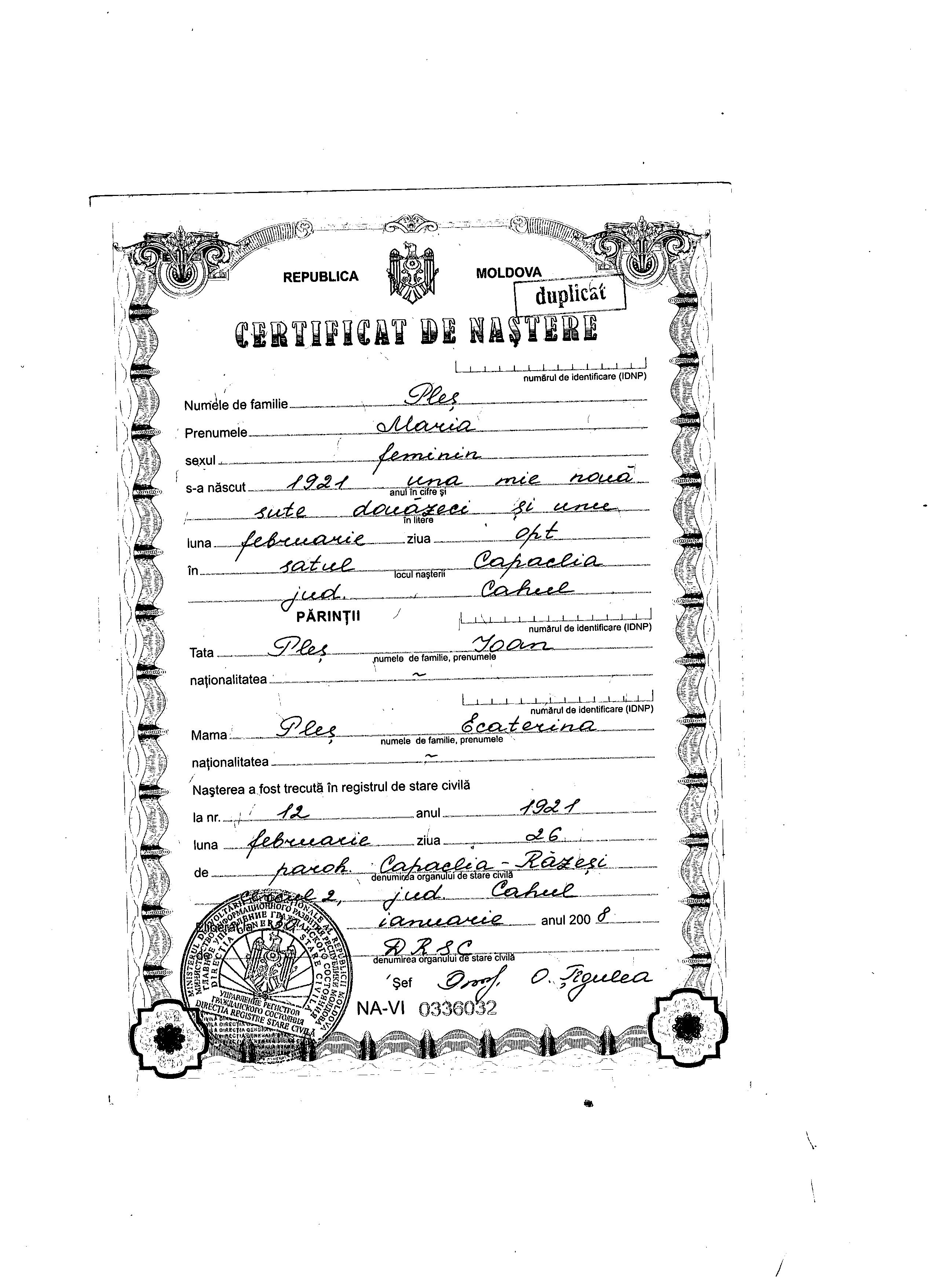
Maria was born on 8 February 1921 in Capaclia; at that time the village belonged to județul Cahul in Romania (S5). Her birth certificate records her parents as Pleș Ioan and Pleș Ecaterina, that is Ioan and Ecaterina Pleș (S5). Her mother's maiden name is not given in the document.
Birth certificate of Maria Pleș: 8 February 1921, Capaclia, parents Ioan and Ecaterina Pleș (S5)
At home the surname was pronounced “Pleșu”, as Maria's daughter Ekaterina Grigorievna remembers (S1). This is a common Romanian form of the same surname, so both should be searched for in the archives.
Her granddaughter Ekaterina Grigorievna tells about Maria's father: Ivan Pleș built mills all over Moldova and was a wealthy man, but later the family was dekulakised. They lived in the village of Sadâc, now in Cantemir district, not far from Capaclia (S323). Documents do not yet confirm this story. In the history of Sadâc compiled from archival files, there are no Pleș either among those given land in 1922 or among the householders of 1942, and between the wars the village had no mill — only an oil press (S588). According to a Romanian directory of 1923–1924, the only steam mill in Capaclia belonged to Dumitru Băcăianu, and it names no Pleș in the whole of Cahul county (S600). There are no Pleș in the catalogue of the repressed of Cantemir district either — apparently, if the farm was taken away, it was without deportation.
Maria had brothers Nikolai, Ivan and Vladimir and a sister, Elena (S50). Two of the brothers were fighting in 1945. Nikolai Ivanovich Pleș, born 1918, a private, was wounded and on 21 April 1945 discharged from an evacuation hospital back to his unit. Vladimir Ivanovich, born 1925, a Red Army soldier of the 287th Rifle Regiment, 51st Rifle Division, was also wounded and on 19 May 1945 returned from a field hospital to his unit (S325). Her sister Elena, as the family remembers, died of cold on her way home.
Where the Pleș family came from can so far only be guessed. In the 1850 revision list for the settlement of Porumbești, a few kilometres from Capaclia, twelve Pleș households are recorded (S326), and in neighbouring Cociulia in 1835 and 1850 there lived Pleș — Ilie, Apostol, Vasile, Nicolae and Dimitrie Petrovich with their families (S408, S409). In neighbouring Lărguța the children of Nicolae Pleș were baptised in 1901 and 1904 (S599). Which of them was a direct ancestor of Ivan Pleș is unknown.
Marriage
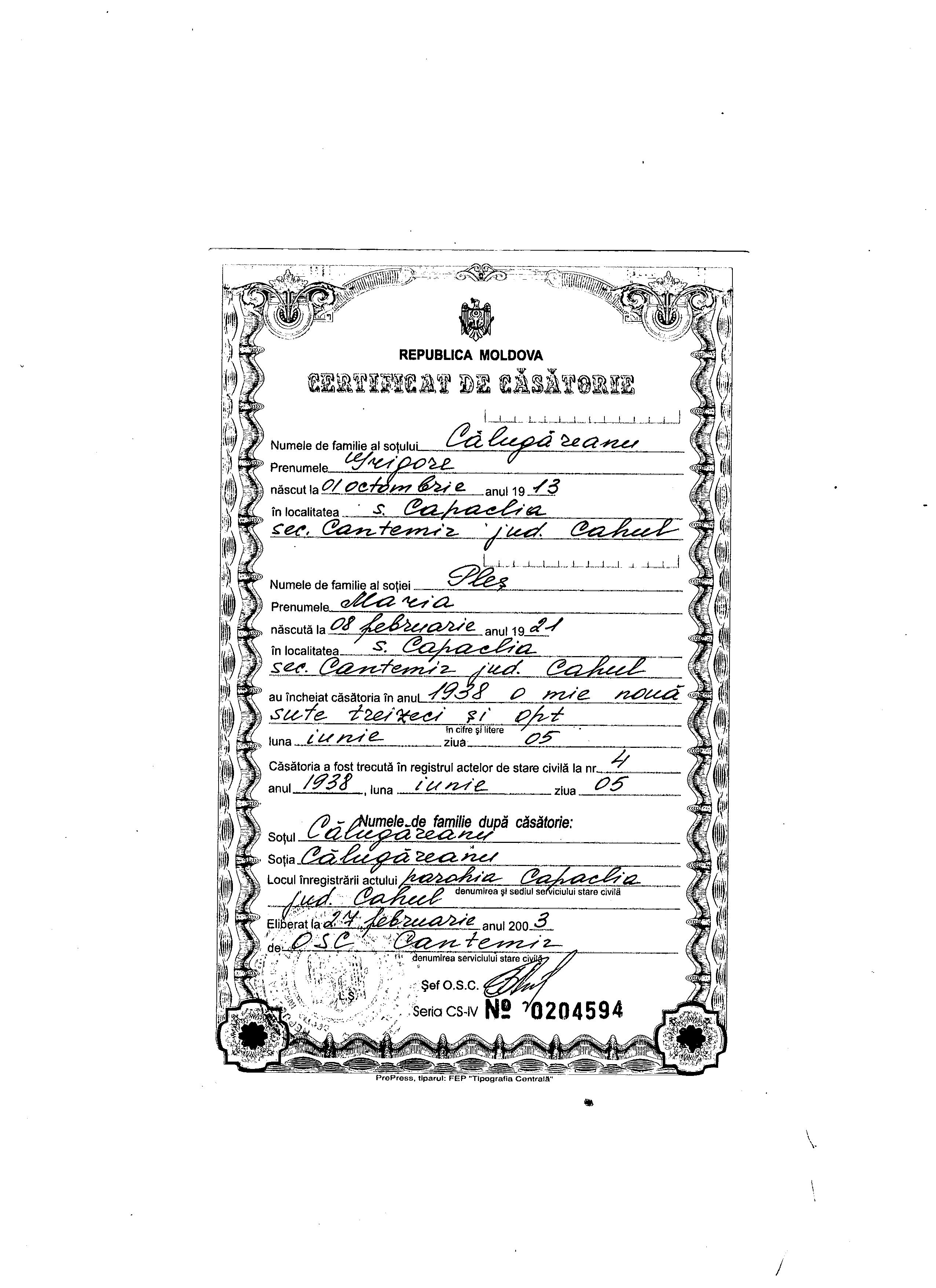
On 5 June 1938 seventeen-year-old Maria married Grigore Călugăreanu, who was twenty-four, in the parish church of Capaclia (S6). From that day she was Călugăreanu; later Russian documents spelled her surname “Kalugaryan”, “Kalugoryanu” and “Kelugeryanu”.
Marriage certificate of Grigore Călugăreanu and Maria Pleș, married on 5 June 1938 in Capaclia (S6)
Maria's youth fell in the years when Bessarabia changed hands: in 1940 it was annexed by the USSR, in the summer of 1941 it came under Romanian rule again, and in August 1944 the Red Army returned. In September 1944 Grigore was called up into the army. His 1945 award sheet gives her as his home address: “Kalugaryan Maria Ivanovna” (S15). Grigore was severely wounded, fought in Berlin after hospital and came back to Capaclia.
Ten children
Maria Ivanovna and Grigore Gheorghievich raised ten children: Ivan, Vladimir, Tamara, Stepan, Mikhail, Alexander, Natalia, Ekaterina, Georgy and Lyubov. When Ekaterina, Igor's mother, was born on 28 March 1953, Maria was thirty-two (S3). Stepan was born in 1960, when she was thirty-nine. The birth order of the other children has not yet been established.
Today the Călugăreanus are a large family: a recent photograph shows about forty people of all ages, from babies to the elderly, gathered on a summer evening in a yard under a big tree (S174).
Last years
Grigore Gheorghievich died in 2011, and Maria Ivanovna outlived him by two years. She died on 27 July 2013, in her ninety-third year (S177), and is buried in Capaclia together with her husband. On the shared slab she is named “Maria Ion 08.02.1921 – 27.07.2013”: in Romanian the father's name follows the person's own, so this means “Maria, daughter of Ion”, that is, Maria Ivanovna (S177).
What we do not know yet
Year of birth. The family used to say 1914, but both the birth certificate and the marriage certificate give 1921 (S5, S6).
Parents. Her mother's maiden name is unknown. Where and when Ioan and Ecaterina married is also unknown: they are not in the marriage records of Capaclia-Răzeși and neighbouring Capaclia Nouă for 1905–1909 (S218). Ekaterina Grigorievna remembers that her grandmother was called Natalia (S323). If this means Maria's mother, it contradicts the birth certificate, where the mother is named Ecaterina (S5); perhaps Natalia was her paternal grandmother, the mother of Grigore Gheorghievich.
It is also unclear where the Pleș family lived and where Ivan Pleș's mills stood. According to the lists of inhabitants, there were no Pleș in Sadâc (S588), while Maria was born in Capaclia (S5) — that is most likely where to look. When the family's farm was taken away is not known either. If any relatives have photographs of Maria Ivanovna, the archive badly needs them.
Elena's grandparents
Yuri Dmitrievich Chebanov
1 October 1925 — 1971
Yuri Dmitrievich Chebanov — the photograph from his service record card in the «Memory of the People» database. He was recognised by Galina Pavlovna (S158).
The son of two doctors, born in Moscow and raised in the south, Yuri Dmitrievich went to war from Ashgabat and made it to Berlin. Later he became a doctor himself, lived in Ashgabat and became the father of Dmitry and Vadim — Elena's grandfather on her father's side.
Moscow, Yakimanka
Yuri was born on 1 October 1925 in Moscow. Many years later his grandson Dmitry found the record of his birth in an archive (S162). It names the parents as Dmitry and Anna Chebanov, the father aged 34 and the mother 27. The family lived on Bolshaya Yakimanka street, house 40, flat 4. Yuri was his parents' first child. The birth was registered by his father, who signed it himself: «D. Chebanov». The parents' occupations are hard to read; tentatively they read as «student» and «medical assistant» (S181).
His father, Dmitry Gerasimovich, was no longer young: he was in his thirty-fifth year. A family inscription on the back of an old photograph calls him a native of the Cossack stanitsa of Ishcherskaya on the Terek and a graduate of the First Medical Institute in Moscow (S183, S185); the same is written on the back of a 1944 photograph (S672). He became a doctor — an otorhinolaryngologist and candidate of medical sciences; the family remembers him as «the ear-nose-and-throat professor» (S162). His mother, Anna Vasilievna, née Kondratieva, also graduated from a medical institute — which one is hard to read on the back of the photograph (S183, S185).
Where Yuri spent his childhood can be traced from documents only in outline. His earliest photograph shows a one-year-old toddler by a wicker chair, marked «Yu. Ch.» (S684). In 1929 the family was photographed in Grozny — that is how their group portrait is inscribed (S183). In 1930–1935 Dmitry Gerasimovich did ENT work in Tajikistan: in 1939 «D. G. Chebanov» published an article about it, and another article the same year already in the journal «Soviet Health Care of Turkmenia» (S595). So by the late 1930s the family lived in Turkmenia, in Ashgabat, where the war found the Chebanovs. From those years there is a childhood photograph of Yura inscribed «In memory to Rimma and Seva from Yura. Yu. Chebanov» (S664); Rimma is apparently his cousin.
The war
In December 1942 the Ashgabat military commissariat called up Dmitry Gerasimovich. He headed the ENT department of an evacuation hospital and stayed with it until the end of the war, received the Order of the Red Star and finished his service as a major of the medical service (S364). In April 1944 he was photographed in Dnipropetrovsk at the courses for otolaryngologists that he taught for front-line doctors (S672, S364).
Yuri was called up a few months later, in 1943, also from Ashgabat. He was seventeen. According to his service record card, he served from February 1943 to March 1948, in units abbreviated on the card as «34 avtop» and «227 OSKB». He finished his service as a senior lieutenant of the medical service. His decorations were the medals «For the Capture of Berlin» and «For the Victory over Germany» (S158). The same database has another entry: Private Yuri Dmitrievich Chebanov, called up in 1943 by the Ashgabat district military office, served in the 206th front reserve rifle regiment and on 18 July 1946 left for the Northern Group of Forces. Most likely this is the same man: the name, patronymic and year match. The originals have not yet been compared (S158).
On 1 December 1943 Yuri signed a photograph of himself in a soldier's greatcoat and fur hat: «… from Yuri. Balakhna, Gorky region» (S669). So at the end of 1943, a few months after being called up, he was in Balakhna near Gorky.
Yuri Chebanov, Balakhna, Gorky region, 1 December 1943 (S669).
The family says that Yuri «made it to Berlin» and was wounded or shell-shocked in the war (S157). The medal «For the Capture of Berlin» confirms these words. There are no documents about a wound yet.
1948
In March 1948 Yuri Dmitrievich finished his service. And on the night of 6 October of the same year Ashgabat was destroyed by an earthquake — one of the most terrible in the country's history: the city was almost entirely reduced to ruins, and tens of thousands of people died (S167). According to the family story, both his parents, Dmitry Gerasimovich and Anna Vasilievna, died that night (S157, S162). Yuri was twenty-three. The family has not yet received any documents about his parents' deaths, and the date of their death — 6 October 1948 — is inferred from the day of the earthquake. A photograph of ruined Ashgabat has survived in the family album (S673).
Ashgabat: family and sons
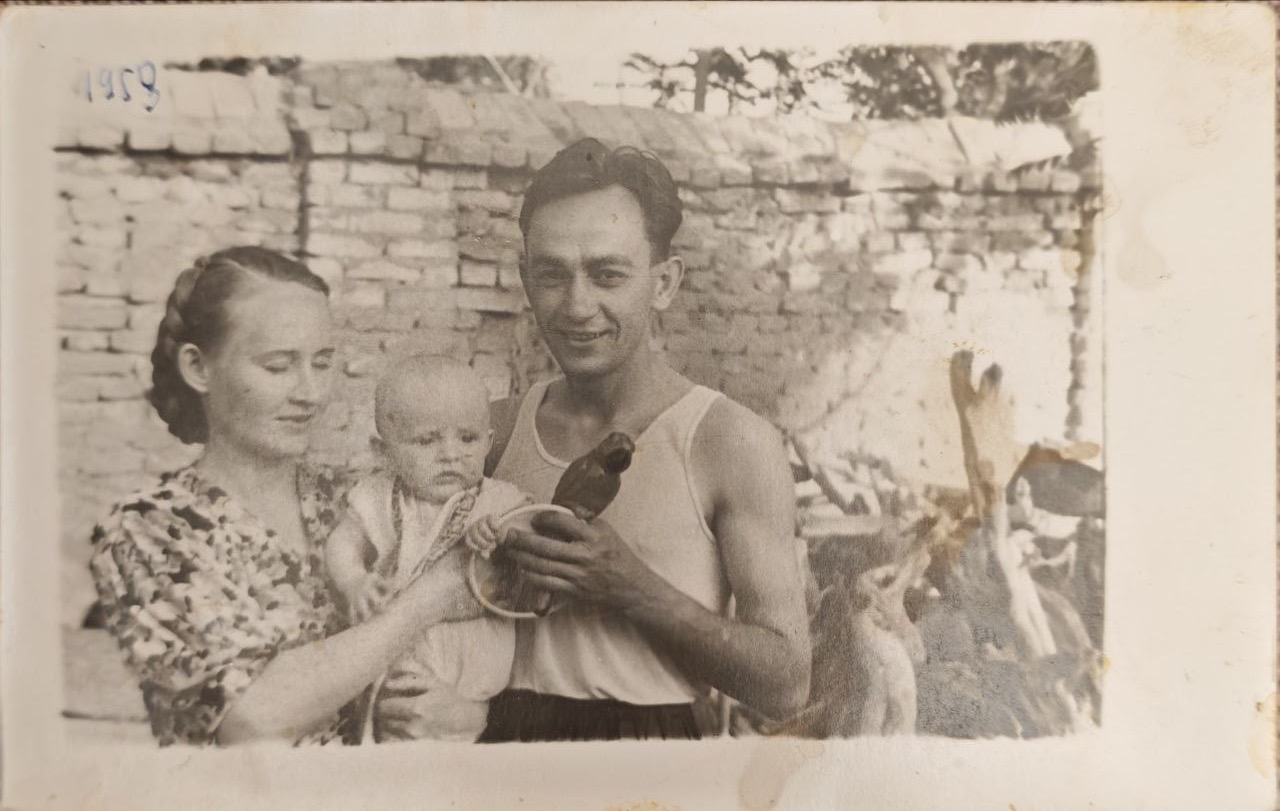
Yuri Dmitrievich stayed in Ashgabat. There he married Lyudmila Petrovna Zamyatina, daughter of Pyotr Petrovich Zamyatin. Both were medical professionals (S157). They had two sons: Dmitry, born on 22 November 1952, and Vadim, Elena's father, born on 19 July 1958. In Vadim's birth certificate Yuri Dmitrievich is recorded as the father, and the mother under her maiden name, Zamyatina (S686): apparently the marriage was not registered, or Lyudmila Petrovna did not change her name. There is also a 1958 photograph of Yuri and Lyudmila with a baby — probably Vadim (S674).
The marriage broke up when the sons were small (S141). Lyudmila Petrovna recalled that after the divorce the boys used to visit their father's new family (S416). Around 1964 she took them away from Ashgabat — first to Solnechnogorsk, then to Norilsk (S420). The sons grew up in their stepfather's family but remained Chebanovs.
In Ashgabat Yuri Dmitrievich had a cousin — Rimma Timofeevna Gerasimenko, wife of the war veteran Yuri Pavlovich, «Aunt Rimma» to Vadim (S157, S419). The family album also has photographs from the 1950s with elderly female relatives whom no one has yet identified: Yuri is pictured with «Granny Nonya» (S681), and in 1954 Lyudmila Petrovna and little Dima were probably visiting «Granny Lyalya» in Grozny (S676).
A second family and the «Circle»
After the divorce Yuri Dmitrievich married Irina Iosifovna Chernobay, a translator from English. They had a son, Alexei Yurievich (S419). Irina Iosifovna lived in Ashgabat and died there in the spring of 2016 (S418). After the deaths of his mother and Aunt Rimma, Alexei moved to the Moscow region and lives in Shchyolkovo (S419). Elena remembers him at Uncle Dima's birthday party: «he looked very much like Dad, but Dad did not keep in touch with him» (S416).
Irina Iosifovna and her husband are mentioned in the magazine «Stsena» in 2022. In the 1960s a creative group of «writers and artists» met in Ashgabat — the «Circle», or LOBZIKhIM. Its members included Renat Ismailov, the artist Stanislav Babikov, «the doctor Yuri Chebanov» and the translator Irina Chernobay, who became the prototype for the heroines of several of Babikov's paintings. In the magazine's name index he is called «Chernobay's husband» (S418, S159). The name, city, profession and time match, so this is probably Yuri Dmitrievich.
How many times he was married, the family tells differently. Lyudmila Petrovna told Galina Pavlovna that she was Yuri's second wife and that after her he had a third (S417). Dmitry Yurievich calls Irina Iosifovna his father's second wife (S419) — apparently counting from his own mother. Nothing is known about a first marriage of Yuri's, if there was one.
A hygienist
The family does not know for certain what Yuri Dmitrievich did in medicine. But in Ashgabat there was a man with exactly the same name — the hygienist Yuri Dmitrievich Chebanov. The 1984 encyclopedia «Turkmen SSR» says that in 1955–1959, together with A. P. Rusyaev, he studied the occupational hygiene of carpet weavers and the hygiene of dwellings, and in 1964–1967, with L. I. Avanesova and E. B. Fridman, the health of workers who used pesticides (S405).
There are also his works (S513). In the journal «Health Care of Turkmenistan» for 1962 (according to another bibliography, 1963) an article on housing construction in a hot climate came out, written together with B. G. Bagirov and Kh. I. Kuliev. In 1966 a methodological letter on pesticides and occupational hygiene compiled by him and a handbook for practising doctors, «Occupational Hygiene in Hand Carpet Weaving», were printed in Ashgabat. The first name, patronymic, medical profession and Turkmenia all match. The books say nothing about his birth or family, so for now this is «possibly him».
What we do not yet know
When Yuri Dmitrievich died is not known exactly. The year 1971 appears only on an «Immortal Regiment» card on the «Road of Memory» site, entered probably by a relative; it also has his later portrait, rephotographed from print (S560). There is no death document, and where he is buried is also unknown. Neither his wound or concussion nor his parents' death in the earthquake is confirmed by documents. The child in the «Grozny, 1929» portrait is possibly Yuri: Elena thinks so, but his name is not on the back (S183, S185). The doctor from the «Circle» and the hygienist from the encyclopedia are probably him, but there is no direct document. It is also unclear whether he had a marriage before Lyudmila Petrovna.
There is also an older family mystery. The reference book «Officers of the Russian Imperial Army» tells of a Cossack of the stanitsa of Ishcherskaya, Dmitry Gerasimovich Chebanov, born in 1891 — an ensign in the First World War and later an officer of the Don Army in the Civil War. The name, stanitsa and year of birth match Yuri's father, but there is no document naming the White officer and the army doctor as one person. If they are the same man, it is clear why Dmitry Gerasimovich's past was not talked about in the family. More in the card of Dmitry Gerasimovich.
Lyudmila Petrovna Egorova (Zamyatina, Chebanova)
15 October 1929 — 5 November 2024
Lyudmila Petrovna around 1960 in Firyuza near Ashgabat — detail of a family photo with her sister Olga and son Vadim. Restored copy, colours are conjectural (S592)
A general practitioner from the Zamyatin family of Ashgabat, Grandma Mila to her grandchildren. After her divorce she took her two sons from Ashgabat beyond the Arctic Circle, to Norilsk, and towards the end of her long life she settled in Strunino near Vladimir.
The Zamyatin family
Lyudmila Petrovna was born on 15 October 1929 in Ashgabat; the entry at the Ashgabat registry office was made on 1 November (S591). Her maiden name was Zamyatina (S71, S141, S591). Her father, Pyotr Petrovich Zamyatin, was born in 1907 in Kyiv (S395) — as his daughter later wrote, «in the house of his grandmother — Gelena Kotlyarevskaya-Kubekova» (S668). Her mother was Antonina Efimovna, née Funtikova (S591, S663, S688). The Zamyatins long lived in Ashgabat at 3 Divizionny Lane, then on Kalinin Street (S688). Besides Lyudmila, three more children grew up in the family: Olga, Veronika and Igor, born in 1939 (S157, S678).
In 1948 Lyudmila finished the tenth grade of Ashgabat Secondary School No. 1: the 1947–1948 graduation album has her portrait signed «Zamyatina L.» (S665). A few months later, on 6 October 1948, the city was destroyed by the earthquake.
All three Zamyatin sisters became doctors. Lyudmila Petrovna was a general practitioner, Olga Petrovna a cardiologist, Veronika Petrovna a dermatovenereologist. Their brother Igor Petrovich was not a medic; Galina Pavlovna thinks he was an engineer or a geologist (S411). In the 1990s Olga and her family moved to Tuapse, Veronika stayed in Ashgabat, and Igor left for Petropavlovsk-Kamchatsky (S157).
Olga Petrovna and Yuri Mirakov had three sons — Oleg, Petya and Samvel. Veronika Petrovna had a daughter, Larisa; while still a student she married a Hungarian, Imre, and after graduating left with him for Hungary. Igor Petrovich, according to Galina Pavlovna, had a wife, Lena, and a son, probably Nikita (S157). So over time the Zamyatin family of Ashgabat scattered from Kamchatka to Hungary.
Pyotr Petrovich did not serve in the war: according to his grandson Dmitry, he had lost an eye (S171). According to the same grandson, he lived «a long and happy life» with Antonina Efimovna (S688). He lived until the mid-1980s and died at Lyudmila Petrovna's home in Strunino (S170).
The countess grandmother
Lyudmila Petrovna used to say that her grandmother had been a countess (S70). Galina Pavlovna treats this with caution: «She may well have made up the countess; all her life she was inclined to exaggerate» (S141). There is indeed no comital family of Zamyatins in the armorials.
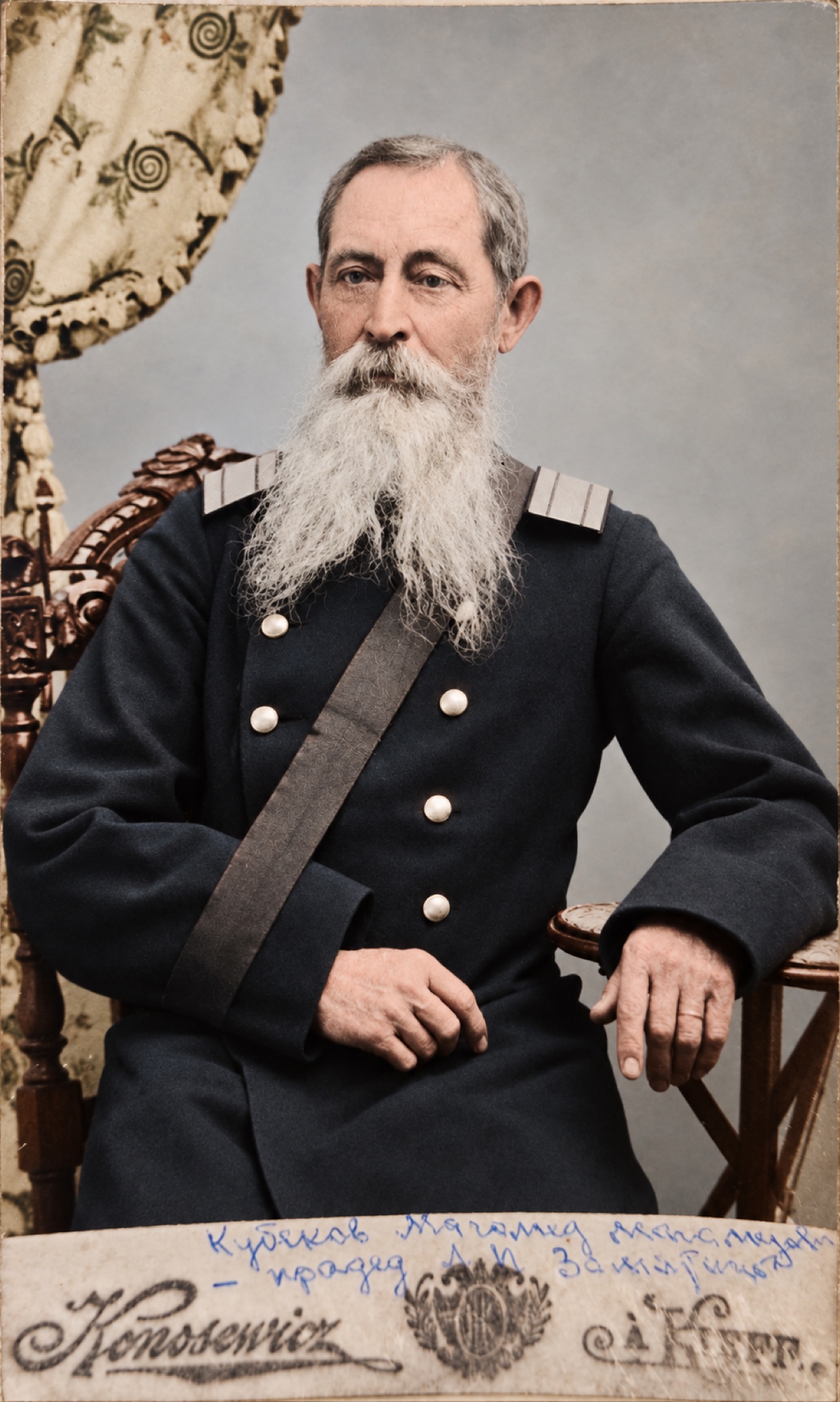
And yet there seems to be something behind the legend. Pyotr Petrovich's 1907 birth record names his mother as Vera Alexandrovna, and his godparents as retired major Prince Alexander Nikolaevich Kubekov and Princess Maria Alexandrovna Kubekova (S395). According to Elena, Vera Alexandrovna Kubekova was the grandmother of «Granny Mila» (S143). The family keeps Vera Alexandrovna's certificate of 1899 and a portrait of an elderly staff officer inscribed «Kubekov Magomed Magomedovich — great-grandfather of L. P. Zamyatina» (S142, S144). On the back of a second print of the same portrait, in the same handwriting as Lyudmila Petrovna's inscriptions on her grandfather's portraits, is written: «Kubekov Magomed Magomedovich, baptised Alexander… My grandmother's father» (S660, S689). Princes, not counts — but perhaps it was this noble kin that the family remembered.
A similar discrepancy appears in other inscriptions. On the back of a portrait of her grandfather, Pyotr Petrovich Zamyatin senior, Lyudmila Petrovna wrote that he was a «state councillor» (S658, S689). According to official directories he was an investigating magistrate for especially important cases in Vladikavkaz and rose to the rank of court councillor — two classes lower (S597, S622). In her hand, too, it is written that her grandfather died on 2 January 1945 in Ashgabat (S659).
A portrait from Konoshevich's studio in Kyiv with a later inscription: «Kubekov Magomed Magomedovich — great-grandfather of L. P. Zamyatina». From the family archive of the Chebanovs and Zamyatins (S144).
Ashgabat: marriage and sons
In Ashgabat Lyudmila Petrovna married Yuri Dmitrievich Chebanov, a war veteran and also a medical man (S157). Yuri Dmitrievich's parents, both doctors, according to the family story died in the Ashgabat earthquake of 1948 (S162). Lyudmila Petrovna and Yuri Dmitrievich had two sons, both born in Ashgabat: Dmitry in November 1952 and Vadim, Elena's father, on 19 July 1958 (S157, S686). In Vadim's birth certificate she is recorded under her maiden name, Zamyatina (S686): apparently her marriage to Yuri Dmitrievich was not registered, or she did not change her name.
Lyudmila Petrovna and Yuri Dmitrievich with a baby, 1958; judging by the year, probably Vadim (S674).
The marriage broke up when the sons were small (S141). Lyudmila Petrovna herself told Galina Pavlovna that she had been Yuri's second wife, and that after their divorce he had a third (S417). According to Grandma Mila's story, which Elena remembers, after the divorce the sons used to visit their father's new family (S416).
Solnechnogorsk and Norilsk
Around 1964, when Dmitry had finished the fourth grade, Lyudmila Petrovna left Ashgabat with her sons. First they lived for about a year in Solnechnogorsk near Moscow, and around 1966 they moved to Norilsk. That is how Dmitry Yurievich remembers it, but he too notes that the dates should be checked against school certificates and photographs (S420).
Norilsk is a city beyond the Arctic Circle, built around a large mining and metallurgical works. Here on 27 October 1967 Lyudmila Petrovna registered her marriage to Viktor Alexandrovich Egorov, born in 1924 in the Bolshaya Murta district of Krasnoyarsk krai, and took his surname (S687). The sons did not take their stepfather's name and remained Chebanovs (S141). Both finished school in Norilsk (S157); Vadim's school portrait is inscribed «10th grade. School No. 10, Norilsk» (S667). Dmitry played drums and saxophone in the school band there (S210).
Ashgabat again, then Strunino
When their work in Norilsk came to an end, the Egorovs returned to Ashgabat. A few years later they moved to Strunino in the Vladimir region (S157). Her father, Pyotr Petrovich, came to visit Lyudmila Petrovna there. Galina Pavlovna saw him there herself. He died in Strunino, at the home of Lyudmila Petrovna and Viktor Alexandrovich; Olga, Veronika and Igor came and took the body to Ashgabat for burial. Elena was about three or four at the time (S170).
Her elder son, Dmitry, also lived in Strunino for a while: he moved there from Krasnoyarsk and married for the second time there (S157).
A long life
Lyudmila Petrovna died on 5 November 2024 (S156). She outlived her younger son: Vadim Yurievich died in January 2022. To her grandchildren she was «Granny Mila» (S143, S416). Much of what we know about the Chebanovs and Zamyatins comes from her stories, remembered by Elena and Galina Pavlovna: about the countess grandmother, about her marriages, about how her sons visited their father. She herself took up the family history: the first sheet of her handwritten essay on the Caucasian War and the Terek Cossacks has survived — apparently the beginning of a story about the Chebanovs from the stanitsa of Ishcherskaya (S685).
What we do not yet know
It is not known where she studied medicine or where she worked, exactly when she married Yuri Dmitrievich and when they divorced. The dates of the moves to Solnechnogorsk and Norilsk are preliminary (S420), although the marriage concluded in Norilsk in October 1967 (S687) agrees with them. Nor do we know where she died and is buried. The archive now has several photographs of Lyudmila Petrovna — with her sons, sisters and parents (S592, S674, S678, S682); if relatives have others, we will be glad to receive them.
The kinship with the Kubekovs looks convincing: Pyotr Petrovich's birth record, family inscriptions on portraits and Elena's words all agree on it (S395, S144, S660, S668). But no birth record of Vera Alexandrovna herself has been found yet. Why Lyudmila Petrovna called her grandmother a countess rather than a princess is unknown; we consider the countess legend unreliable.
Pavel Stepanovich Kamyshanov
12 July 1925 — 16 September 2001
Pavel Stepanovich in 1970. On the back: «1970. 50th anniversary of the GOELRO plan. Photo for the board of honour» (S426).
A boy from Novorossiysk whom the Germans deported to Ukraine together with his mother and brothers, he became a soldier at eighteen, was wounded in the chest and went through the war as a tank crewman. Then came fifty years in his home town: family, study by correspondence, the power industry and the board of honour.
Novorossiysk, a fitter's family
Pavel was born on 12 July 1925 in Novorossiysk (S348, S410). In her «Notes» Ekaterina Konstantinovna wrote briefly: «into a fitter's family» (S27). His father, Stepan Ignatievich Kamyshanov, grew up on the Don. His mother, Anastasia Mikhailovna, came from a peasant family in the Grodno region, in Western Belarus. Both came to Novorossiysk and married there (S27).
Pavel was the eldest of four sons. After him came Ivan, Leonid and Vladimir (S27, S28). Leonid, born in 1936, later became a research scientist at the Energia design bureau in Kaliningrad near Moscow, today's Korolyov. For Galina Pavlovna he is «of all the Kamyshanov brothers, the closest person after Dad».
Before the war Pavel managed to finish nine grades of school (S27, S52).
Deportation
In 1942 the war reached Novorossiysk, and the fighting for the city lasted more than a year — it was liberated only in September 1943. The Germans deported Anastasia Mikhailovna and her sons to Ukraine, and Stepan Ignatievich too (S27). The family ended up in the village of Staraya Mayachka in Tsyurupinsk district, in southern Ukraine: this address of his mother was later written in the certificate of Pavel's wound (S52).
The front and the wound
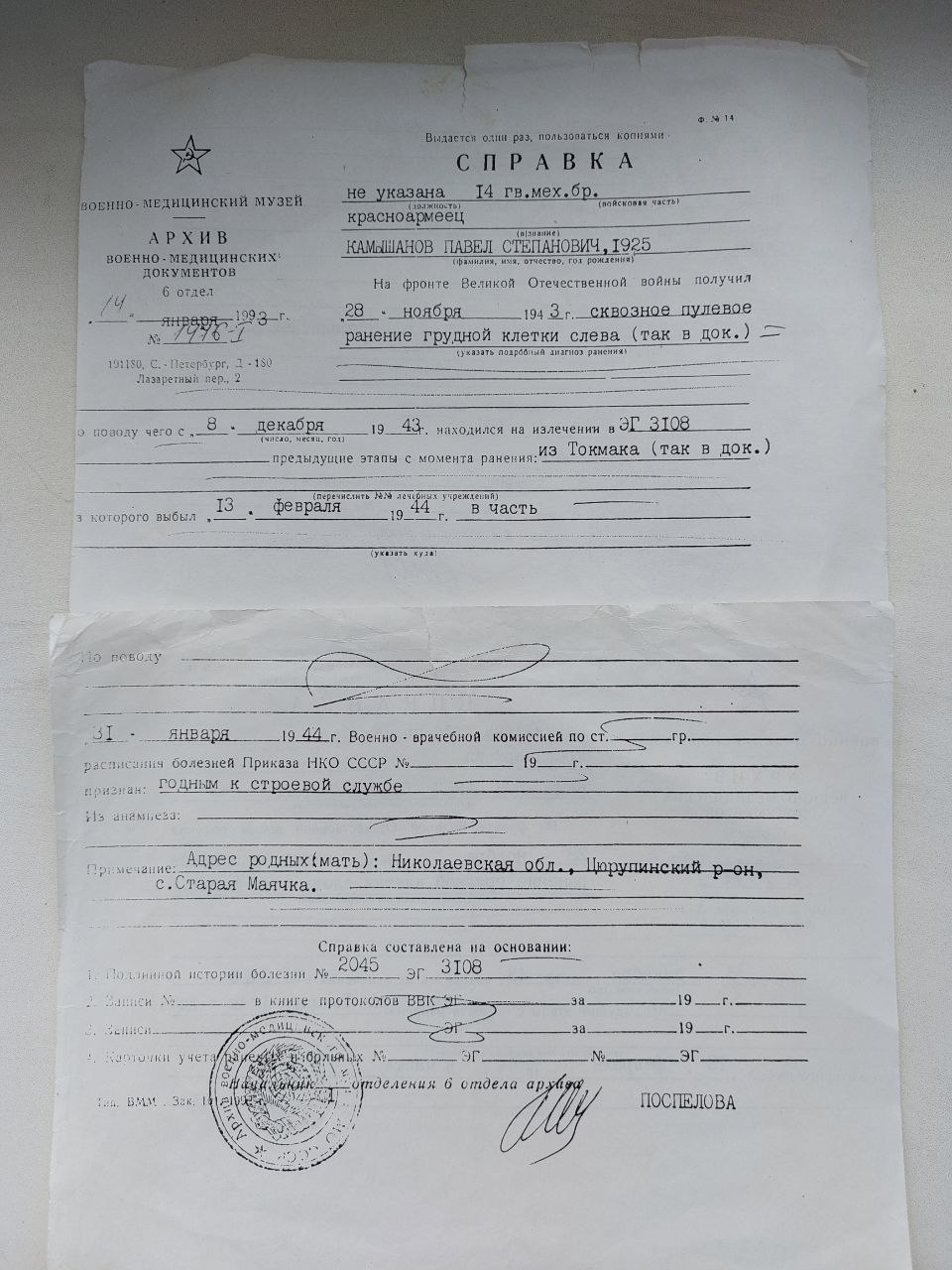
When this area was liberated, the eighteen-year-old Pavel was called up in November 1943 by the Tsyurupinsk military office (S18, S403). He was assigned as a rifleman to the 14th mechanised brigade (S410). As early as 28 November 1943 Private Kamyshanov received a through-and-through bullet wound to the left side of the chest. He was treated in evacuation hospital No. 3108, which he entered on 8 December from Tokmak. On 31 January 1944 a medical board found him fit for combat duty, and on 13 February he returned to his unit (S52).
Galina Pavlovna says that the bullet passed right through without damaging any organs, and the wound was considered light. The service record card also says «light wound to the chest», but with a different date — 17 November 1943 (S410). And in her 2001 manuscript Ekaterina Konstantinovna wrote: «At the front he was severely wounded in the chest» (S27).
Certificate from the Archive of Military Medical Documents about Pavel Kamyshanov's wound of 28 November 1943. It also gives his mother's address: the village of Staraya Mayachka (S52).
Tank crewman
On 15 February 1944 Pavel took the oath in the 79th Tank Brigade and became the radio operator and machine-gunner of a medium tank (S410). The brigade was part of the 19th Tank Corps. With it Pavel liberated Crimea and the Baltic states, rising to junior and then senior sergeant (S18, S27). In the spring of 1944 the 19th Tank Corps broke through the defences at Perekop and took part in the liberation of Simferopol — for these battles it received the honorary name «Perekop» — and was then transferred to the Baltic. In March 1945 Pavel was sent to a training tank battalion and became a medium tank driver-mechanic. From June 1945 he served in the 221st Separate Pernov Tank Regiment (S542), and from November 1946 as a heavy tank driver-mechanic in military unit 33209 (S410).
His decorations: the Order of Glory, 3rd class, the medal «For the Victory over Germany», the medal «30 Years of the Soviet Army and Navy», and in 1985, for the fortieth anniversary of the Victory, the Order of the Patriotic War, 1st class (S18, S410).
Five years after the Victory
The war was over, but not his service. Pavel served another five years, according to Galina Pavlovna in Leningrad (S411). He was discharged on demobilisation on 27 March 1950 as a senior sergeant of the technical service (S410). In 1950 he returned to his family in Novorossiysk and lived there for the rest of his life (S411).
Things were not peaceful at home. His father, Stepan Ignatievich, had also come back from the war but mistreated his mother. Pavel, as Ekaterina Konstantinovna wrote, «stood up for his mother», and his father left for the Don (S27). He died in 1964 in Morozovsk in the Rostov region (S45).
Family
On 16 September 1951, at the Novorossiysk registry office, Pavel Stepanovich married Ekaterina Konstantinovna Figurovskaya. A young power engineer, she had been assigned to Novorossiysk after the Ivanovo Power Engineering Institute (S27). In marriage she kept her own surname (S136).
On 2 August 1952 their son Yuri was born, and on 24 September 1956 their daughter Galina (S337). Ekaterina Konstantinovna's mother, Alexandra Semyonovna, also lived with them in Novorossiysk. In 1965 his wife's niece Irina sent them her portrait inscribed: «To Aunt Katya, Uncle Pavlik, Yurochka and Galochka from Irina» (S229).
Study and the power industry
Pavel Stepanovich studied by correspondence, first at an industrial technical college and then at the Moscow Polytechnic Institute (S27). According to his service record card, in 1963 he graduated from the power engineering faculty of the All-Union Correspondence Polytechnic Institute and became an electrical engineer. He worked at the Novorossiysk electricity grid (S410) — in Ekaterina Konstantinovna's words, in «big power engineering», as she did herself (S27).
In 1970, for the fiftieth anniversary of the GOELRO plan, his photograph hung on the board of honour. That is how his portrait in a suit and tie is inscribed (S426).
Last years
In 1993 Pavel Stepanovich lost his son: Yuri died at forty-one. In Novorossiysk he left his wife Anna Alexandrovna and sons Oleg and Evgeny. By 2001 Pavel Stepanovich had four grandchildren (S27).
He died on 16 September 2001 (S18). He is buried in Novorossiysk, in the cemetery on Mount Kabakhakha, in an enclosure for two graves under a large black monument. Ekaterina Konstantinovna wrote down on a notebook page how to find the grave, for future generations (S179). According to Galina Pavlovna, there is still only one grave in the enclosure: Ekaterina Konstantinovna bought the place next to it for herself, to lie beside her husband.
What we do not yet know
The date of death, 16 September 2001, is known only from a military office record (S18). It falls exactly on the fiftieth anniversary of the wedding. This may be a coincidence, or the date in the record may mean something else; this is worth checking with Galina Pavlovna.
The documents also disagree about the wound: 28 or 17 November 1943, light or severe (S52, S410, S27). The «Novorossiysk Book of Memory» says that he «came to Novorossiysk in April 1963» (S403). This is the compilers' mistake: in 1963 he graduated from the institute, and he returned to Novorossiysk in 1950. Pavel's birth record and the family's pre-war address have not yet been found.
Ekaterina Konstantinovna Figurovskaya
b. 25 September 1926
Ekaterina Figurovskaya during her studies at the Ivanovo Power Engineering Institute. On the back: «August 1948». She is twenty-one (S428).
The daughter of an army veterinarian and a teacher, she changed schools six times and lived through her father's arrest, her brother's death and a hungry wartime winter, then became a power engineer and tied her life to Novorossiysk. In 2001 she wrote down in her own hand the history of five generations of the family — our archive began with those pages. On 25 September 2026 Ekaterina Konstantinovna turned one hundred.
Ostrogozhsk
Ekaterina was born on 25 September 1926 in Ostrogozhsk, Voronezh region. The 14th artillery regiment was stationed there at the time, in which her father, Konstantin Fyodorovich Figurovsky, served as deputy regimental commander for veterinary matters (S27, S136). The son of a Kostroma clergyman, he had graduated from the Kostroma theological seminary and then become a veterinary surgeon. Her mother, Alexandra Semyonovna, née Kolodina, came from Puchezh on the Volga. She had graduated from the Yuryevets gymnasium and worked as a teacher until typhus left her deaf in one ear (S27).
Katya had an elder brother, Yuri, born in 1920 — Alexandra Semyonovna's son by her first marriage to Boris Zamolomsky. Konstantin Fyodorovich adopted him, and Yura became a Figurovsky (S27). In a photograph from Ivanovo-Voznesensk of July 1924, where four-year-old Yura sits beside his grandmother Anna Ivanovna Kolodina, he is still signed «Yura Zamolomsky» (S625).
Six schools in ten years
The family lived wherever her father was posted, and in ten years Katya changed schools six times (S27). In 1935 Konstantin Fyodorovich was demobilised and worked as a veterinarian in Suzdal and Rybinsk. In 1937 he was arrested under Article 58 and spent a year in prison. Yura, the adopted son of an «enemy of the people», was expelled from flight school, and Alexandra Semyonovna went to work in an accounts office. When her father was released, Yura was reinstated, and the family moved to Arkhangelsk (S27).
Alexandra Semyonovna with Katya and Yura, around 1938–1939. On the back, in Ekaterina Konstantinovna's hand: «The Figurovskys. Mum, Katya, Yura. Arkhangelsk», and in the corner «6th grade» (S31).
The family used to say that the Figurovskys were «from somewhere around Vyatka or Ivanovo». Ekaterina Konstantinovna's manuscript explains this: the Kolodins came from Puchezh, relatives lived in Ivanovo, during the war the family was in Vyatskiye Polyany, and the Figurovskys themselves came from Kostroma.
Ekaterina Konstantinovna herself believed that she had been baptised by her grandmother, Anna Ivanovna Kolodina, in Puchezh, where she was taken for the summers as a child. So says Galina Pavlovna.
The war
On 23 June 1941 her father went to the front as an army veterinary surgeon. Katya and her mother stayed in Arkhangelsk. There, in March 1942, she had her school photograph taken and signed it: «Katya Figurovskaya March 1942 8th grade 15 years old Arkhangelsk» (S427).
Katya Figurovskaya, eighth grade, Arkhangelsk, March 1942 (S427).
In the summer of 1942 her brother Yuri, a technician-lieutenant in a bomber regiment, wrote to «Mum and Katya». On 11 June he asked: «Katya, write to me about your studies and about everything» (S219). On 8 July he urged them to move to Vyatskiye Polyany, to his wife Tamara: «Mum, move as soon as you can. Take only what is necessary… Together you will find life much easier, and I will be calmer too, and when the war is over we will all meet» (S221).
There was famine in Arkhangelsk, and, as Ekaterina Konstantinovna writes, mother and daughter abandoned their flat with everything in it and left for Vyatskiye Polyany in the Kirov region (S27). And on 5 September 1942 Yuri was killed at an airfield near Moscow during an enemy air raid. He is buried in a mass grave by the Herzen sanatorium near Kubinka (S19).
Katya finished school in Vyatskiye Polyany. Her certificate was issued on 22 July 1944, and every subject in it is marked «excellent» — including German and military training (S53).
Ivanovo and «big power engineering»
After school, at the invitation of her aunt, her mother's sister Maria Semyonovna Vladimirova, Katya entered the Ivanovo Power Engineering Institute (S27). After the institute she was assigned to «big power engineering» — in Novorossiysk.
In those years her parents' marriage fell apart. After the war her father and mother lived in Rauta near Leningrad. According to Ekaterina Konstantinovna's manuscript, drinking and rows began, it came to a court case and a new prison term, and Alexandra Semyonovna was taken in by relatives (S27). When her daughter finished the institute, Alexandra Semyonovna moved to join her in Novorossiysk. After his imprisonment Konstantin Fyodorovich lived in a care home in Kovrov and died in 1981.
Novorossiysk
On 16 September 1951 in Novorossiysk Ekaterina Konstantinovna married Pavel Stepanovich Kamyshanov, a war veteran and former tank crewman. She did not change her surname and remained a Figurovskaya (S136). Later her daughter and her niece Irina did the same.
Wedding photograph of Ekaterina Konstantinovna and Pavel Stepanovich, Novorossiysk, 1951 (S30).
In 1952 their son Yuri was born. In 1956 their daughter Galina was born (S337). Alexandra Semyonovna lived with them in Novorossiysk — a photograph of her with her little granddaughter Galya, about 1958, has survived (S634); she died in 1985 and is buried in the Mefodievskoe cemetery (S178).
In 1965 Yuri's daughter, Irina, sent her portrait inscribed «To Aunt Katya, Uncle Pavlik, Yurochka and Galochka from Irina» (S229).
Losses
In 1993 Ekaterina Konstantinovna buried her son: Yuri died at forty-one. In September 2001 Pavel Stepanovich passed away (S18). He is buried in the cemetery on Mount Kabakhakha. According to Galina Pavlovna, Ekaterina Konstantinovna bought the place next to him for herself.
A family tree of five generations
In March 2001 Ekaterina Konstantinovna drew on graph paper a «Family tree of five generations from ~1860» and wrote detailed «Notes» to go with it (S27, S28). They cover the Kolodins of Puchezh, the Figurovskys of Kostroma, the Kamyshanovs from the Don and the Grodno region, and the lives of her parents, brother, husband and children. Most of our research began with these pages.
At her daughter's request she wrote another manuscript too — «Cemeteries in Novorossiysk»: where her mother, husband, son and mother-in-law are buried and how to find their graves, so that future generations would know (S178, S179, S180).
One hundred years
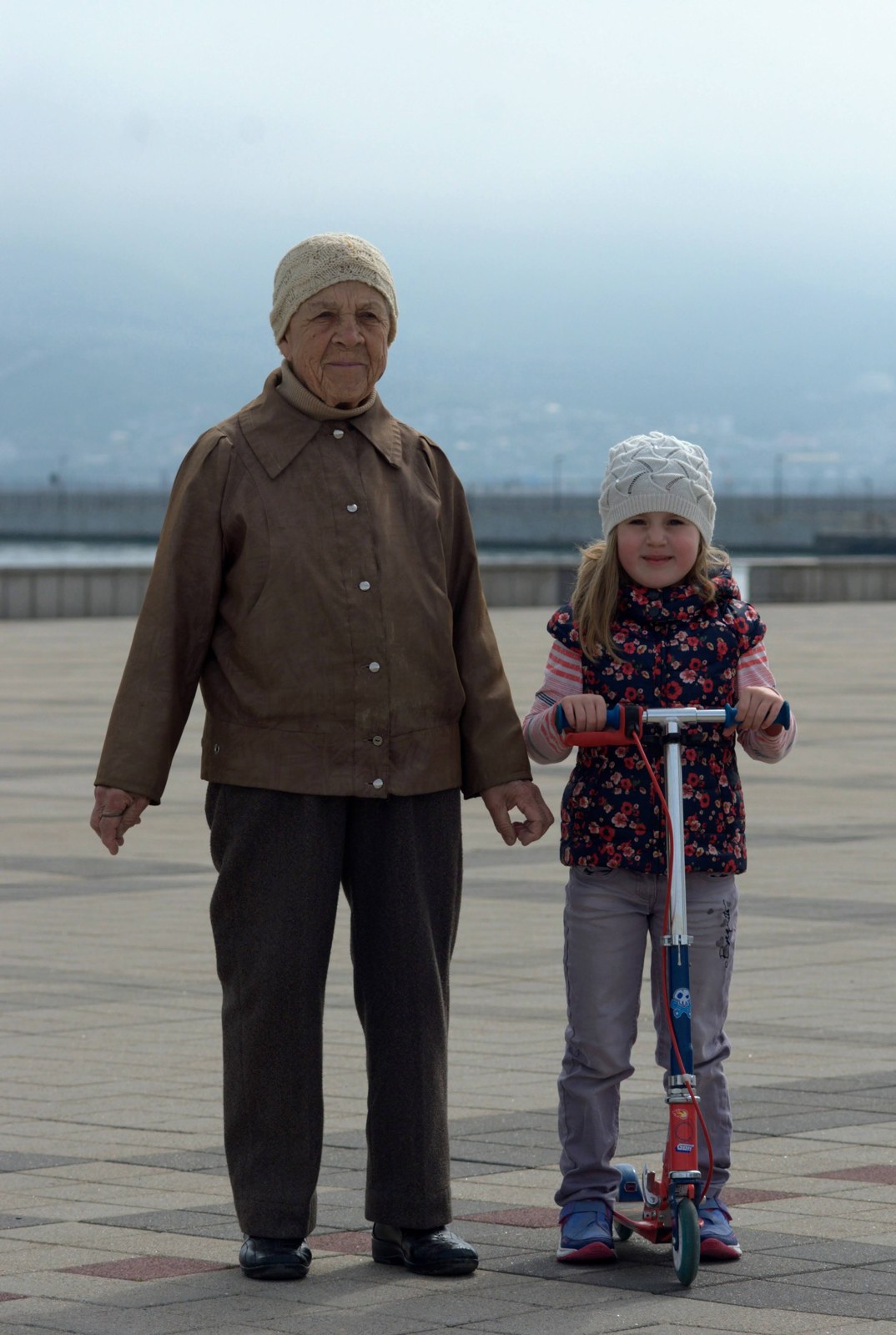
Around 2016 Ekaterina Konstantinovna was photographed on the Novorossiysk embankment with her great-granddaughter Masha (S39). On 25 September 2026 she turned one hundred. The girl from Ostrogozhsk who changed schools six times and lived through her father's arrest, her brother's death, the hungry Arkhangelsk winter and evacuation is the eldest in our large family.
Ekaterina Konstantinovna with her great-granddaughter Masha on the Novorossiysk embankment, around 2016 (S39).
What we do not yet know
Whether and where Ekaterina Konstantinovna was baptised cannot be checked: the Puchezh parish registers after 1918 have not survived, and the archive has none for Ostrogozhsk for 1926 (lead L68). Nor is it known exactly when the family moved from Arkhangelsk to Vyatskiye Polyany. The manuscript says winter 1941–1942, but in March 1942 Katya was still at school in Arkhangelsk, and in July Yuri was only urging his mother to move (S27, S221, S427). So the move was no earlier than the summer of 1942.
We do not yet know in which towns and schools she spent her pre-war years, apart from Ostrogozhsk and Arkhangelsk, or where she worked in Novorossiysk. She herself or Galina Pavlovna can tell us best.